

Parashat Chayei Sarah
Parashat Chayei Sarah: Avraham's Wisdom in Securing the Future
Discover how Avraham's purchase of the Cave of Machpelah, his search for a wife for Yitzchak, and his inheritance decisions reveal powerful lessons about responsibility, foresight, and preserving family peace
- Yosef Yaavetz
- | Updated
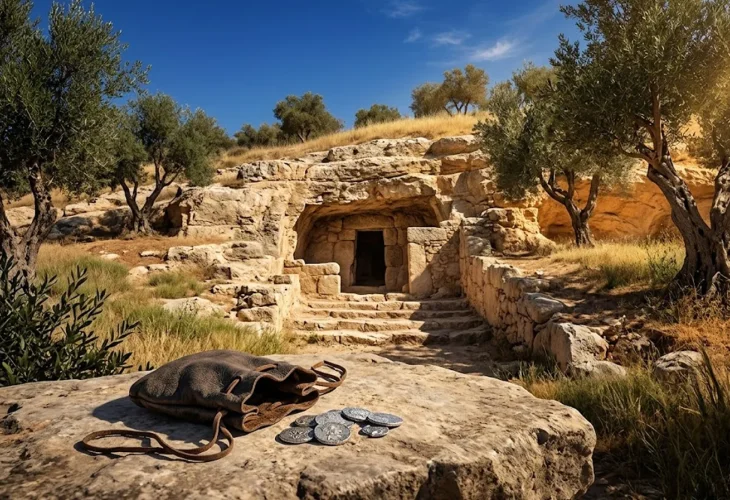
When Avraham seeks to purchase a burial plot for Sarah Imeinu, he chooses the Cave of Machpelah, located in Ephron's field. If he already knows which property he wants, why, asks the Abarbanel, does he approach all the Hittites rather than speaking directly to the landowner?
Another question arises from the difference between Avraham's request and their response. Avraham asks to acquire a burial property, while the Hittites offer him his choice of their burial places. They address him as a "prince of God," honor him, and assure him that none of them would refuse to let him bury Sarah in their tombs. Why does Avraham decline such a seemingly generous offer?
Why Avraham Insisted on Owning the Burial Site
The answer lies in the distinction between permission and ownership. The Hittites offered Avraham the use of property that would remain theirs, while Avraham wanted a burial place that would belong to him. Their respect and generosity did not eliminate the need for clear legal ownership. He sought a permanent burial site for his family, not a temporary arrangement dependent on another person's goodwill. From this perspective, the Hittites' offer was less generous than it appeared. They were willing to honor Avraham by allowing him to use their burial places, but they were not offering him actual ownership.
This also explains why Avraham initially approached the entire community rather than Ephron himself. He feared that a direct request might be rejected, since a wealthy and respected landowner would not necessarily be willing to part with his property. Instead, Avraham began with a general appeal to the Hittites. Once they publicly expressed their willingness to help him, he asked them to approach Ephron on his behalf. Their declaration of goodwill now became the basis for his specific request, and the presence of the townspeople gave the negotiations additional weight. A commitment made before the entire community carries greater significance than a private conversation, potentially helping to secure the agreement and prevent either party from withdrawing.
Why Ephron Offered the Entire Field
Ephron's response raises another question. Avraham asks to purchase the cave at the edge of the field, but Ephron offers him the entire field, including the cave. Why expand the transaction beyond what was requested? The Abarbanel suggests a practical explanation: Selling the cave separately could interfere with the surrounding property. When a burial site is located within a field belonging to someone else, maintaining a clear separation between the uses and ownership of the two properties can become complicated.
Avraham, meanwhile, insists on completing the payment before burying Sarah. Although Ephron repeatedly urges him to proceed with the burial, Avraham refuses to leave the financial terms unresolved. According to the Abarbanel, Avraham wanted to ensure that ownership was fully established before the burial took place, preventing Ephron from exploiting the circumstances to impose additional conditions.
The Torah first describes the field as having been formally acquired by Avraham. Following Sarah's burial, it again emphasizes that the field and cave were established as his burial property. The Abarbanel initially suggests that these two descriptions distinguish between the financial acquisition and the act of taking possession through burial. He then offers another possibility: Local custom may have required the consent of the townspeople before a field could be designated as a cemetery. According to this explanation, Avraham needed both to purchase the property and to secure public recognition of its intended use.
Securing Yitzchak's Future
Immediately after the account of Sarah's burial, the Torah states, "And Avraham was old, advanced in years." His decision to send Eliezer to find a wife for Yitzchak was far more than an ordinary matchmaking arrangement. It represented a form of spiritual will, ensuring the continuation of Avraham's legacy. As the Abarbanel explains, Avraham recognized the need to make arrangements during his lifetime and appointed Eliezer to carry out his instructions.
Following Sarah's burial, Avraham turned his attention to the responsibilities associated with his advancing age and the future of his household. Ideally, he would have traveled to Haran himself to find a wife for Yitzchak, since he knew his relatives, the region, and the journey. However, his advanced age and the demands of managing his considerable wealth made such a trip impractical. Instead, he entrusted the mission to Eliezer, providing clear instructions to ensure that his family's spiritual future would be protected.
Preventing Family Conflict Before It Begins
Avraham then turns to the distribution of his property. He gives everything he owns to Yitzchak, provides gifts to his other sons, and sends them away from Yitzchak while he is still alive. According to the Abarbanel, this decision reflects a fundamental principle: "A person must make every effort to prevent conflict among his children."
Avraham understood that inheritance disputes often arise when expectations are unclear or family members believe they have competing claims. By arranging the distribution of his property during his lifetime, he sought to prevent jealousy, rivalry, and future disagreements. It was not enough for him to know what he wanted; he needed to make his intentions clear to everyone involved, ensuring that his wishes would not become a source of conflict after his death.
The wisdom of this approach is reflected in the Torah's final description of Avraham's life, when Yitzchak and Yishmael come together to bury their father. Avraham lived to see his sons reconcile, and the peaceful conclusion of his life included the knowledge that harmony had been restored between them. Their joint participation in his burial reflected the reconciliation and peace that Avraham had worked to establish.
The Wisdom of Preparing Today for Tomorrow
The three major episodes form a single, meaningful progression. In purchasing the Cave of Machpelah, Avraham secures clear ownership and the necessary public agreement regarding the property's use. In sending Eliezer to find a wife for Yitzchak, he establishes responsibility and provides instructions for preserving his spiritual legacy. In distributing his wealth, he clarifies the family's inheritance arrangements and seeks to prevent future disputes.
In each situation, Avraham addresses a potential problem before it becomes a crisis. Rather than leaving difficult decisions for others to resolve, he takes responsibility for securing the future while he still has the opportunity. His example teaches us that true wisdom involves recognizing how today's choices shape tomorrow's relationships and challenges. By addressing uncertainty before it develops into conflict, we create the conditions for greater stability, continuity, and peace.

