

Parashat Chayei Sarah
The Land That Rises to Meet Us
The Torah's account of Abraham's purchase of a burial plot reveals a remarkable truth about the Jewish people's relationship with their land
- Rachel Wigman
- | Updated
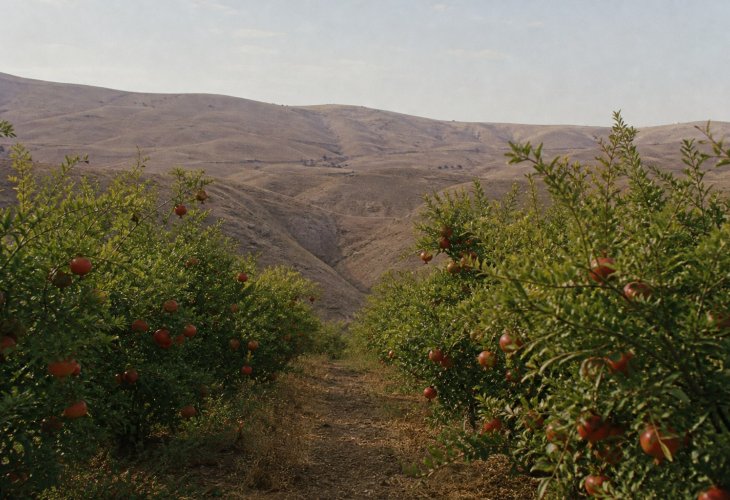 Illustrative image: a pomegranate orchard facing bare hills
Some time ago, my husband and I visited a farm that sat at the border of Israel, Jordan, and Syria. It was a refuge for at-risk youth, and one of our friends worked there, so when we were in the area, we swung by to say hello. This friend gave us a tour of the farm, showed us what they do, introduced us to the sheep they raise, and then took us to an overlook where we could see all three countries.
It was remarkably clear where the border lay. That hill over there clearly belonged to Syria; it was overgrazed and bare and looked downright inhospitable. The hill next to it had significantly more shrubbery, though it wasn’t quite verdant; that hill belonged to Jordan. And the hill that we were standing on, the one that contained the pomegranate orchard, that was Israel. Three adjacent hills, yet only one of them thriving.
To traverse this country is to see that story play out on a national level. When the city of Tel Aviv was founded in 1909, it was a small collection of homes built improbably on sand dunes. Today it is Israel’s second-most populous city, and the only sand dunes to be found are on the beaches that make up such an integral part of Tel Avivian culture. The city of Bet Shemesh, which bears the distinction of being Israel’s fastest growing city, has pockets of eucalyptus trees dotting the city, trees which were planted to drain the swamps that were the dominant feature in the area. If you stand at the lookout by Ma’ale Gilboa in Emek Hama’ayanot and look out at the land, you’ll see farmland stretching as far as the eye can see. Even down south, in the desert, you’ll find settlements that are, against all odds, yielding produce year-round.
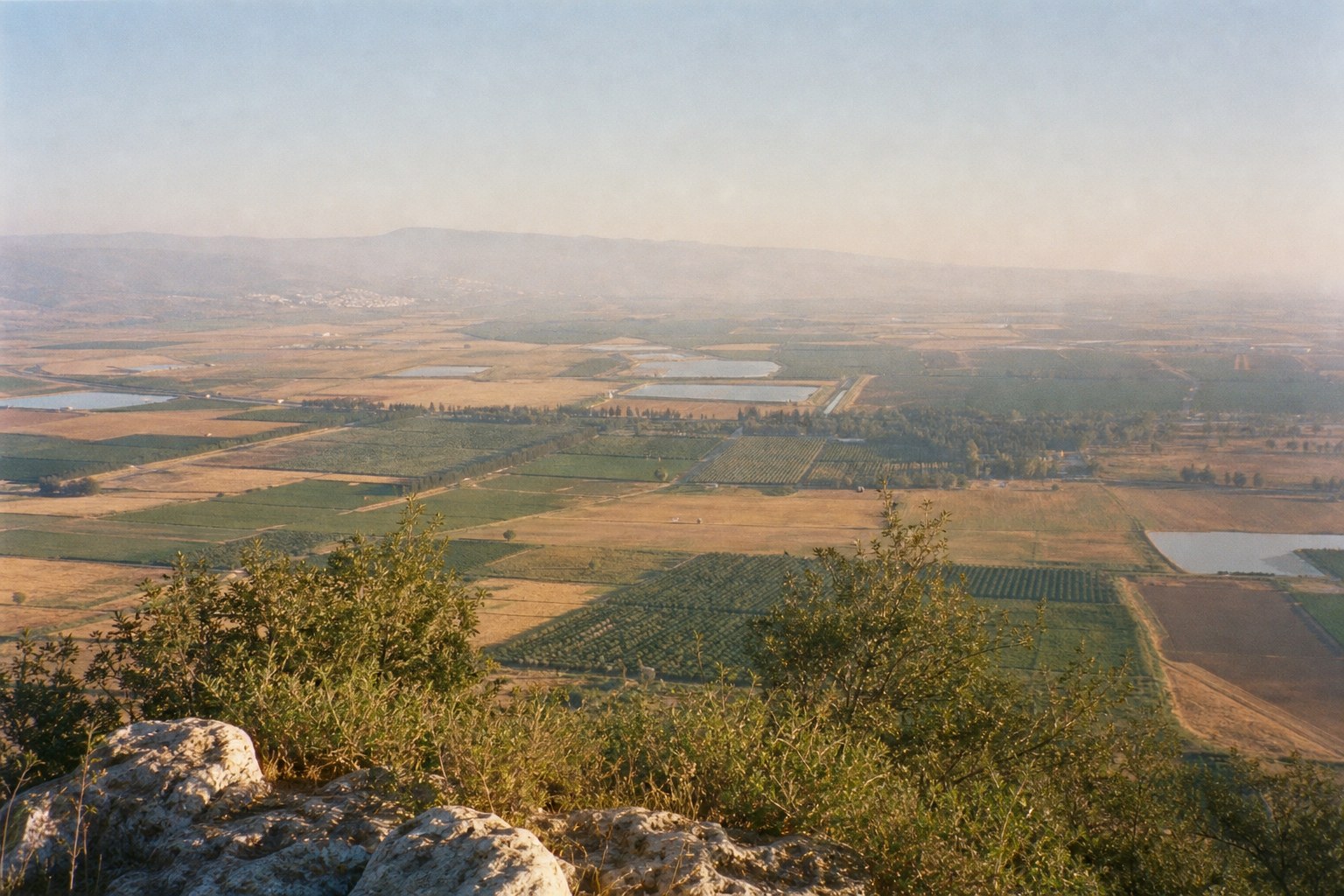 Farmland stretching as far as the eye can see below Mount Gilboa
Of course, we are seeing the fruit of the labor of our predecessors, the ones who offered up their blood, sweat, and tears to make this land bear fruit. It turns out, though, if we look in this week’s Torah portion, that this is the very nature of our relationship to the land.
The opening story of this week’s portion is the death of Sarah. At one hundred twenty seven years old, having lived to miraculously become a mother at the age of ninety, Sarah returned her soul to her maker. Abraham, her husband of many decades, found himself in the land that was promised to him with not even a plot of land to be able to bury his wife. From the depths of his grief, “Abraham arose from in front of his dead, and he spoke to the people of Het” (Genesis 23:3).
Rabbi Eliyahu Dessler, a prominent twentieth century Torah scholar, notes in his Michtav Mei’Eliyahu the dignity with which Abraham comports himself in the course of the negotiations for the field. Abraham could easily have been excused for acting poorly; he had just returned from the ordeal of the Binding of Isaac, his wife is now gone, and all he wants to do is give her a final resting place. As if to add insult to injury, he eventually will have to pay an exorbitant cost to purchase the field and the cave within it that became Sarah’s grave. Not once, though, did Abraham lose his cool. He spoke calmly and deferentially, from beginning to end, bowing where appropriate, showing respect and gratitude to the Hittites, and comporting himself with honor and with grace.
At the end of the negotiations, after Abraham laid out the four hundred bits of silver that was the cost of this plot, the Torah once again uses the word arose, this time, unusually, to describe the land itself: “And the field of Ephron arose, that which is in Machpelah, facing Mamre, the cave that was in it, and all the trees that were in the borders of the field” (23:17). Land, of course, does not pick itself up the way Abraham arose from his grief. Rashi makes note of this unusual wording and says, “It was uplifted, because it passed from a commoner [Ephron] to a prince [Abraham].”
As if that were not enough, after Abraham buries Sarah, the entire saga closes with reiterating the land’s being uplifted: “And the field and the cave that was in it arose as a burial plot for Abraham from the people of Het” (23:20).
This portion of land, the first part of our land that ever belonged to our people, was not won easily. Abraham had to negotiate carefully and then pay a handsome sum for the privilege of burying his wife. (For those interested, the amount he paid comes out to somewhere between $7,000-9,000, depending on exactly how it’s calculated.) But the insistence in and of itself, Abraham’s willingness to invest so much into the land, was reciprocated when the land was uplifted by the simple virtue of his taking possession of it. And in that moment, in that very first purchase of the land, Abraham laid down the precedent for all time.
This land of ours is uplifted when we invest in it. My husband and I could stand at the meeting point of Israel, Syria, and Jordan, and clearly see which hill belonged to Israel because it was uplifted, it arose to meet the people who toiled over it. We can travel through the land that tells the story, wherever you go, of the land itself arising in a way that land does not do but this land of ours somehow does.
Following in the footsteps of our forefather, from the ashes of the Holocaust in 1945, we arose to establish a country in 1948. And from a fallow, malaria-infested swampland, this land arose, and continues to rise, to become the place that Jews around the world call home.

