

History and Archaeology
How Much Is the Cave of Machpelah Worth? Appraisers Weigh In
Two Israeli real estate experts examine Abraham's historic purchase of the Cave of Machpelah, revealing what he paid 3,700 years ago and what the sacred site could be worth today
- Michal Arieli
- | Updated
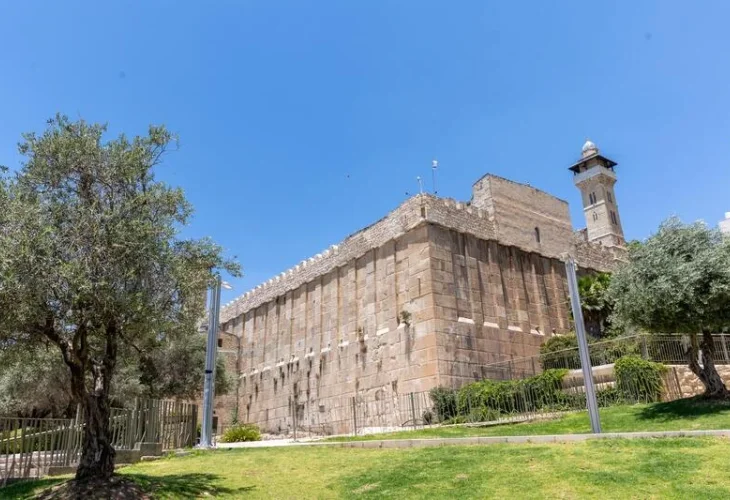 The Cave of Machpelah (Photo: Yossi Aloni, Flash 90)
Approximately 3,700 years ago, Abraham stood before Ephron the Hittite and finalized one of the most famous real estate transactions in history, paying 400 shekels of silver for Ephron's field and the Cave of Machpelah. The purchase, recorded in Parashat Chayei Sarah, would become one of the most significant land transactions in Jewish history. Wat would happen if two experienced real estate professionals examined this ancient purchase using modern property valuation methods? How much was Abraham's payment actually worth, and what would the historic property be valued at today?
That was the unusual challenge undertaken by Shalom Steinberg, a veteran real estate appraiser and Torah scholar, and Omer Tzangut, an urban planner specializing in property valuation. "We come from completely different backgrounds," they explain, "but that combination allows us to approach Torah and historical questions using the professional tools of real estate appraisal."
How Do You Appraise a Property Purchased 3,700 Years Ago?
Steinberg recalls that the idea first occurred to him approximately four years ago, shortly before Parashat Chayei Sarah. "I realized that this transaction has almost everything a real estate appraiser looks for: a seller, a buyer, detailed negotiations, a property description, witnesses, and an agreed-upon price. The only things missing are a land registry document and comparable sales from that period," he explains.
This year, Steinberg asked his colleague Tzangut to update and expand the original research. Together, they devoted considerable time to examining the historical and economic evidence in an effort to produce the most accurate estimates possible.
According to Tzangut, modern real estate valuation generally relies on three principal methods: the sales comparison approach, which examines similar properties; the income capitalization approach, which evaluates a property's economic potential; and the cost approach, which estimates the expense of constructing a comparable property from scratch. "The Cave of Machpelah obviously doesn't have a conventional real estate market," Tzangut explains. "We therefore needed to combine several valuation methods to arrive at a meaningful estimate."
The Surprising Value of 400 Shekels of Silver
The Torah states that Abraham paid Ephron 400 shekels of silver, described as currency acceptable to merchants. However, the shekel of that period was not a minted coin but a unit of weight, generally estimated at approximately 8–11 grams. Using those estimates, the researchers calculated that Abraham's payment represented roughly 3.2–4.4 kilograms of silver. Based on the metal's contemporary market value used in their analysis, that would amount to approximately NIS 16,000–22,000.
At first glance, the figure seems astonishingly low for such a historically significant purchase. But the researchers emphasize that the modern value of the silver itself tells only a small part of the story. To understand the transaction's true economic significance, they examined the purchasing power of silver in the ancient world, drawing on wage information found in the Code of Hammurabi.
Their calculations suggested that 400 shekels of silver could have represented approximately 12,000 days of labor, equivalent to roughly 40 years of work for an ordinary laborer. When translated into contemporary Israeli wages, the amount rises dramatically to an estimated NIS 3.6–7.6 million. This comparison illustrates the difference between calculating the modern commodity value of an ancient payment and estimating its actual purchasing power at the time.
Comparing Abraham's Purchase With Other Biblical Real Estate Deals
To evaluate whether their estimates were reasonable, Steinberg and Tzangut examined several other land transactions recorded in the Tanach. One example is King David's purchase of the threshing floor and oxen from Araunah the Jebusite. The Book of Samuel records a payment of 50 shekels of silver, while the Book of Chronicles describes a much larger payment of 600 shekels of gold for the site. The apparent discrepancy has been addressed by Chazal and later commentators.
The researchers also considered Jacob's purchase of a parcel of land in Shechem for 100 kesitah, an ancient form of payment whose precise value remains disputed. Additional comparisons included the prophet Jeremiah's purchase of a field in Anathoth for 17 shekels of silver and King Omri's acquisition of the hill of Samaria for two talents of silver.
However, the researchers caution that these transactions cannot serve as straightforward comparisons. "The difficulty is that the transactions took place during different historical periods, in different locations, and under different economic conditions," Steinberg and Tzangut explain. "In some cases, we also lack reliable information about the size of the properties involved. We therefore used these examples only to test whether our estimates were reasonable, rather than as a definitive basis for determining value."
Could Abraham Have Paid the Equivalent of Millions More?
The calculations become even more intriguing when traditional Jewish sources are considered. The Talmud in Bava Metzia includes an interpretation suggesting that Ephron received exceptionally large silver units known as kantarim. According to certain commentators, the quantity of silver involved could have reached an extraordinary 22 tons. Using the silver prices applied in their study, this would translate into an estimated NIS 82–106 million.
The researchers stress that this interpretation reflects a traditional understanding of the magnitude of Abraham's payment rather than a figure established through archaeological evidence. Nevertheless, it offers an indication of the extraordinary importance that Jewish sources attach to the transaction.
What Would the Cave of Machpelah Be Worth Today?
The researchers also approached the question from a conventional real estate perspective, examining the land itself rather than the ancient payment. The original property included not only the burial cave but also an extensive field. According to their estimates, the land may have covered approximately 100–150 dunams.
Assuming that the property was used for agricultural purposes, the appraisers applied modern productivity assumptions and an income capitalization rate of 5%. Their calculations produced an estimated economic value of approximately NIS 300,000 per dunam, or as much as NIS 45 million for the land.
But what about the monumental structure that stands above the Cave of Machpelah today? The researchers emphasize that the familiar building, associated with the Herodian period, did not exist in Abraham's lifetime and was constructed many centuries later. Nevertheless, they attempted to estimate what it would cost to reproduce such a structure using the labor-intensive building techniques of the ancient world.
Their assessment considered the immense effort required to quarry, shape, transport, and position the enormous stone blocks using the tools and manpower available at the time. On that basis, they estimated the structure's construction value at approximately NIS 10 million. Combining their estimates for the land and the building, Steinberg and Tzangut arrived at a total valuation of approximately NIS 50 million for the complex, a rounded figure based on their economic assumptions.
A Property Whose True Value Cannot Be Measured
Despite the extensive calculations, comparisons, and financial models, the researchers believe the most important conclusion lies far beyond the world of real estate. "The Torah deliberately records the precise payment of 400 shekels of silver," Steinberg explains, "to establish that this was a legitimate, documented transaction conducted openly and according to the accepted commercial practices of the time."
The purchase was not simply a private agreement between Abraham and Ephron. It was carried out publicly, before witnesses, with a clearly stated price and an explicit transfer of ownership. Over the thousands of years that followed, however, the Cave of Machpelah became something far greater than a piece of land. As the traditional burial place of the Jewish patriarchs and matriarchs, it became an enduring symbol of Jewish history, faith, and spiritual heritage.
The researchers' work demonstrates that Abraham's original payment can be examined through several economic approaches, producing dramatically different estimates depending on the method used. The value of the silver itself, its ancient purchasing power, and the modern estimated worth of the property each tell a different part of the story.
But ultimately, Steinberg concludes, the most meaningful value of the Cave of Machpelah cannot be expressed in financial terms. "Over thousands of years, this place has transformed from a local property into a symbol of holiness, history, and faith. We can attempt to calculate the original purchase price using various economic methods, but the Cave of Machpelah is unlike any other place in the world. No price tag could even begin to reflect its true value."

