Wonders of Creation
How Does a Venus Flytrap Catch Insects? The Plant That Counts to Five
Scientists reveal how the Venus flytrap uses tiny sensory hairs, electrical signals, and a remarkable counting mechanism to capture insects and trigger digestion
- Tehila Cohen
- | Updated
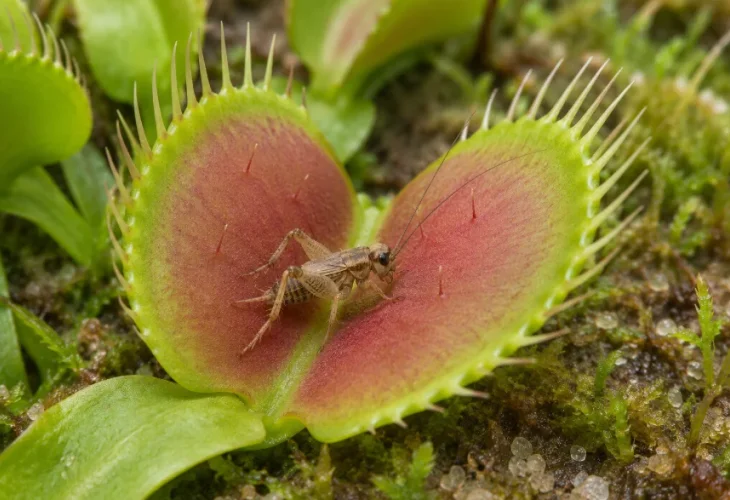
The Venus flytrap looks like something straight out of a cartoon. At the end of each leaf are two open lobes lined with thin, tooth-like projections. Hidden inside the trap are several tiny hairs that control its snapping mechanism. Sometimes, an insect can touch one of these hairs without triggering the trap at all. To understand why, we first need to explore what happens inside the leaf when something touches it.
The Plant That Counts to Five Before Digesting Its Meal
The tiny hairs inside the trap are called sensory hairs. When one of these hairs bends sufficiently, cells inside the leaf respond by generating a small electrical signal that travels through the leaf.
After a single electrical signal, the trap generally remains open. However, when a second signal is generated within a short period, the trap snaps shut around the insect. As the trapped insect struggles to escape, its legs repeatedly brush against the sensory hairs, producing additional electrical signals. Researchers have discovered that a total of five signals, including the two that triggered the trap's closure, is enough to activate the plant's digestive machinery.
A 2020 study revealed an important part of this mechanism. Following the first touch, calcium levels inside the leaf's cells rise before gradually declining. If a second touch occurs before the calcium levels have fallen sufficiently, the additional increase can trigger the trap to close. However, when researchers waited approximately 30 seconds between touches, the second stimulus was no longer sufficient to activate the trap.
What Happens When the Plant Reaches Five?
Imagine a cricket trapped inside a Venus flytrap. As it struggles to escape, its legs continue brushing against the sensory hairs, generating additional electrical signals even after the trap has closed.
In a 2016 study, researchers stimulated the sensory hairs themselves and examined how the plant responded to different numbers of electrical signals. They discovered that after five signals, the leaf began producing substances involved in breaking down its prey. Once the trap seals around the insect, it releases digestive fluids that gradually dissolve the insect's soft tissues, allowing the plant to absorb valuable nutrients.
Why Does the Venus Flytrap Eat Insects?
Venus flytraps grow naturally in wetland habitats in North and South Carolina, where the soil is relatively poor in nutrients. Like other green plants, they use sunlight to produce sugars through photosynthesis. However, insects provide additional nutrients that are difficult to obtain from their natural environment.
By capturing and digesting insects, the Venus flytrap can absorb these essential nutrients and supplement what it receives from the soil. Its remarkable ability to respond to a sequence of electrical signals helps ensure that the plant does not waste energy closing its trap or producing digestive fluids unnecessarily.