

Parashat Vayetze
Rachel and Leah: Why Spiritual Growth Matters More Than Perfection
Discover how Parashat Vayeitzei reveals two paths to spiritual greatness—and why Hashem values our efforts to overcome challenges, not just the results we achieve
- Rabbi Moshe Sheinfeld
- | Updated
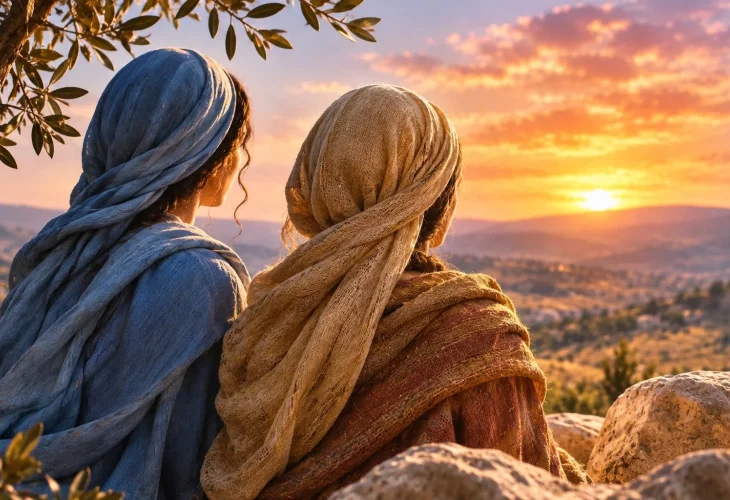
The story of Yaakov and Rachel is not easy to understand. Throughout his life, Yaakov encounters circumstances that seem to contradict his deepest hopes. He longs to marry Rachel, yet finds himself married to Leah. This unexpected turn repeats itself at three significant stages of his life: marriage, family life, and ultimately, burial.
On his wedding night, Yaakov believes he is marrying Rachel, only to discover the following morning, "And behold, it was Leah" (Bereishit 29:25). A week later, he marries Rachel as well, committing himself to another seven years of work for Lavan. Yet Rachel dies young, giving birth to her second son, while Leah remains with Yaakov for many more years. According to Seder Olam Rabbah, Yaakov and Rachel were married for just fourteen years; Rachel was twenty-two when they married and thirty-six when she died.
Perhaps the most poignant contrast emerges after their deaths. Leah is buried alongside Yaakov in the Cave of Machpelah, while Rachel rests alone along the road to Bethlehem. Why does this pattern repeat itself? What is the deeper significance of the contrast between Rachel and Leah?
Rachel and Leah: Two Paths to Spiritual Greatness
The Torah introduces the sisters with a striking description: "Leah's eyes were tender, while Rachel was beautiful in form and appearance. Yaakov loved Rachel and said, 'I will work for seven years for Rachel, your younger daughter'" (Bereishit 29:17–18).
While these verses can be understood literally, the spiritual stature of our Patriarchs and Matriarchs invites a deeper interpretation. In Jewish thought, beauty can represent more than physical appearance. It may also reflect purity, nobility, and spiritual refinement—a person's inner qualities expressed through an outward radiance.
Rachel's beauty can be understood as an expression of her exceptional character. She embodied humility, kindness, and devotion to Hashem. Her willingness to surrender the secret signs she had arranged with Yaakov, rather than allow her sister to suffer public humiliation, reveals the depth of her compassion.
Leah, however, possessed a different kind of greatness, one captured in the Torah's description of her tender eyes. The Talmud (Bava Batra 123a) explains that Leah's eyes were tender because of the many tears she shed over her anticipated marriage to Esav. People commonly said that Rivkah had two sons and Lavan had two daughters, and that the older daughter would marry the older son while the younger daughter would marry the younger son.
When Leah inquired about the brothers, she learned that Esav was a wicked man who robbed others, while Yaakov was a righteous scholar devoted to Torah study. Terrified by the prospect of marrying Esav, she cried and prayed so intensely that her eyelashes fell out.
Leah refused to passively accept what appeared to be her destiny. She fought to change it, turning to Hashem with unwavering determination. Her tender eyes were not a sign of weakness, but a testament to her strength.
Their Children Reflect Their Spiritual Legacies
The contrast between the sisters is also reflected in their children. Rachel gave birth to Yosef and Binyamin, two sons associated with exceptional spiritual purity. Yosef, described like his mother as beautiful in form and appearance, became known as Yosef HaTzaddik for his remarkable righteousness, despite the severe trials he faced.
Binyamin, too, attained an extraordinary level of spiritual perfection. The Talmud (Bava Batra 17a) identifies him as one of four individuals who died solely because of the decree of mortality that followed Adam's sin, rather than because of their own transgressions.
Leah's children, by contrast, are portrayed as confronting significant personal challenges, although these must be understood in the context of their exceptional spiritual stature. Reuven struggled with impulsiveness, while Shimon and Levi faced challenges involving anger, as reflected in Yaakov's final blessings. Yehuda, meanwhile, experienced the complicated events surrounding Tamar.
Yet these difficulties became opportunities for transformation. Yehuda, in particular, is associated with the path of teshuvah, repentance, through his willingness to acknowledge wrongdoing. His example demonstrates that a person's mistakes need not determine his future.
Leah's descendants went on to play an extraordinary role in Jewish history. She gave birth to six of the twelve tribes, including Levi, from whom came the priesthood, Moshe, and Aharon; Yehuda, the ancestor of King David and Mashiach; and Yissachar, whose descendants became renowned for their Torah scholarship.
Through her children, Leah established a legacy that would shape the spiritual foundations of the Jewish people for generations.
Why Yaakov Was Buried Beside Leah
This contrast offers a deeper perspective on Yaakov's marriages. Yaakov desired Rachel, whose spiritual beauty reflected the qualities he hoped to cultivate in his family. Yet Hashem's plan also included Leah, whose life would demonstrate the extraordinary potential of human perseverance.
The final chapter of Yaakov's life brings this lesson into sharper focus. Throughout her marriage, Leah yearned for Yaakov's affection. The names she gave her children reflect her longing: "Now my husband will love me," she said after Reuven's birth. With Levi, she expressed the hope that her husband would become attached to her, and with Zevulun, she anticipated that he would finally honor her.
Yet in the end, it is Leah who rests beside Yaakov in the Cave of Machpelah.
Perhaps, as the years passed, Yaakov came to recognize the extraordinary contribution Leah had made not only to his own life, but to the destiny of the Jewish people. The woman who had once felt unloved became the mother of tribes from which some of Israel's greatest leaders would emerge.
The Value of an Imperfect Journey
Leah's story offers a meaningful perspective to anyone who struggles with spiritual growth. A person may look at his observance of Torah and mitzvot and feel discouraged. Every achievement seems to demand enormous effort, every step forward involves another internal battle, and even the victories feel incomplete. What value can such imperfect service have?
The answer lies in recognizing that Hashem does not measure spiritual achievement solely by the outcome. The determination, sacrifice, and perseverance invested in overcoming personal limitations possess profound value of their own. Rachel represents the beauty of spiritual wholeness, while Leah reveals the greatness that can emerge through the process of becoming.
Sometimes, our greatest spiritual achievements are not the ones that come naturally, but the ones we must struggle to attain.
 Parashat VayechiRachel’s Tears and the Promise of Redemption: Why Rachel Weeps for Her Children
 Parashat VayetzeYaakov’s Ladder: Finding the Power of Prayer in Life’s Darkest Moments
 Torah PersonalitiesRachel Our Matriarch: The Life, Trials, and Eternal Legacy of the Mother Who Weeps for Her Children
 Parashat VayetzeWhy Must We Fight for the Promised Land? A Lesson in Faith from Yaakov

