

Parashat Vayetze
Yaakov’s Journey: How the Jewish Home Became the Foundation of a Nation
Discover how Parashat Vayeitzei reveals the deeper meaning of Yaakov’s journey, his vision of a House of G-d, and the spiritual foundation that has sustained the Jewish people through generations of exile
- Yosef Yaavetz
- | Updated
In Parashat Vayeitzei, Yaakov Avinu leaves Beersheba and travels toward Haran, retracing the journey of his grandfather Avraham in the opposite direction. Avraham had left Haran for the Land of Canaan, where he eventually established himself in Beersheba. Yaakov, however, leaves the land of his forefathers and heads back toward the place from which Avraham had departed.
This reversal carries profound significance. The Jewish people are called Bnei Yisrael, the Children of Israel, after Yaakov, rather than the children of Avraham. Remarkably, it is precisely Yaakov's departure into exile that marks the beginning of the nation that would bear his name. Yaakov would eventually descend to Egypt, setting in motion the first great exile of the Jewish people. His journey thus foreshadows the experiences of his descendants, reflecting the principle that maaseh avot siman labanim—the actions of the forefathers are a sign for their children.
Centuries later, the Babylonian exile would play a defining role in Jewish history. The name "Jews" derives from Yehudah, the tribe associated with the kingdom whose inhabitants were exiled to Babylonia and whose descendants later returned to the Land of Israel. From there, Jewish communities eventually spread across the world.
A Journey Without Material Possessions
There is a striking difference between the journeys of Avraham and Yaakov. When Avraham left his homeland, he traveled with his wife, members of his household, relatives, and possessions. Yaakov, by contrast, departed alone and without material wealth.
According to this interpretation, the circumstances of Yaakov's departure allowed him to demonstrate that his pursuit of the birthright and blessings had never been motivated by material gain. He left the flocks, possessions, and worldly wealth to his older brother, Esav, because the inheritance he sought was fundamentally spiritual.
The true treasures Yaakov carried were the qualities of his character, his spiritual convictions, and the legacy he had inherited from his forefathers. These were the resources with which he intended to establish a family and lay the foundations of the Jewish nation.
The Revolutionary Idea of a House of G-d
One of Yaakov's greatest contributions was his recognition that the Divine Presence belongs not only in extraordinary places of revelation, but also within the framework of everyday Jewish life. At Beit El, following his remarkable dream, Yaakov declares that the place where he has slept is a "House of G-d." This introduces a foundational idea: The home, where a person lives, raises children, and transmits values to the next generation, can become a setting for Divine service.
When the Beit HaMikdash stood in Jerusalem, it served as the spiritual center of the nation. During the long years of exile, the synagogue became a central institution of Jewish communal life, providing a place of worship and learning that supported individual households. This vision is reflected in Bilam's famous declaration: "How goodly are your tents, O Yaakov, your dwelling places, O Israel" (Bamidbar 24:5). The tents of Israel represent homes characterized by modesty, dignity, and spiritual purpose.
Yaakov's journey to Haran was therefore much more than a search for a wife. He was preparing to establish the family structure through which his forefathers' legacy would be carried forward.
The Stone That Became a Foundation
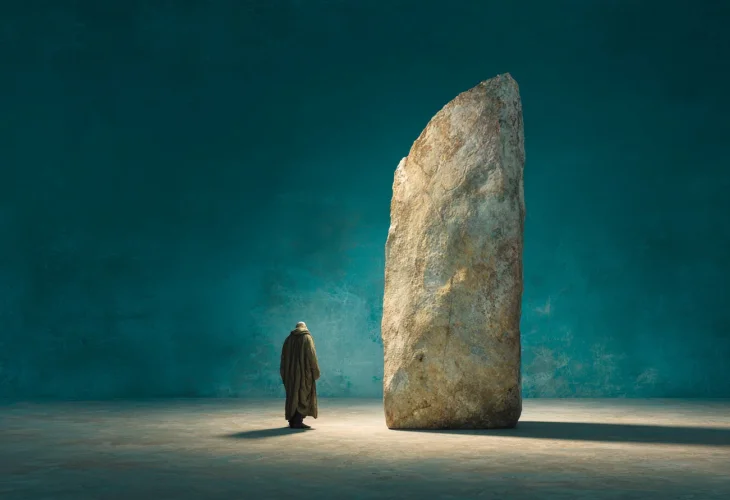
The Torah describes how Yaakov took a stone from the place where he slept and later erected it as a monument. He then made a remarkable declaration: "And this stone, which I have set up as a monument, shall become a House of G-d" (Bereishit 28:22).
At that moment, Yaakov stood at a crossroads, far from home and uncertain about what awaited him. Yet he looked toward the future with confidence, dedicating an ordinary stone to a sacred purpose. The stone symbolized the foundation upon which his future would be built. Yaakov understood that establishing a household was not simply about acquiring shelter or material security. It meant creating a life connected to Hashem and to the larger community of Israel.
His declaration also anticipated the broader purpose of the Beit HaMikdash: to serve as a spiritual center whose influence would extend into every aspect of Jewish existence.
Bringing Holiness Into Everyday Life
When Hashem commands the Jewish people, "They shall make Me a Sanctuary, and I shall dwell among them" (Shemot 25:8), the purpose of the Mishkan extends beyond the construction of a sacred building. The Divine Presence is meant to dwell among the people themselves, shaping their conduct and their relationship with the world.
This principle appears throughout the Torah. In Vayikra (26:12), Hashem promises, "I will walk among you," while Devarim (23:15) declares that Hashem walks within the camp of Israel. Remarkably, the latter verse refers even to a military encampment, emphasizing that spiritual responsibility extends beyond places traditionally associated with worship.
The ultimate expression of this vision appears in the prophecy of Zechariah (14:21): "Every pot in Jerusalem and Judah shall be holy to Hashem of Hosts." Even ordinary household utensils will become instruments of holiness. The prophecy describes a future in which the distinction between sacred spaces and everyday activities no longer implies that Divine service belongs exclusively to one sphere of life.
A Foundation That Endures Through Exile
Toward the end of his life, Yaakov once again invokes the imagery of a stone. In his blessings to his sons, he refers to Hashem as the source of strength from whom comes the "Stone of Israel" (Bereishit 49:24). This image recalls the stone he dedicated years earlier, when he was alone and preparing to begin his journey. What initially represented the hopes of one individual had become associated with the destiny of an entire nation.
The imagery of a stone also appears in the prophecies of Zechariah. The prophet describes a stone watched over by seven eyes (Zechariah 3:9), symbolizing Divine attention and providence, and later refers to the "chief cornerstone" (Zechariah 4:7) in connection with the rebuilding of the Temple. These images evoke the idea of a spiritual foundation that endures despite exile, hardship, and the passage of generations. The stone of Yaakov's vision can also be understood as recalling the Even HaShetiyah, the Foundation Stone associated with the holiest place in the Beit HaMikdash.
Yaakov's journey began without the material resources that ordinarily provide a person with security. Yet he carried a vision that would sustain his descendants through centuries of exile, wherever they established their homes and communities.
The enduring lesson of Yaakov's journey is that the strength of the Jewish people rests not merely upon possessions or external circumstances, but upon the spiritual values they preserve and pass from one generation to the next.
 Parashat VayetzeThe Hidden Meaning of Yaakov’s Ladder: A Glimpse Into the Divine Order of Creation
 Parashat VayetzeHaftorah of Parashat Vayeitzei: From Divine Judgment to Mercy and Redemption
 Parashat VayetzeRachel and Leah: Finding Hidden Blessings in Life's Unexpected Challenges
 Parashat VayetzeYaakov and the Shepherds: A Lesson in Honesty, Integrity, and Work Ethics

