

Israel News
Likud and Gadi Eisenkot Hold Unity Government Talks Amid Disagreements
Representatives of Netanyahu, Eisenkot, and Bennett meet to explore a national unity government, but disputes over leadership and coalition partners remain major obstacles
- Shlomi Diaz
- | Updated
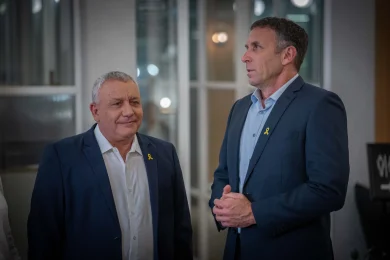
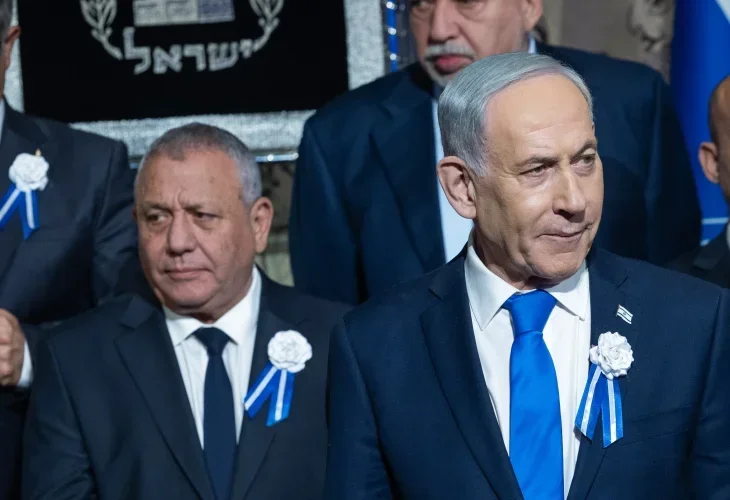 Netanyahu and Eisenkot (Photo: Chaim Goldberg, Flash90)
Representatives of Gadi Eisenkot's Yashar party met with Likud officials at a hotel in Herzliya on Sunday evening to explore the possibility of forming a national unity government. The meeting also included political adviser Shalom Shlomo, representing former Prime Minister Naftali Bennett's Beyachad party.
Eisenkot was represented by MK Chili Tropper and former IDF spokesperson Ronen Manelis, who is managing Eisenkot's election campaign. Representing Prime Minister Benjamin Netanyahu were Likud faction chairman Ofir Katz and attorney Michael Rabilo, who previously served as Netanyahu's legal counsel. In a joint statement following the meeting, the parties said: "The meeting between representatives of Yashar, Beyachad, and Likud has concluded. The discussion took place in a constructive atmosphere, and it was agreed that dialogue between the parties would continue."
The talks drew criticism from other opposition figures. As the meeting began, Democrats party chairman Yair Golan condemned the initiative, arguing that the opposition should pursue a different approach. "The change bloc must lead a change in the rules of the game. It should meet with the leaders of the Arab parties, examine partnerships based on substantive issues, and stop allowing Netanyahu to determine who is legitimate and who is not," Golan wrote on X. Figures within Avigdor Liberman's Yisrael Beytenu party also voiced opposition to the meeting.
Eisenkot: Unity Must Be Based on Shared Values
Shortly before the talks, Eisenkot addressed the issue during a visit to the Ben-Gurion Heritage Institute and David Ben-Gurion's gravesite in Sde Boker. He emphasized that a national unity government should be built around shared principles rather than political convenience.
"Unity is usually discussed in the context of political circumstances," Eisenkot said. "In my view, the substance of unity in terms of values is far more important than reaching a political agreement to establish a national unity government."
Describing Israel as being at a historic crossroads, Eisenkot called for a renewed focus on public education, military and public service, mutual responsibility, and the relationship between citizens and the state. He stressed that genuine unity requires a commitment to advancing common goals, rather than merely assembling a parliamentary majority to create an appearance of political stability.
Disagreement Over Who Would Lead a Unity Government
According to reports in several Israeli media outlets, Eisenkot proposed that Likud join a government headed by him, without a rotation agreement or an arrangement to alternate leadership positions. Eisenkot's party reportedly indicated that it would be willing to include any party from the current governing coalition, with the exception of National Security Minister Itamar Ben-Gvir's Otzma Yehudit party.
Likud, however, rejected the proposal outright, insisting that Netanyahu must serve as prime minister in any national unity government. The party also demanded that all members of Netanyahu's political bloc be included in such a coalition, including Ben-Gvir's party.
Despite the significant disagreements over leadership and coalition composition, the parties agreed to continue discussions.
 Israel NewsNetanyahu Calls for National Unity Government; Eisenkot Dismisses Appeal as Political Stunt
 Israel NewsNetanyahu Warns: “If a National Emergency Requires It, I’ll Lead an Organizing Committee”
 Israel NewsHerzog Taps Gadi Eisenkot to Form Israel’s Next Government After Securing 67 Endorsements
 Israel NewsIsraeli Opposition Leaders Agree on Key Roles as 26th Knesset Opens

