Sukkot
The Water Libation on Sukkot: Why Was It So Important?
Discover the deeper meaning of Nisuch HaMayim, the ancient Sukkot water libation ceremony, its connection to Creation and Jerusalem, and why the Sadducees opposed this sacred Temple ritual
- Yosef Yaavetz
- | Updated
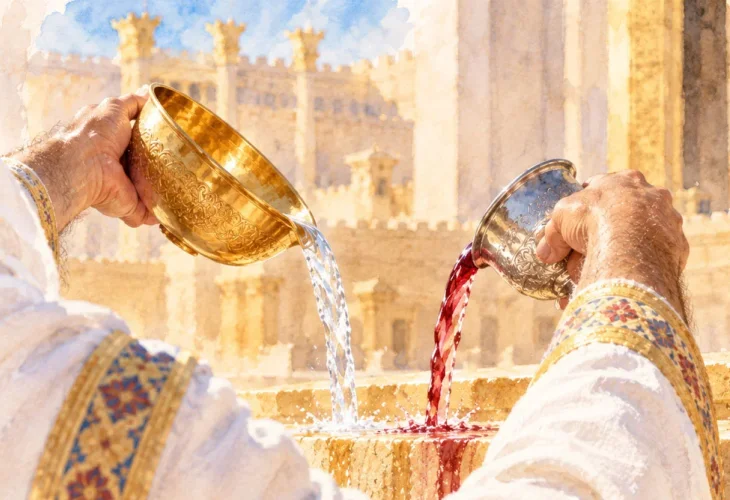
One of the central mitzvot performed in the Beit Hamikdash during Sukkot was Nisuch HaMayim, the water libation ceremony. In a special procession, water was drawn from the Shiloach Spring and poured onto the altar. The ceremony took place on each of the seven days of Sukkot and was accompanied by extraordinary celebrations known as Simchat Beit HaShoevah, the Rejoicing of the Water Drawing.
The Mishnah famously declares, "Whoever has not witnessed the joy of Simchat Beit HaShoevah has never witnessed true joy in his life."
What made this ceremony so significant? Why did the simple act of pouring water onto the altar inspire such overwhelming joy, and why did the Sages describe it as a mitzvah originating from the six days of Creation?
The answer reveals a connection between the natural world, humanity's original purpose, and the spiritual significance of Jerusalem.
The Water Cycle and Humanity's Role in Creation
The water libation ceremony can be understood as a symbolic representation of the natural water cycle that sustains life on Earth. Water evaporates and rises into the atmosphere, where it forms clouds that carry moisture across the land. Eventually, the water returns as rain, nourishing the fields and sustaining life.
The ceremony reflected this cycle. Water was drawn from the Shiloach Spring, carried to the Temple Mount, and poured onto the altar. From there, it flowed through underground channels known as the shittin, returning to the depths beneath the earth.
Yet the Sages regarded Nisuch HaMayim as far more than a symbolic celebration of nature. They described it as "an important mitzvah originating from the six days of Creation." This remarkable statement suggests that the ritual's significance reaches back to the very beginning of the world, long before the giving of the Torah.
To understand this connection, we must return to the Torah's description of the world before Adam's creation. Genesis describes a time when the plants of the field had not yet begun to grow because rain had not fallen upon the earth. Instead, a mist rose from the ground and watered its surface. Adam was subsequently placed in the Garden of Eden "to work it and to guard it."
These verses establish a relationship between water, the cultivation of the earth, and humanity's responsibility for Creation. Adam was not placed in the world merely to enjoy its abundance. He was entrusted with working the land, preserving its beauty, and ensuring that the garden continued to flourish.
According to this interpretation, the water libation reflected that original responsibility. By drawing water from the depths and returning it to the earth through the Temple service, the Jewish people symbolically participated in the cycle that sustains life.
Some Midrashic traditions associate the Garden of Eden with the Temple Mount. Other rabbinic teachings connect the site with the subterranean waters of the earth, including the account of King David excavating the foundations of the Beit Hamikdash, when the waters of the deep threatened to rise and overwhelm the world.
Together, these traditions suggest that the water libation expressed humanity's enduring responsibility to cultivate and preserve the world Hashem created.
Why Did the Sadducees Oppose the Water Libation?
The ceremony's importance becomes even more apparent when we consider the fierce opposition it encountered from the Sadducees, who rejected the authority of the Oral Torah and challenged practices that lacked an explicit biblical commandment.
The Mishnah recounts an incident involving a High Priest who, instead of pouring the water onto the altar, poured it onto his feet. According to the traditional account cited here, this was King Alexander Jannaeus. His actions provoked an intense reaction from the assembled worshippers. Why would anyone deliberately disrupt a ceremony that brought so much joy to the Jewish people?
Disagreements over biblical interpretation are understandable. For example, the Sadducees understood the Torah's commandment of "an eye for an eye" differently from the rabbinic interpretation preserved in the Oral Torah. They could argue that they were following what they regarded as the plain meaning of Scripture.
The water libation, however, presents a different question. Even if the ceremony is not explicitly commanded in the Written Torah, why should that make it objectionable? Every society develops religious traditions and customs. Moreover, pouring water before Hashem appears elsewhere in Scripture, including Samuel I, 7:6 and Samuel II, 23:16.
The intensity of the Sadducees' opposition suggests that the disagreement concerned more than the ritual itself. It reflected a deeper dispute about the authority of Jewish tradition and the spiritual meaning attributed to the Temple service.
Jerusalem's Unique Place in Jewish Tradition
Although Jerusalem occupies a central position in Jewish tradition, the Torah does not explicitly identify it as the future location of the Beit Hamikdash.
The Garden of Eden is described without a clearly identifiable location. Abraham is commanded to travel to "the land that I will show you," while the binding of Isaac takes place in "the land of Moriah," whose precise location is not specified in Genesis. Only later, in the Book of Chronicles, is Mount Moriah explicitly identified with Jerusalem.
Similarly, the Torah describes Melchizedek as king of Salem and priest of the Most High God without directly identifying Salem as Jerusalem. Throughout Deuteronomy, the future site of the Temple is repeatedly called "the place that Hashem will choose," without naming the city.
Jerusalem's centrality becomes fully apparent through the unfolding of Jewish history, particularly during the reign of King David, who established it as his capital. The city subsequently became the site of the Beit Hamikdash, a center of prophecy and Torah, and the focus of the Jewish people's prayers and longing throughout centuries of exile.
The prophets also describe Jerusalem as the setting of future redemption. As the Book of Joel declares, "On Mount Zion and in Jerusalem there shall be deliverance."
According to the interpretation presented here, the Sadducees' rejection of traditions not explicitly stated in the Written Torah also prevented them from accepting the broader spiritual significance that the Sages attributed to Jerusalem.
The water libation embodied precisely that understanding. Through the ceremony, the Jewish people acknowledged the Temple's unique role in connecting the natural world with divine blessing. For the Sages, this was not merely an additional religious custom. It was an expression of a tradition whose roots extended back to Creation itself.
The Deeper Meaning of the Water Libation
The controversy surrounding Nisuch HaMayim highlights a fundamental distinction between the Written Torah and the traditions through which its teachings have been understood and practiced.
Many aspects of Jewish belief and observance are not explained explicitly in the biblical text. Their fuller meaning emerges through the interpretations and traditions transmitted by the Sages.
The water libation is one such example. Its significance cannot be understood solely through the physical act of pouring water onto the altar. It reflects the relationship between heaven and earth, the natural world and divine blessing, and humanity's responsibility to care for Creation.
From this perspective, the extraordinary joy of Simchat Beit HaShoevah becomes easier to understand. The Jewish people were not simply celebrating the drawing of water or anticipating the winter rains. They were rejoicing in their connection to Hashem and their participation in the divine order established at the beginning of time.
Perhaps this is why the Sages declared that anyone who had never witnessed the joy of the water-drawing celebration had never truly witnessed joy.