Personal Stories
From Siberia to Jerusalem: An Artist's Remarkable Journey to Judaism
Raised in a Soviet home with no religious traditions, artist Elisheva Galperin followed her passion for art to Israel, discovered her connection to Judaism, and now shares Jewish stories and spirituality through exhibitions across Europe
- Michal Arieli
- | Updated
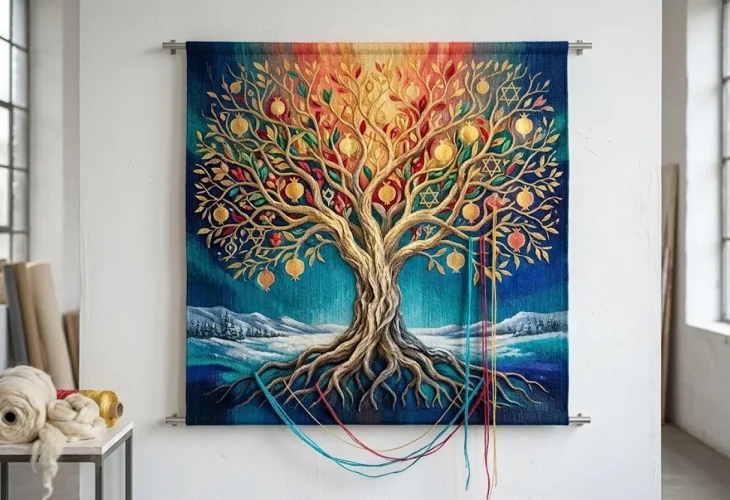
Walking into an exhibition by artist Elisheva Galperin, it is difficult to imagine that the moving, deeply Jewish works on display originated in a place so far removed from Judaism—or, for that matter, from religion of any kind.
Galperin was born in an industrial city in the remote reaches of Siberia, where religious life was virtually nonexistent under Communist rule. "It was a small city by local standards," she recalls. "There were about a million residents. We lived under a Communist regime that worked to erase every trace of religious identity and tradition. My father came from a Jewish family, but that had absolutely no expression in our home. We never discussed religion or showed any interest in it."
The girl who grew up in this environment would eventually become an internationally exhibited artist whose work draws deeply on Jewish spirituality and tradition.
A Childhood Dream of Becoming an Artist
Although religion played no role in Galperin's childhood, academic achievement was highly valued in her family. On her father's side, she belonged to a distinguished scientific family. Her grandfather established a factory that manufactured pain-relieving medications, while other relatives pursued careers in chemistry, research, and education. Her mother's family had a strong artistic tradition.
"I probably inherited my talent from my grandfather, who was a painter, a musician, and an exceptionally skilled woodworker," Galperin explains. "Unfortunately, he paid a heavy price for his political views. He spent eight years in Siberian labor camps as a political prisoner."
Her family, whose roots in Poland extended back four generations, had settled in remote Siberia hoping to escape the attention of the authorities. But isolation came at a cost. "There was no synagogue, no Jewish community, and no religious knowledge whatsoever," she says. "There was simply nothing."
Despite these circumstances, Galperin knew from the age of six that she wanted to become an artist. "The dream of painting followed me everywhere. I always wanted to study art professionally, but our city was so remote that there were no opportunities to pursue it."
After finishing school, she moved to another Siberian city and enrolled at a university, studying philology and ancient languages. However, she quickly realized that her heart was elsewhere. "I would sit through lectures and feel completely unable to concentrate," she recalls. "During every class, my hands were constantly drawing on the page. Eventually, I understood that there was no point fighting what I was meant to do. If I was destined to become a painter, I had no reason to remain there."
She left the university and set her sights on gaining admission to the prestigious art academy in St. Petersburg, considered one of the world's leading institutions for artistic training. For someone from a remote provincial town, the prospect seemed almost impossible. She had no relatives in the city, no influential connections, and no guaranteed employment. Nevertheless, her determination and talent ultimately opened the door.
An Unexpected Connection to Israel
In 1997, Galperin immigrated to Israel. The Jewish Agency enrolled her in a program designed to help young immigrants prepare for academic studies, combining Hebrew instruction with preparation for university entrance examinations. After just five months, she was accepted into the Bezalel Academy of Arts and Design in Jerusalem.
"As I began studying, I also started getting to know Israeli society and the students around me," she recalls. "From the beginning, I was deeply curious about their life stories. I wanted to understand where they came from and what they had experienced. I didn't speak Hebrew yet, but my English was good, so we were able to communicate."
Upon completing her studies, Galperin received an attractive job offer from a major international textile company abroad. The company wanted her to design fabrics, and she eventually managed a project involving the flooring of its exhibition halls. The position was financially rewarding, and even the language spoken around her was her native tongue.
Still, she felt strangely out of place. "They paid me well, and supposedly I should have been happy. But I felt like such an outsider," she recalls. "I missed Israel and the people I had met there. That was the moment I realized that my heart was drawn to the Land of Israel and to Judaism." She left the position and returned to Israel, determined to explore that connection more deeply.
 Elisheva Galperin (Photo: Oleg Kalashnikov Vadim K Reiz)
Following Her Soul Toward Judaism
Although Galperin's decision to convert to Judaism came suddenly, the process itself was long and demanding. "It was very important to me that the conversion be carried out properly," she explains. "That required tremendous dedication to studying and attending classes. But I love learning, and I understood how necessary it was. I didn't want to live according to practices I didn't understand."
The process was especially challenging because her Hebrew was still developing. Whenever she felt overwhelmed, however, she reminded herself why she had begun. "I told myself that I didn't want to keep living between two worlds. I wanted to be Jewish because that was where my soul was drawing me. Eventually, I completed the conversion and changed my name from Elizabeta to Elisheva. It felt completely natural."
Her decision would eventually inspire another unexpected development within her family. When asked about her parents, Galperin becomes emotional as she describes her mother's decision to follow a similar path. "My mother is an academic who spent her life studying English," she explains. "She came to visit me in Israel and immediately felt a special connection to the country, the people, and the atmosphere."
That experience eventually led her mother, already in her seventies, to undertake and complete a full conversion to Judaism. "I don't know many women who would be capable of taking such a step at her age," Galperin says. "I admire her tremendously for it."
Bringing Jewish Stories to the World Through Art
Today, Galperin lives in Jerusalem, where she is raising her three children, and works from her studio in the Talpiot neighborhood. After years of advanced training with accomplished painting instructors, she began presenting solo exhibitions in Austria, Germany, Italy, and other European countries.
Her work combines artistic weaving with Jewish narratives, using a visual language that communicates across cultural and religious boundaries.
"I am currently presenting a new solo exhibition titled Knocking on Heaven's Gate," she explains. "It explores the idea of the lost Garden of Eden and seeks to connect a familiar Jewish narrative with broader European culture."
For Galperin, sharing these works with international audiences is especially meaningful. "I feel deeply privileged to introduce non-Jewish audiences to so many Jewish and religious symbols," she says.
The exhibition is being presented across Europe, with a showing also planned at the Global Art Gallery in Tel Aviv.
The Israeli Story Behind the Artwork
Presenting distinctly Jewish artwork abroad has not always been straightforward, particularly amid tensions surrounding Israel. Asked how international audiences have responded, Galperin says that most reactions have been positive. "Perhaps that's partly because people who don't identify with Israel simply don't invite me to exhibit," she suggests.
Nevertheless, Israel's security situation has created practical challenges. "Last year, I opened an exhibition in Austria, but I couldn't attend because of the security situation. It was during the war, and there was simply no possibility of traveling."
As a result, her artwork was displayed without her presence to explain the Israeli experiences behind it. She pauses, reflecting on the irony. "Perhaps the fact that the exhibition couldn't present its Israeli side was, in itself, the most powerful way it could tell the Israeli story."