

Personal Stories
Her Jewelry Was Stolen: What Happened After Simchat Torah
Her precious jewelry disappeared on Hoshana Rabbah, and everyone told her there was little hope of getting it back. Then, after Simchat Torah, an unexpected call changed everything.
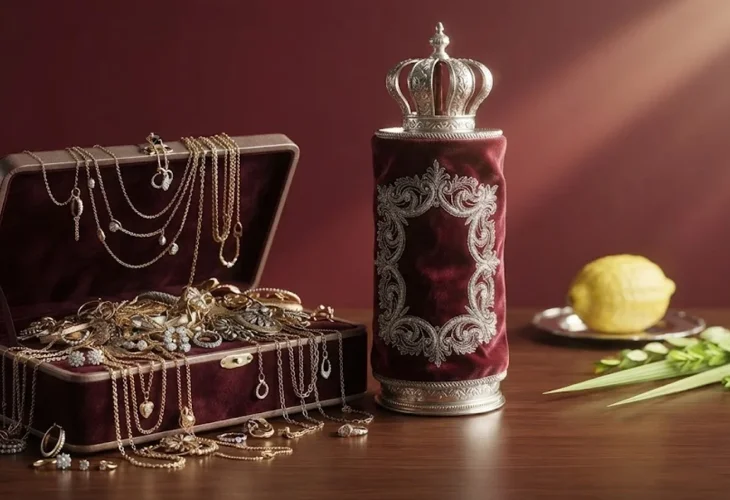
It was the night of Hoshana Rabbah, 5786. My husband and sons had gone to the synagogue to learn, while I stayed behind to pray in the sukkah, hoping to hold on to a few more precious moments beneath its shelter before the holiday came to an end.
Close to midnight, I went inside. I took off my jewelry and went to place it in its usual box, only to freeze when I opened it. The box was empty. Inside had been some of my most valuable jewelry: diamond earrings, gold necklaces I had inherited from my mother, and other precious pieces. Their financial value was considerable, but that was almost beside the point. Some of them were irreplaceable because of the memories attached to them.
My knees buckled. Where could everything have gone? I began searching frantically, emptying closets and checking every place that made sense, followed by plenty of places that didn’t. Nothing.
Then one thought entered my mind: the cleaning lady. Apart from my husband and me, she was the only person who regularly entered our bedroom. I suddenly realized how little information I actually had about her. She came from the Bethlehem area, and whenever she worked at our home, I would pick her up at the checkpoint. I didn’t have an address or many other identifying details.
I called the police, but I was told that because the suspected theft was not currently taking place, I would need to go to a police station and file a complaint. The problem was that I had no proof and almost no information to give them. What exactly could I report?
The Longest Night
I decided that in the morning, I would confront her myself. I sent her a message saying that I urgently needed help cleaning the house the next day and would pick her up at the checkpoint as usual. She happily agreed, with no idea what I was planning.
Then I tried to sleep, but I couldn’t. The missing jewelry was painful enough, but there was something else that hurt deeply: the feeling that someone had entered my private space and betrayed my trust. I had treated this woman warmly and respectfully. Had she really taken advantage of that? And then there were the pieces themselves: jewelry from my mother, my engagement jewelry, things that carried memories no amount of money could replace.
There was one person I desperately wanted to speak to: my husband. He knows how to calm me, strengthen my emunah, and help me put things into perspective. But it was Hoshana Rabbah, and as he does every year, he had gone to study Torah through the night. I knew that if I called, he would want to hear everything, but I also knew that once he heard what had happened, it would be difficult for him to return to his learning with the same concentration. I couldn’t bring myself to interrupt him. His Torah learning came first.
In the middle of the night, I suddenly heard a key in the door. My husband had come home briefly to pick something up. “Why aren’t you sleeping?” he asked. A battle raged inside me. I wanted so badly to tell him everything, but I knew he needed to go back. “I couldn’t fall asleep,” I said simply. He gave me a few encouraging words and returned to his learning.
Early the next morning, I drove to the checkpoint to meet the cleaning lady. Before she arrived, I spoke to the soldiers stationed there and told them I was about to confront someone I suspected of stealing jewelry from my home. I asked them to keep an eye on the situation in case anything unusual happened.
A few minutes later, she appeared and got into my car with an enormous, friendly smile. I decided there was no point waiting. “Look,” I told her, “you’ve left me no choice. My jewelry is gone. There were necklaces from my late mother, diamond earrings from my mother-in-law, and other pieces that mean a great deal to me. I believe you took them, and I want them returned.”
Her reaction was immediate. “Me?” she cried, insisting that she had taken nothing. How could I accuse her? She had thought I considered her a friend, and now I was treating her this way. But I stood my ground. I told her that if the jewelry was not returned, I intended to file a police complaint. She continued to deny everything and eventually got out of the car, still insisting that she had nothing to return.
“There’s Nothing More You Can Do”
I drove home devastated. My husband had returned from prayers, and finally I could tell him everything. “Let it be an atonement,” he told me. “We’ll buy you new jewelry. Don’t let this destroy you.” He reminded me that I had no evidence and little chance of proving what had happened, but I still couldn’t let it go.
I called my sister, who had a relative in the police, and asked whether he might be able to help. He listened to the story and essentially agreed with my husband: without evidence, there was very little that could be done. Still, he offered to call the cleaning lady. He identified himself as a police officer, but although she panicked, she continued to insist that she had taken nothing.
About an hour later, the officer called me again. For a moment, I was sure there had been a breakthrough. Instead, he told me that a woman identifying herself as the cleaning lady’s attorney had contacted him and warned him not to call her client again. The woman continued to deny taking anything, and without proof, he told me, there was really nowhere to go from there.
I thanked him and reminded myself what day it was. It was Hoshana Rabbah, and soon Shemini Atzeret and Simchat Torah would begin. I made a decision: until the holiday was over, I was putting the jewelry aside.
Sukkot is zman simchateinu, the time of our joy, and the Torah commands us, “You shall rejoice on your festival.” I couldn’t control what had happened to my jewelry, but I could decide whether I would allow it to take the holiday away from me too.
That day was already filled with powerful emotion and gratitude, and I decided to focus on everything I still had to rejoice over. I went shopping with my son for special things for the holiday, we prepared a beautiful festive meal together, and I kept myself busy creating, preparing, and finding ways to bring happiness into our home.
Then came Simchat Torah. There is a unique joy in celebrating the Torah: dancing with it, holding it close, and remembering how precious it is to the Jewish people. I had spent the night of Hoshana Rabbah protecting my husband’s Torah learning rather than interrupting him with my distress. Now I tried to protect the joy of Yom Tov too, refusing to allow my anger and disappointment to consume it.
And somehow, Hashem helped me. The holiday passed beautifully. I rejoiced, enjoyed my family, and for those precious hours, the missing jewelry was no longer at the center of my world.
Then Came the Voicemail
After the holiday, once we had finished taking down the sukkah, I noticed a voicemail from an unfamiliar number. “This is the attorney for your cleaning lady,” the woman said. “I would like to meet with you as soon as possible. Please call me back.”
My heart began pounding. All the anger and frustration I had deliberately put aside before the holiday came rushing back. I called immediately and made my position clear: there was nothing for us to discuss. Either the jewelry was returned or I would pursue the matter with the police.
Then she said something I never expected to hear.
“My client wants to return the jewelry she took from you. I want to meet with you so I can give it back.”
I was stunned. Just before the holiday, she had denied everything. Her attorney had insisted there was no basis for my accusation. Everyone I spoke to had told me there was no proof and no realistic way to recover what I had lost. And now she wanted to give it back.
What had changed? I still don’t know.
But in that moment, I couldn’t help thinking about the night of Hoshana Rabbah. I remembered how desperately I had wanted to tell my husband what had happened, and how difficult it had been to remain silent so that he could continue learning Torah with a peaceful mind. I thought, too, about the effort it had taken to put the jewelry aside and enter Simchat Torah with joy.
I cannot know the calculations of Heaven. But in my heart, I felt that the Torah learning I had tried so hard to protect, and the joy of Yom Tov I had refused to surrender, had stood as a merit for me.
The jewelry I thought I had lost was coming home.
And suddenly, one verse took on an entirely new meaning: “The Torah of Your mouth is better to me than thousands of gold and silver” (Psalms 119:72).
The gold and silver mattered to me. Some of it was deeply precious. But for one night, I had chosen Torah over the jewelry.
And after Simchat Torah, the jewelry came back.

