

Raising Children
How One Teacher Turned a Boy's Shame Into Pride
When a sixth grader felt embarrassed by his father's job as a garbage truck driver, one thoughtful teacher transformed Career Day into a powerful lesson about dignity, respect, and the lasting impact of great educators
- Avinoam Hersh
- | Updated

Some lessons children remember for an exam. Others stay with them for a lifetime.
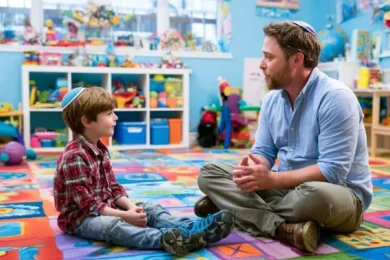
Several years ago, I heard a story about a sixth-grade teacher at a school in the Krayot region of Israel. The class was preparing for Career Day, an event in which each student would introduce classmates to the profession of one of their parents. For the teacher, however, the event presented a challenge that went far beyond planning a classroom activity. One of his students had a father who worked as a garbage truck driver, and the boy was already painfully aware of the jokes, looks, and comments his classmates might make.
The teacher could have ignored the issue and hoped the class would behave respectfully. He could have suggested that the boy choose another family member to present instead. But a good teacher doesn't merely look for ways to get through a lesson without problems. He asks how that lesson might become an opportunity to strengthen a child.
And that is exactly what this teacher set out to do.
A Lesson That Changed the Class's Perspective
Rather than addressing the boy's embarrassment directly, the teacher designed an activity that would challenge his students' assumptions about different professions. Together, they created a chart ranking occupations according to one simple question: How long would it take for the public to notice if the people working in these professions went on strike?
Engineers, high-tech employees, bankers, diamond dealers, lawyers, and accountants were placed in a category of professions whose absence, at least in ordinary daily life, might not be immediately noticeable for more than a week. But other professions were different. If police officers, grocery store owners, plumbers, or garbage truck drivers stopped working, the effects could be felt almost immediately.
Suddenly, the profession that had seemed like a potential source of embarrassment took on an entirely different meaning.
The teacher went a step further. He invited the student to introduce his father first and explained to the class that sanitation work involves much more than demanding physical labor. It is an essential part of public health. Regular garbage collection prevents the accumulation of waste, reduces the presence of pests, limits pollution, and helps prevent the spread of disease. In other words, sanitation workers also contribute to preventive healthcare.
The boy's father arrived at school, gave a presentation about sanitation work, and explained what his profession involved. At the end of the presentation, the teacher approached him and asked to take a selfie together.
It seemed like a small gesture, but children understand the language of symbols remarkably well. They notice whom adults respect, who is invited to stand at the front of the classroom, whose words are treated as important, and whom their teacher chooses to stand beside. In that moment, the teacher did more than compliment the father. He sent a powerful message to the boy in front of his classmates: Your father deserves respect. His work is important. There is absolutely nothing to be ashamed of.
Recognizing the Shame a Child Never Expresses
This is where the sensitivity of a truly dedicated educator becomes apparent. Children do not raise their hands and announce, "I'm embarrassed." Often they remain silent, avoid participating, or make excuses. Others may even laugh at themselves first, hoping to protect themselves from being laughed at by their peers.
Teachers who genuinely know their students can recognize these vulnerabilities before they develop into lasting emotional wounds. An educator cannot solve every difficulty a child faces, but they can create an environment in which the child does not need to confront feelings of shame alone.
That evening, the father called the teacher, deeply emotional, to thank him. Then he shared something that transformed the significance of the entire Career Day event. For five years, his son had refused to accompany him on his garbage truck because he was embarrassed by his father's profession. But that afternoon, for the first time in five years, the boy had asked to join him on his route.
The Extraordinary Power of a Good Teacher
To me, this story is one of the most important reminders of what teaching is really about. Teachers do far more than deliver information. Sometimes, they give children an entirely new way to understand their own lives.
They can take something that makes a child feel small and transform it into a source of pride. They can challenge the social hierarchies that develop among children, not through moralizing lectures, but through thoughtful teaching, knowledge, and personal example.
Children do not need to hear "Every honest profession deserves respect" repeated as an empty slogan. They need to see what that respect looks like in practice. This teacher understood that perfectly. Instead of telling the boy, "Don't be ashamed of your father," he created an experience that allowed the boy to see his father differently.
Perhaps that is one of the greatest gifts a teacher can offer: not telling a child who they ought to become, but helping them recognize the value of who they already are.
May we all have a wonderful school year, filled with opportunities to lift our students higher than they ever imagined possible.
Avinoam Hersh is an educator and the founder of the parenting community Growing Through Adolescence With Love.
 Raising ChildrenThe Hidden Crisis in Education: Why So Many Children Are Losing Their Way
 Raising ChildrenHow to Correct Your Child Without Shouting: A Parenting Lesson from Moses
 Raising ChildrenEvery Student Has a Frequency: A Back-to-School Message for Teachers
 Raising ChildrenWhat to Do When Your Child Doesn’t Like Their Teacher: A Practical Guide for Parents

