

Raising Children
Every Student Has a Frequency: A Back-to-School Message for Teachers
Grades and achievements matter, but sometimes the most important part of teaching is something much harder to measure.
- Avinoam Hersh
- | Updated
The truth is, after all the media noise surrounding the status of teachers, there may be educators walking into their classrooms with doubts and background noise about one of the craziest, most intense professions in the world: teaching.
I’ve even heard that there are single women who, if they see you’re a teacher, will probably swipe past your profile because they’re specifically looking for an accountant, a programmer at Intel, or a partner at a law firm.
And yet, I know teachers who, excuse me, would never, ever consider leaving teaching and education or giving up the privilege of shaping the souls of the next generation.
You can say they’re living in la-la land.
You can say, fine, enough with the slogans and clichés. At the end of the day, someone who needs to support a family has to buy groceries and make a living.
It’s all true. And I hope people here start treating teachers in a way that reflects the importance of their profession.
Still, anyone who has never stood in front of a classroom on the first day of school, looked at the students, and seen the excitement and anticipation in their curious eyes doesn’t really know what I’m talking about. From the outside, it’s difficult to understand.
Every Student Has a Frequency
I understood this early in my career, when I was still a new teacher, full of good intentions and with very little idea of what was really going on inside a child’s soul.
I had a fourth-grade student who didn’t speak. At all. You could have put the Great Wall of China next to him, and suddenly it would have looked like a revolving door.
I tried everything. Really.
I asked questions. I showed interest. I approached him. I smiled. I kept talking. I tried again.
Nothing.
After two months, I had already given up.
Then a friend of mine, who taught the parallel class, looked at me and said something I remember to this day:
“There isn’t a student who doesn’t have a frequency. You just haven’t found his yet.”
A frequency? Come on, what are you talking about? What frequency? Who has a frequency? What does that even have to do with anything? Do I look like a phone technician searching for reception?
But then he started asking me about the kid.
“What does he like?”
“Soccer.”
“Which team?”
“Maccabi Haifa.”
“Great,” he told me. “I want to show you something.”
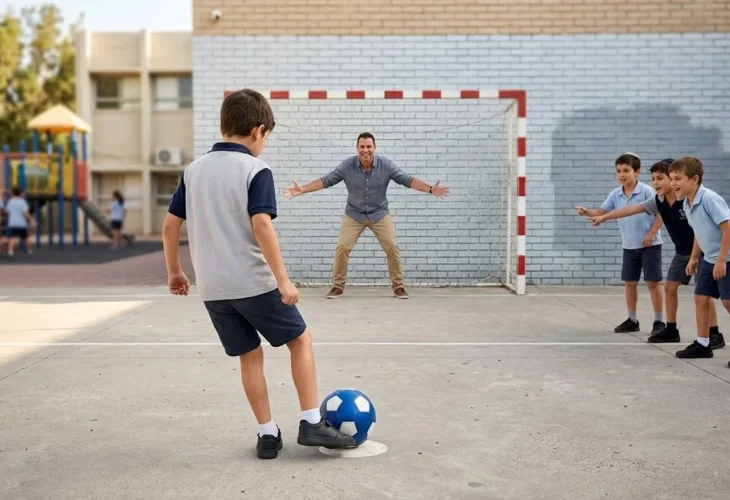
During recess, he walked over to the boy and said, “Listen, champ. If you score a penalty kick on me, your whole class gets an extra recess.”
The students went wild. Suddenly, the boy snapped to attention.
“But wait, wait. What if I miss?”
My friend looked him straight in the eyes, a smile spreading across his face.
“If you miss, you admit that Maccabi Haifa is a garbage team.”
For the first time, I saw this kid light up.
His eyes opened wide. A smile appeared.
He placed the ball on the spot as though he were the greatest soccer player in the world, with 90,000 fans in the stands holding their breath.
He stepped back with great importance, his eyes never leaving the goalkeeper. Then he took his run-up and kicked.
Of course, the teacher, with his belly and oversized confidence, hadn’t even had time to move before the ball was deep in the net.
The field exploded.
In one second, the quiet kid became the hero of the class.
The next day came a high five. Then another one.
By the fourth day, that student was already a different child. He approached my friend, the teacher who had played with him, and asked to talk.
His father had left home. His parents were getting divorced. It was hard for him. He was alone. He had no one to talk to.
Suddenly, we understood that his silence wasn’t defiance, disconnection, or indifference.
It was distress.
And when the adult who found his frequency arrived, the child began to speak.
The school counselor became involved. His mother became involved. A plan was built, emotional support was put in place, and the child began to thrive. His grades improved too, but that was almost a minor detail.
Because before a student improved, a child came back to us.
The Power We Place in a Teacher’s Hands
I think about that story every time a new school year begins.
Because being a teacher in Israel is not just another job, whether you punch a time clock or not.
Being a teacher and educator in Israel is one of the most influential roles in society.
We speak with admiration about great leaders, trailblazers, doctors, scientists, thinkers, commanders, and entrepreneurs.
But how many of us remember that almost all of them once had a teacher?
Someone taught them how to read. Someone saw something in them before they could see it themselves. Someone gave them confidence, boundaries, curiosity, or faith.
And sometimes an even more troubling thought comes to mind.
Even history’s cruelest dictators were once children. They, too, sat in classrooms. They, too, encountered adults.
We can’t know whether one teacher could have changed the course of their lives. But it’s hard not to wonder what humanity might look like if every child met, at the right time, someone who knew how to find their frequency, teach them empathy, set boundaries, and remind them that the person standing in front of them is a human being.
That is the power of education. And that is why it is time for the Israeli public to start talking differently about teachers.
Not only about vacations. Not only about salaries. Not only about shortages.
But about the enormous responsibility we place in their hands.
And still, teachers are not meant to replace parents.
School is not home, and an educator is not a father or mother.
I believe that good education is holistic education. The home provides roots, love, identity, and belonging. School provides space, community, knowledge, boundaries, experience, and the opportunity to encounter the world.
These are not two sides fighting over the child. They are two hands meant to hold the child together.
Look for the Frequency
So as the school year begins, I wish our teachers one thing: Don’t look only for achievements. Look for frequencies.
Because behind the child who disrupts, behind the girl who stays quiet, behind the student who gets on your nerves, and behind the one you have already decided “doesn’t want to,” there is a story.
Sometimes it takes a conversation. Sometimes it takes patience. And sometimes all it takes is a ball, a goal, and one teacher willing to join in during recess.
There isn’t a student who doesn’t have a frequency.
There is only a frequency we haven’t found yet.
And maybe that is exactly why being a teacher is one of the greatest professions in the world. Truly. No exaggeration, no pretending.
Because every morning, the future enters the classroom. And the teacher, you, me, we are among the rare people who can actually influence and change it.
May we have, with Hashem’s help, a school year wrapped in siyata d’shmaya, with huge hearts and a generous eye toward our students and their parents, and yes, toward ourselves too.

