

Israel News
Knesset Advances Bill to Strip Rights From MKs Who Refuse to Recognize Hamas as a Terror Group
Israeli lawmakers approve a preliminary bill targeting MKs who refuse to recognize Hamas as a terrorist organization, while advancing separate proposals to repeal judicial and media reforms
- Shlomi Diaz
- | Updated
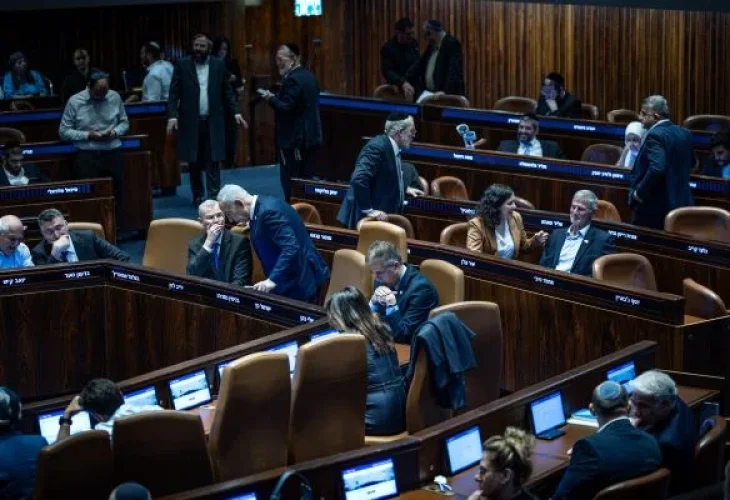 Today's session in the Knesset plenum (Photo: Yonatan Sindel, Flash90)
The Knesset approved a preliminary reading of a bill that would revoke certain parliamentary rights from lawmakers who refuse to recognize Hamas as a terrorist organization. The proposal passed with 48 votes in favor and no opposition, while members of the Arab parties and the opposition's Change Bloc did not participate in the vote.
The bill has been referred to the Knesset's Arrangements Committee, which will determine which parliamentary committee will review the legislation.
According to the explanatory notes accompanying the proposed Basic Law, its purpose is to establish a constitutional principle requiring members of the Knesset to acknowledge Hamas's legal designation as a terrorist organization.
"The purpose of this proposed Basic Law is to establish a constitutional principle under which a member of the Knesset who refuses to recognize Hamas as a terrorist organization, or makes statements denying that designation, will not be entitled to exercise their rights as a member of the Knesset for as long as that refusal continues," the proposal states.
The legislation further argues that elected representatives serving in Israel's parliament have an obligation to recognize Hamas's legal status as a terrorist organization, and that refusing to do so undermines national security and public trust in government institutions.
Knesset Advances Bills to Repeal Judicial and Media Reforms
Meanwhile, with the support of all parties opposed to the current government, the Knesset approved three additional legislative proposals aimed at repealing controversial reforms passed during the previous parliamentary term. The first proposal seeks to repeal legislation changing the composition of the Judicial Selection Committee. The second would overturn legislation that opponents have described as weakening the attorney general's authority, while the third aims to repeal the Communications Law.
The votes sparked sharp criticism from Justice Minister Yariv Levin and Communications Minister Shlomo Karhi, both of whom had played central roles in advancing the reforms.
Justice Minister Yariv Levin Condemns Effort to Reverse Judicial Reforms
Before the vote, Justice Minister Yariv Levin strongly criticized the attempt to repeal the judicial reform legislation he had promoted during his tenure.
"Look what you've reduced the Knesset to—you who lectured us about the need to discuss everything thoroughly," Levin told lawmakers from the Change Bloc. "What is all this hysteria and urgency? The procedure is improper because the government was not given sufficient time to formulate its position."
Levin warned that repealing the legislation would restore representatives of the Israel Bar Association to the Judicial Selection Committee, a move he claimed would revive conflicts of interest. "The meaning of this repeal is bringing Bar Association representatives back onto the committee, with all the conflicts of interest involved. That is corruption," he said.
He also renewed his criticism of the judicial system, alleging selective enforcement and a culture of insiders appointing one another. "The truth about the judicial system has been fully exposed. It is no longer possible to conceal selective enforcement or the system of friends appointing friends. There is no way to undo what has been revealed so clearly."
Communications Minister Karhi Defends Media Reform
Communications Minister Shlomo Karhi, who spearheaded the Communications Law during the previous Knesset, also criticized efforts to repeal his legislation.
"Even if you repeal the law, you will not succeed in stopping the revolution or blocking new and diverse players, such as Channels 15 and 16," Karhi declared. "The left's monopoly has already been shattered. The train has left the station."
Karhi accused opponents of resisting changes intended to increase competition and expand consumer choice in the broadcasting industry. "You don't want to give creators and producers 6.5% in original productions. You don't want personalized packages that would allow consumers to pay less. You don't want a diversity of opinions," he said. "You are afraid of transparency and the truth."
The competing legislative initiatives reflect ongoing political disagreements over Israel's judicial system, media regulation, and the responsibilities of elected representatives. All the proposals must advance through additional stages of the legislative process before becoming law.
 Israel NewsKnesset Approves New Border-Smuggling Law With Up to 9 Years in Prison
 Israel NewsKnesset Set to Approve October 7 Terror Trials Today Amid Billion-shekel Budget Clash
 Israel NewsNetanyahu Calls for National Unity Government, Warns of Renewed Iranian Threat
 Israel NewsShas Lawmaker Moshe Arbel Announces Resignation From the Knesset

