

Israel News
Netanyahu Calls for National Unity Government, Warns of Renewed Iranian Threat
Addressing the opening session of Israel's 26th Knesset, Prime Minister Benjamin Netanyahu urges political unity to confront Iran's nuclear ambitions while rejecting a coalition dependent on Arab parties
- Shlomi Diaz
- | Updated
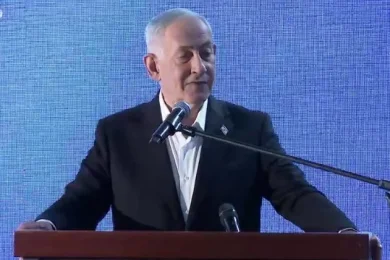
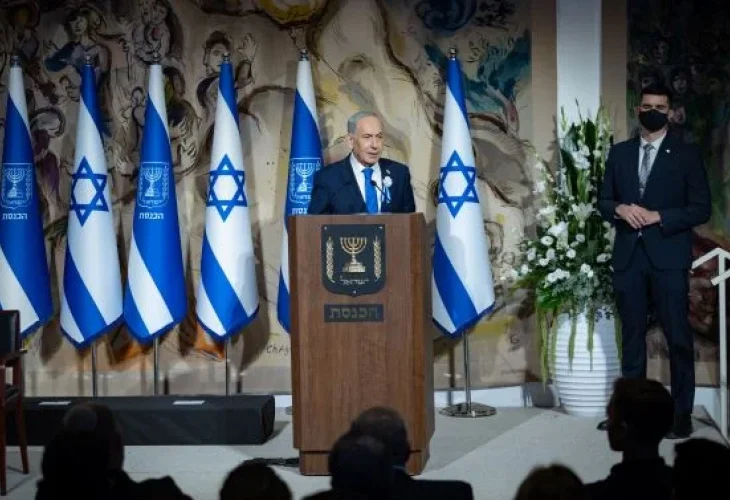 (Photo: Chaim Goldberg, Flash90)
Prime Minister Benjamin Netanyahu delivered the opening address at the inaugural session of Israel's 26th Knesset on Tuesday evening, calling for the establishment of a national unity government to confront the major security challenges facing the country.
Netanyahu began by addressing President Isaac Herzog and his wife, Michal, Knesset Speaker Amir Ohana, Supreme Court President Justice Yitzhak Amit, Opposition Leader Yair Lapid, government ministers, current and former Knesset members, and the families in attendance. "The 26th Knesset has opened under the shadow of major threats to the State of Israel, despite the severe blows we have dealt Iran," he declared.
The prime minister warned that Tehran remains committed to its goal of destroying Israel and is working to rebuild its nuclear program despite the damage inflicted during recent military operations. "Iran has not abandoned its plan to destroy Israel. After we pushed back the immediate existential threat posed by Iran's nuclear program, Iran is now working to restore it," Netanyahu said. "The only way to eliminate this existential threat permanently is to overthrow the ayatollah regime."
Netanyahu Highlights Military Achievements Against Iran and Its Allies
Netanyahu credited Israel's military achievements to the courage of its soldiers, the resilience of the Israeli public, and decisions made by his government. "Thanks to the heroism of our soldiers, the steadfastness of our people, and the courageous decisions we made in the government, we have achieved tremendous accomplishments," he said.
The prime minister listed a series of military and strategic successes, including the elimination of senior Hamas leaders Mohammed Deif, Ismail Haniyeh, and Yahya Sinwar, Hezbollah leader Hassan Nasrallah, and Iranian Supreme Leader Ali Khamenei. He also cited the fall of Bashar al-Assad's regime in Syria, the elimination of senior Iranian scientific and military figures, and extensive damage to Iran's naval and air force infrastructure. "We dealt a very severe blow to Iran and the axis of evil. We changed the face of the Middle East," Netanyahu declared.
However, he cautioned that Israel would soon face mounting international pressure to accept a nuclear-armed Iran and the continued existence of a regime seeking its destruction. He also warned of pressure to relinquish Israel's military gains, particularly the security zones established during recent operations.
"In the near future, we will face international pressure to accept a nuclear Iran and the continued existence of the regime of terror that seeks to destroy us," he said. "We will also face pressure to withdraw from our tremendous achievements, including our major accomplishment in the security zones."
Against this backdrop, Netanyahu urged lawmakers to put political differences aside and form a broad coalition capable of addressing the challenges ahead. "Faced with these threats, we must do one thing in this house: set aside every other consideration and establish a national unity government. Only such a government will be able to confront challenges of this magnitude," he stated.
Netanyahu Warns Against Coalition Dependent on Arab Parties
The prime minister also sharply criticized opposition efforts to establish a government with the support of Arab political parties, arguing that such a coalition would be incapable of addressing Israel's security challenges.
"We cannot rely on a government of people who hate Israel, and I am not talking about Arabs, but about those who hate Israel," Netanyahu said. He also called for an investigation into alleged foreign interference in Israel's elections.
Addressing reports of plans to establish a narrow coalition, Netanyahu warned against including parties or lawmakers whom he characterized as supporters of terrorism. "There is talk in the Knesset about establishing a narrow government with supporters of terrorism. It is impossible to confront these threats with a government that includes supporters of terrorism," he declared.
Netanyahu further argued that there was no meaningful distinction between the Joint List and the United Arab List, also known as Ra'am, which he described as only supposedly moderate. He claimed that some of the political figures whose support such a government might depend on have portrayed Hamas as a "charitable organization" and, according to his allegations, denied the massacres and acts of violence committed by the terrorist group.
Netanyahu's address highlighted the political divisions surrounding the formation of Israel's next government, even as he called for national unity in response to the country's ongoing security challenges.
 Israel NewsNetanyahu Calls for Broad Unity Government to Confront Israel's Security Threats
 Israel NewsNetanyahu Calls for Right-Wing Government After Israeli Election Results
 Israel NewsTrump Open to Helping Netanyahu Form National Unity Government
 Israel NewsNetanyahu to IDF Brass: "The Job Isn’t Finished. Two Big Threats Still Loom from Lebanon"

