

Interesting
How Trees Communicate Underground: The Hidden Network Connecting Forests
Discover how trees share nutrients through underground fungal networks, the role of “mother trees,” and what new research reveals about the surprising connections beneath forest floors
- Shira Priant
- | Updated
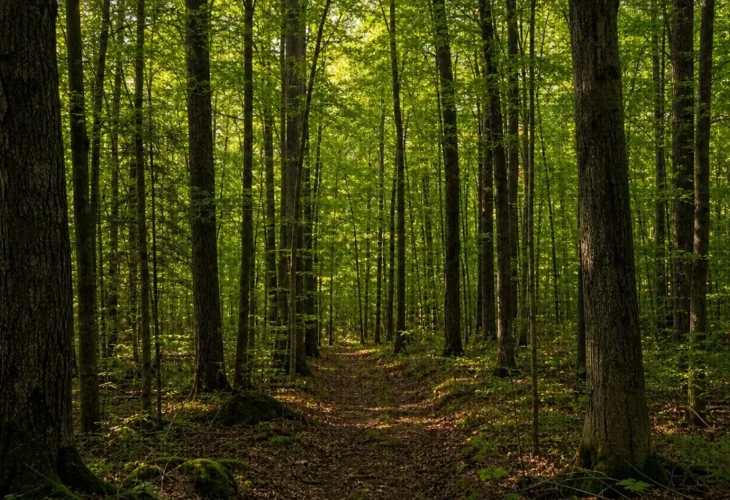
Research conducted over the past two decades at the University of British Columbia has challenged traditional ideas about how forests function. Ecologist Dr. Suzanne Simard has demonstrated that beneath the forest floor lies an intricate biological network of fungal threads that connects tree roots, allowing nutrients and carbon to move between trees and potentially enabling the exchange of chemical signals.
Rather than existing solely in competition for sunlight, water, and nutrients, trees can also participate in complex ecological relationships that help sustain the forest around them.
How the Underground Network Works
The system is built on a mutually beneficial relationship between trees and soil fungi, known as mycorrhizal symbiosis. Because fungi cannot produce their own food through photosynthesis, they extend fine threads called hyphae through the soil, absorbing water and minerals that they provide to tree roots. In exchange, the trees supply the fungi with sugars produced through photosynthesis. These fungal networks can connect the roots of neighboring trees, creating underground pathways through which carbon and nutrients can move between plants.
In experiments conducted by Simard, researchers observed seasonal exchanges between birch and fir trees. During the summer, when young fir trees were shaded, nearby birch trees transferred carbon to them. In other seasons, the direction of carbon transfer could reverse, demonstrating the dynamic nature of these underground connections.
The Role of “Mother Trees”
Not all trees occupy the same position within these networks. Simard has identified large, mature trees that serve as important connection points, referring to them as “mother trees.” These older trees can be linked through fungal networks to numerous surrounding plants, including younger seedlings. Her research suggests that mature trees may preferentially support genetically related seedlings, potentially directing more resources toward their own offspring.
Simard has also investigated what happens when older trees are injured or begin to die. Her findings suggest that carbon may be transferred from declining trees to neighboring plants through shared fungal networks. Other research has explored whether plants connected through these networks can transmit chemical signals that help neighboring plants activate defenses against pests or disease. However, scientists continue to debate how widespread these processes are in natural forests and whether the transfers consistently benefit the receiving trees.
A New Understanding of Forest Life
Simard's research has attracted considerable attention, but her terminology has also sparked debate within the scientific community. Expressions such as “forest intelligence,” “communication,” and “mother trees” have been criticized by some researchers as potentially attributing human-like intentions to biological processes.
Simard, however, maintains that the language of communication helps convey the significance of the interactions observed in her research, including the movement of resources and potential defensive signals between plants. She also believes that making these ecological relationships understandable to the public can encourage greater environmental awareness and more responsible forest management.
“We as humans can relate to this better,” she explained. “If we can relate to it, we will care about it more, and we will do a better job of managing and conserving our landscapes.”
While many questions remain about the extent and significance of underground fungal networks, the research has helped reshape scientific discussions about forests, highlighting the intricate relationships between trees, fungi, and the ecosystems they form.
 InterestingShampoo Ginger: The Fascinating Plant That Produces Natural Shampoo
 InterestingGlowing Mushrooms: The Mysterious Fungi That Light Up in the Dark
 InterestingUnderwater Sniper: The Fish That Shoots Down Its Prey
 InterestingAustralia's Pink Lake: How Heavy Rain Transforms the Desert Into a Colorful Wonderland

