

Raising Children
The Age Children Start Using Social Media May Affect Their Grades, Study Finds
A new study involving more than 5,000 students links early social media use to lower academic performance, with some achievement gaps equivalent to half a year of schooling
- Yitzchak Eitan
- | Updated
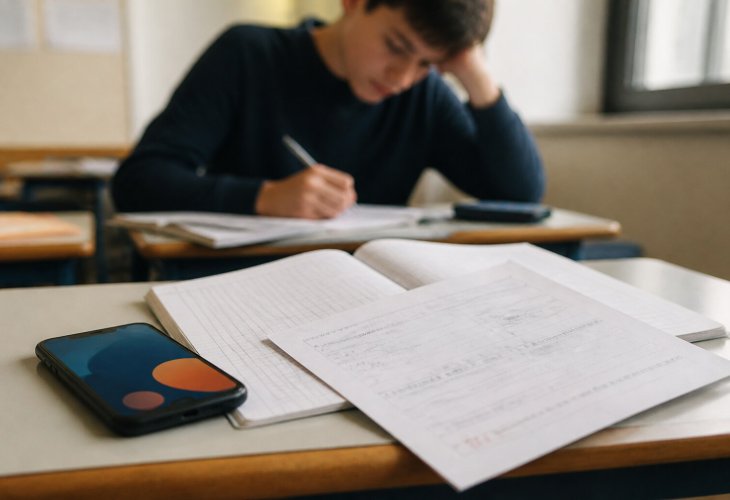
Almost every parent of a teenager has heard the familiar complaint at some point: "Everyone else is on social media, and I'm not." But a new study from Italy suggests that when it comes to social media, what matters is not only how much time children spend online, but also the age at which they begin using it.
Published in the scientific journal Nature Human Behaviour, the study was conducted by researchers at the University of Milan. The researchers surveyed thousands of 10th- and 11th-grade students in northern Italy, asking when they first opened a social media account and when they received their first smartphone. Their responses were then compared with their scores on national standardized tests throughout their school years. The final analysis included 5,227 students.
Early Social Media Use Linked to Lower Academic Performance
The findings revealed that 11% of students had opened their first social media account while still in elementary school, while 98% owned a smartphone by the end of eighth grade.
The researchers compared children who began using social media at an early age with students from similar backgrounds who waited until ninth grade or later. Those who opened an account in sixth grade performed worse in both language and mathematics by eighth grade, with the achievement gap in mathematics widening further by tenth grade.
According to the researchers, the difference was equivalent to approximately half a year of schooling. Students who began using social media in seventh or eighth grade showed smaller differences in academic performance. Early users were also more likely to repeat a grade and reported lower confidence in their academic abilities.
How Smartphones May Affect Learning
The researchers also examined possible explanations for the connection between early social media use and lower academic achievement. A significant part of the association appeared to be linked to everyday smartphone habits, particularly checking phones before bedtime or while completing homework.
The findings suggest that the potential impact of social media extends beyond the amount of time children spend online. The constant presence of smartphones during activities that require concentration, as well as before sleep, may also play an important role in academic performance.
What Can Parents Do?
The researchers recommend providing clearer guidance to parents and schools, particularly families from disadvantaged backgrounds. One of their key recommendations is to delay children's introduction to social media for as long as possible.
Parents may also benefit from coordinating with other families in their children's classes. When several families agree to establish similar boundaries, children may feel less pressure to join social media simply because their peers are already using it.
Creating screen-free areas at home can also help. Keeping smartphones away from beds and homework desks may reduce distractions, while establishing a shared family charging station in the living room can encourage healthier habits. Rather than imposing sudden restrictions, parents are encouraged to introduce changes gradually, with clear expectations established in advance.
Although the study does not prove that early social media use directly causes poorer academic performance, its findings suggest that delaying access to social media and establishing healthy smartphone habits may help support children's learning and academic confidence.
 MagazineA Week Without Smartphones: What Happens When Teenagers Disconnect
 Raising Children5 Simple Ways to Reduce Screen Time for Kids and Families
 Raising ChildrenThe Power of Forgiveness: Why Letting Go of Blame Matters in Parenting
 Raising ChildrenParenting Struggling Teens: The Mistake Many Parents Make

