

Parshat Vayishlach
Why Did Jacob Wrestle With an Angel? On Faith, Courage, and Redemption
Explore the deeper meaning of Jacob’s struggle with Esau’s angel, his transformation into Israel, and how his injury and victory foreshadow the Jewish people's suffering in exile and ultimate redemption
- Yosef Yaavetz
- | Updated
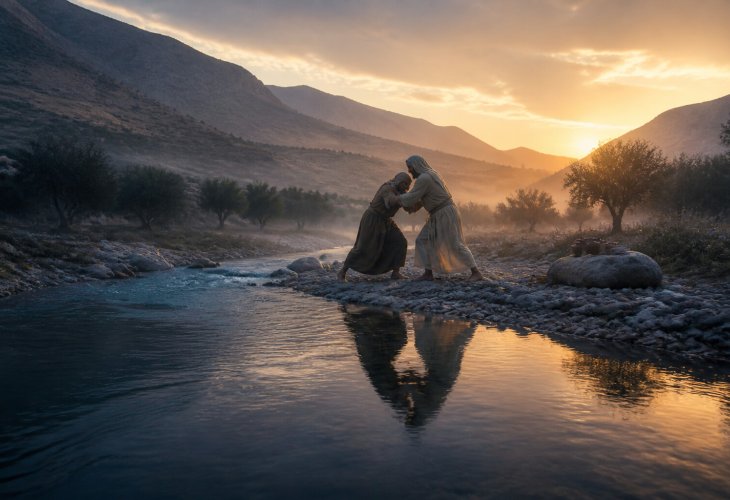
The caravan had already crossed the Jabbok River. Jacob had sent his family ahead and remained behind to oversee the transfer of his possessions. Once his servants had completed their work, he found himself alone on the other side of the river. Chazal explain that Jacob had returned to retrieve several small vessels he had left behind. Abarbanel offers a symbolic interpretation: In Jacob's eyes, everything he had accumulated in Haran was no more than a collection of "small vessels" compared to his family and the spiritual legacy he carried. It was precisely at this moment, standing alone beside the river, that the struggle destined to give him a new name began.
Several hours earlier, the messengers Jacob had sent to the land of Seir had returned with alarming news: "We came to your brother Esau, and he is also coming to meet you, accompanied by four hundred men" (Genesis 32:7). The Torah immediately tells us, "Jacob was greatly afraid and distressed." Yet this was the same Jacob whom Hashem had assured, "Behold, I am with you, and I will protect you wherever you go" (Genesis 28:15). In his prayer, Jacob himself recalls Hashem's command to return to his homeland and His promise to deal kindly with him. How could Jacob reconcile his fear of Esau with his trust in Hashem's protection?
True Courage Does Not Mean Being Fearless
Drawing on Aristotle's teachings on ethics, Abarbanel explains that courage is not the absence of fear, but the willingness to confront a danger one fully understands. A warrior who believes he cannot be harmed may be reckless rather than brave. Similarly, generosity is meaningful when a person values his possessions yet willingly parts with them. The true measure of an action lies partly in what it demands of the person performing it.
Jacob's fear arose from his natural instinct for self-preservation, while his decision to continue was guided by reason and trust in Hashem's promise. He could have fled, sought refuge in a fortified city, or asked his father Isaac to intervene with Esau. Instead, he prepared to meet his brother, dividing his camp, praying, and arranging gifts to send ahead. As Abarbanel writes, Jacob "strengthened himself and went to meet his brother."
The Nighttime Struggle That Changed Jacob's Name
Beside the Jabbok River, the danger became tangible. "A man wrestled with him until the break of dawn" (Genesis 32:25). The Hebrew word vaye'avek, meaning "he wrestled," can be understood as a reference to the dust (avak) raised by two opponents struggling against each other. Alternatively, it can describe two people locked together in a physical embrace, each attempting to overpower the other.
At the end of the night, Jacob declares, "I will not let you go unless you bless me." His insistence reveals who has emerged victorious. A wrestling match may end when one opponent throws the other to the ground, but it can also end when the defeated opponent acknowledges the victor's strength. Jacob demands that acknowledgment from the mysterious figure confronting him.
The man, or angel, responds: "Your name shall no longer be called Jacob, but Israel, for you have struggled with God and with men, and have prevailed" (Genesis 32:29). The significance is unmistakable: Jacob has triumphed. The name Jacob evokes someone who follows at another's heel, attempting to grasp his brother's foot. Israel, by contrast, represents victory, both spiritual and physical. He has struggled with divine and human forces and prevailed.
Was Jacob's Struggle a Dream or a Physical Encounter?
Abarbanel examines a longstanding disagreement among earlier commentators concerning the nature of Jacob's struggle. Did it take place physically, while Jacob was awake, or was it a prophetic vision?
Maimonides, in The Guide for the Perplexed (1:43), interprets the encounter as a prophetic vision, connecting it to Jacob's meeting with the angels at the end of Parashat Vayetzei. Nachmanides challenges this interpretation by pointing to Jacob's limp the following morning. How could an injury sustained in a dream leave a physical mark on his body?
Abarbanel initially responds that even an experience occurring during sleep can produce a genuine physical reaction. Nevertheless, his own position is that Jacob's struggle took place while he was awake, in what he describes as a tangible prophetic experience perceived through the senses. This interpretation gives particular significance to Jacob's solitude, his naming of the location afterward, and the severe injury to his thigh that hindered his ability to walk. Even the sunrise becomes part of the event. Abarbanel explains that the warmth of the sun helped Jacob regain his ability to walk despite his limp, offering an interpretation of Chazal's teaching that the sun rose specifically for his benefit.
The Angel of Esau and the Future of the Jewish People
Chazal identify Jacob's mysterious opponent as the guardian angel of Esau. Abarbanel clarifies that this refers not merely to Esau as an individual, but to the spiritual representative of the nation destined to descend from him, similar to the heavenly princes associated with various kingdoms in the Book of Daniel.
The nighttime struggle therefore extends far beyond the impending reunion between two brothers. Jacob receives a message about the confrontation awaiting him the following morning, but also a prophetic glimpse into the distant future of his descendants. The angel attempts to overpower Jacob but cannot defeat him. Nevertheless, he succeeds in injuring Jacob's thigh, which Abarbanel interprets as a symbol of Jacob's descendants, drawing on the biblical expression "those who came from Jacob's thigh" (Exodus 1:5).
The injury foreshadows the suffering that the Jewish people will endure throughout their long exile, while Jacob's survival represents their ability to withstand these hardships. The breaking of dawn, meanwhile, symbolizes the end of exile and the arrival of redemption.
Jacob emerges from the struggle wounded but undefeated. His limp remains a reminder of the suffering that lies ahead, while his new name, Israel, testifies to the strength that will enable his descendants to endure. The darkness of the night may be prolonged, but it will ultimately give way to the light of redemption.
 Parshat VayishlachParashat Vayishlach: The Meaning of Gid Hanasheh and the Promise of Redemption
 Parshat Lech-LechaWhy Did Abraham Have to Leave His Homeland? The Abarbanel on Lech Lecha
 History and ArchaeologyThe Holy Language: Why Hebrew Is Sacred
 Facts in JudaismWho Was Amalek? The Bible’s Ancient Enemy

