

History and Archaeology
The Lost City Beneath the Sea: The Story of Ancient Tyre
Once one of the wealthiest cities in the world, Tyre was ultimately reduced to ruins both above and below the water.
- Yehosef Yaavetz
- | Updated
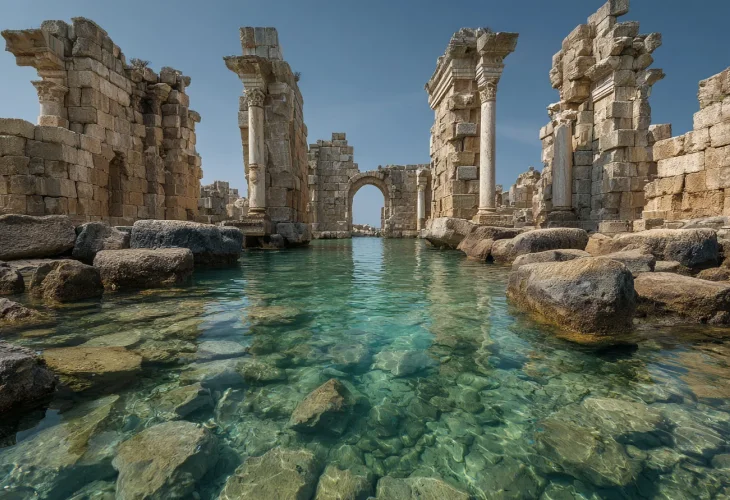
For centuries, the ancient city of Tyre was considered one of the most powerful and secure cities in the world. Surrounded by the sea and protected by formidable defenses, it seemed untouchable. Yet centuries before its downfall, the prophet Yechezkel described in remarkable detail what would happen to the proud Phoenician stronghold. The story of Tyre's destruction remains one of the most fascinating examples of a biblical prophecy that appears to have unfolded in history with extraordinary precision.
The Mighty City That Trusted the Sea
The city of Tyre was one of Israel's adversaries toward the end of the First Temple era and beyond. Although King Hiram of Tyre maintained a close alliance with King Solomon, later generations abandoned that friendship and often sided with Israel's enemies.
The Tyrians were renowned sailors, merchants, and shipbuilders. Their wealth flowed from international trade, and their island fortress in the Mediterranean was considered virtually impossible to conquer. Protected by strong walls and surrounded by water, Tyre seemed invincible.
At the height of its power, the prophet Yechezkel devoted an entire section of his prophecy to the city. While describing its wealth and influence, he also delivered a startling prediction: Tyre's walls would be destroyed, its houses demolished, and even its stones, timber, and soil would be thrown into the sea.
The prophecy concludes with a dramatic declaration:
"I will make you a bare rock; you shall be a place for spreading nets. You shall never be rebuilt."
Alexander the Great's Unlikely Siege
In 332 BCE, Alexander the Great arrived at Tyre.
The city's inhabitants were unimpressed.
Alexander commanded one of history's most successful armies, but he faced a serious problem: Tyre sat on an island nearly half a mile offshore. The Tyrians possessed a powerful navy, while Alexander had virtually no fleet at all.
From a military perspective, conquering the city seemed nearly impossible.
Alexander responded with an extraordinary plan.
He ordered his soldiers to dismantle the abandoned mainland portion of Tyre completely. Buildings were torn down stone by stone. Timber, rubble, and soil were gathered in enormous quantities.
Then came the surprising command: throw everything into the sea.
Over many months, Alexander's army built a massive causeway connecting the mainland to the island fortress. Using the remains of the city itself, they gradually created a land bridge across the water.
Once the causeway was completed, Alexander's forces stormed the island and captured Tyre.
In a striking historical parallel to Yechezkel's prophecy, the city's stones, timber, and soil were literally cast into the sea.
A City Lost Beneath the Water
Yet the story may not have ended there.
In a later chapter, Yechezkel describes Tyre as being "destroyed in the midst of the sea" and speaks of its multitude falling into the depths of the waters.
For generations, commentators wondered whether part of the ancient city had actually sunk beneath the Mediterranean.
In 1997, Lebanese diver Muhammad al-Sarji made a remarkable discovery off the coast between modern-day Tyre and Sidon.
Beneath the water, he found carved stone blocks, streets, walls, harbor structures, building foundations, and even burial sites. Further surveys revealed what appeared to be portions of an ancient submerged city resting several meters below the surface.
Today, underwater remains of ancient structures can still be seen in the area, including walls, plazas, water installations, and sections of a harbor that disappeared beneath the sea long ago.
Remarkably Described Centuries Earlier
What makes the discovery even more intriguing is that long before modern archaeology, Jewish scholars and travelers wrote about seeing remnants of Tyre beneath the water.
The Abarbanel, commenting on Yechezkel, wrote that the city's foundations and buildings could still be seen beneath the sea.
The famous Jewish traveler Benjamin of Tudela described viewing towers, streets, markets, and palaces visible beneath the water from passing ships.
Other historical travelers reported seeing large submerged ruins, ancient buildings, and remnants of a once-great city lying beneath the Mediterranean.
The Prophecy That Refused to Disappear
The story of Tyre remains one of the most discussed historical episodes connected to biblical prophecy.
Part of the city was dismantled and cast into the sea to build Alexander's causeway. Another part appears to have disappeared beneath the waters, becoming a submerged archaeological site visible to divers and researchers thousands of years later.
For many readers of Yechezkel, the fate of Tyre serves as a powerful reminder that wealth, military strength, and seemingly impenetrable defenses are never a guarantee of permanence.
The mighty city that once ruled the seas ultimately became exactly what the prophet described: a place remembered more for its ruins than for its glory.

