

World News
France Unveils a New Kind of Tank Defense for the Drone Age
At a major arms expo in Paris, the French military introduced an upgraded Leclerc tank with a dedicated anti-drone protective cage—offering a glimpse of how armored warfare is changing in an era shaped by explosive drones and artificial intelligence.
- Yuval Aviv
- | Updated
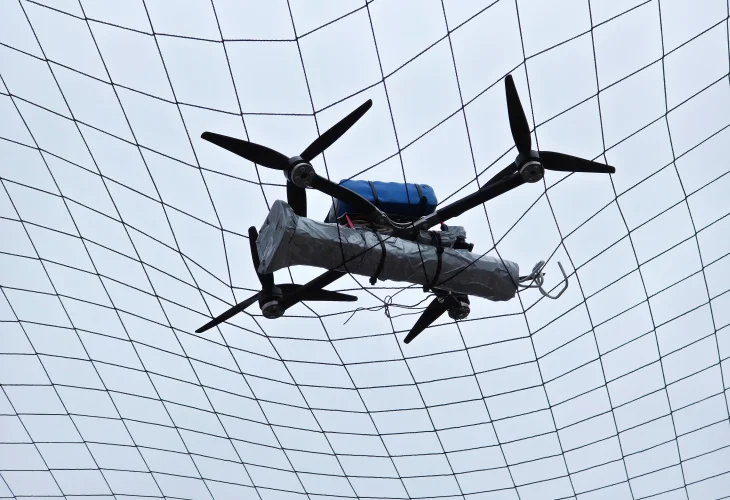 Explosive drone (Credit: shutterstock)
At the international arms exhibition Eurosatory 2026, the French military unveiled a new and upgraded version of the Leclerc tank, featuring an unusual protective measure that has become an integral part of modern battlefields in recent years: a metal "cage" installed above the tank’s turret, designed to reduce the growing threat posed by attacking explosive drones.
The new tank, the Leclerc XLR, reflects lessons learned in recent years from the Russia-Ukraine war as well as from fighting in the Middle East, where drones have become one of the main threats to armored forces. The overhead protective measure, which previously drew ridicule on social media when it first appeared on Russian tanks in 2022, is now receiving broad recognition after proving effective in many cases.
The head of the French military’s technical development division, General Olivier Koka, said during a briefing for reporters in Paris that the prototype of the system was developed by the army’s research unit, and that serial production has already begun at KNDS France. According to him, the protection systems are already in the process of being supplied to the French army’s armored units.
The purpose of the cage is to create an additional layer of protection between the drone’s warhead and the roof of the tank. By creating distance between the charge and the armor, it is possible to disrupt the angle of impact and even cause the charge to detonate early, before it strikes the turret directly. Even so, this is only a passive defensive measure, and it does not provide a complete solution for every scenario.
In France, officials note that experienced FPV drone operators can sometimes get around the defense. Unlike munitions that fall vertically from above, these drones are controlled in real time באמצעות משקפי מציאות מדומה, allowing them to be flown on a horizontal path and aimed at other weak points on the tank, including its sides, the engine area, or beneath the protective structure itself.
Israel has also accumulated similar experience in dealing with the threat. After the October 7 attack, the IDF installed nets and protective cages on Merkava tanks to shield sensitive areas of the turret. Later, amid the threat of Hezbollah explosive drones, improvised nets were deployed in southern Lebanon above positions and military vehicles, including parked tanks, with the goal of causing drones to explode at a safe distance from the forces. In the IDF, officials believe these protective measures proved themselves in the field, but they emphasize that this is only a partial solution in the face of ongoing efforts to bypass it.
Beyond the overhead protection, the Leclerc XLR is part of the "Scorpion" program to modernize French ground forces. As part of the upgrade, the tank received new computers, improved modular armor, and a remotely operated weapon station intended for combat in built-up areas. It is also equipped with the Galix system for creating smoke screens and deception, measures for protection against charges and mines, and electronic warfare systems for disrupting remotely controlled threats. The tank carries a 120 mm cannon, includes an automatic loading system, and is operated by a crew of only three soldiers.
At the same time as it upgrades its existing tank fleet, the French military is already planning the next generation of armored systems. The Leclerc is expected to reach the end of its operational life around 2035, while the MGCS system, being developed jointly with Germany, is only expected to enter service about a decade later.
General Koka elaborated on the future vision and made clear that the MGCS system "will certainly not be just a tank," but rather a broad platform that will integrate several systems operating together on a single network, alongside advanced artificial intelligence capabilities. According to him, the interim capability that France plans to develop in the coming years will in fact be "the first building block of the MGCS."

