

Evolution
From Atheism to Faith: Dr. Gottfried’s Unexpected Turning Point
What happens when a scientist begins asking deeper questions? This inspiring story follows one professor's search for truth.
- Yehosef Yaavetz
- | Updated
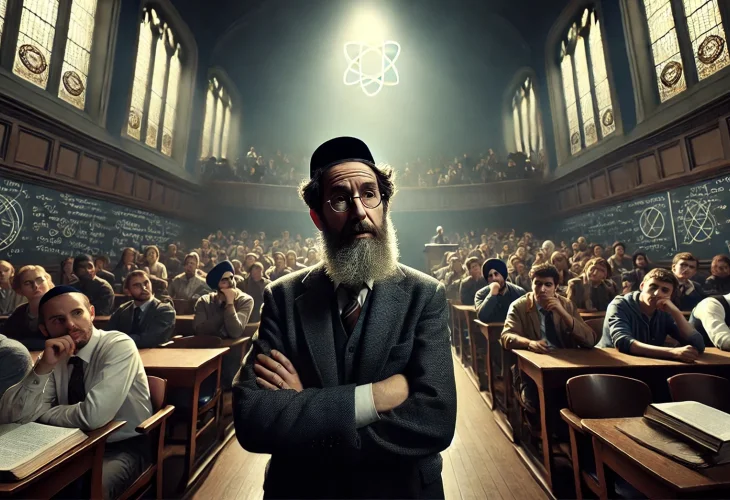
Today, Dr. Ernie Gottfried of Toronto, Canada, is known for his lectures on faith, science, and the relationship between the two. But there was a time when he passionately believed the exact opposite.
So what changed?
According to Gottfried, the journey began with a challenge to one of the most deeply rooted assumptions of his life.
"We All Have a Little Abraham Inside Us"
In one of his lectures, Gottfried reflected on the story of Abraham, who challenged the beliefs of his generation.
"Abraham was a zealot," he explained. "He was so committed to the truth that he smashed his father's idols. It nearly cost him his life, but ultimately his revolutionary idea — that there is one invisible, all knowing, all powerful Creator — transformed the world."
Gottfried believes that everyone experiences moments when they are forced to question ideas they once took for granted.
"We all have a little Abraham inside us," he said. "I had my own moment in the early 2000s. At first it seemed small, but it eventually turned into a storm."
Challenging a Scientific Dogma
The "idol" Gottfried sought to challenge was not a physical object.
"It was an idea."
By that point, he had earned a doctorate in zoology from the University of Toronto and had spent years immersed in the biological sciences.
Like many scientists, he accepted Darwinian evolution without hesitation.
"The truth is, I believed it completely," he recalled. "Without the slightest doubt."
The theory, which teaches that all living creatures developed through random mutations and natural selection over vast periods of time, was considered a foundational principle within modern biology.
Gottfried knew the subject thoroughly. Yet despite his confidence, an unexpected encounter would force him to reconsider some of his assumptions.
A Six Hour Conversation
The turning point came when he met an intelligent Chabad rabbi.
What began as a discussion turned into a six hour debate.
"He had answers to all my questions," Gottfried remembered. "And questions for all of my answers."
The conversation left a lasting impression.
For the first time, Gottfried found himself questioning ideas he had always considered certain.
"I came away confused," he admitted. "I was no longer the absolute atheist I thought I was, but I was still very far from accepting the Torah."
A New Direction
The debate sparked years of research and study.
Gottfried immersed himself in books, scientific literature, and discussions about faith and science. Gradually, he developed a growing interest in the relationship between traditional Jewish belief and scientific discovery.
Over time, he became a sought after lecturer on subjects such as cosmology, the age of the universe, and the scientific questions surrounding evolution.
One of his most popular lectures was titled "Evolution: Myths and Facts."
An Unexpected Challenge
During one university lecture, Gottfried stood before approximately one hundred students enrolled in his course on faith and science.
He had carefully prepared his presentation, but nothing prepared him for what happened during the question and answer session.
As soon as he invited questions, one student stood up and launched into a passionate criticism.
"It's unbelievable what this guy thinks he can get away with!" the student shouted.
Pointing at Gottfried, he continued:
"Look at him, with a beard and a kippah. He's trying to brainwash everyone. If what he's says is true, why doesn't every professor teach this way? We can't just sit here and stay silent."
The Students Respond
Before Gottfried could answer, another student spoke up.
An Asian student challenged the critic directly.
"What exactly is your problem with what he said?" he asked. "Are the scientific quotations inaccurate? Is there a problem with the mathematics?"
A second student, a Sikh wearing a turban, joined the discussion.
"Who's trying to preach here?" he asked. "Your accusations don't make sense."
The outspoken student looked around the room in surprise.
One after another, students defended the right to examine evidence and discuss ideas openly.
The confrontation quickly faded, and the lecture continued.
The Conversation That Followed
Rather than dismissing the student, Gottfried chose a different approach.
"I'd really like to hear more about your perspective," he told him. "I have an hour free before next week's lecture. Why don't we meet and continue the discussion?"
The student accepted the invitation.
Later, he visited Gottfried's home, where the two continued their conversation in a calmer setting.
According to Gottfried, the meeting became an opportunity not only to discuss science and faith, but also to explore Judaism on a deeper level. During the visit, the student even had the opportunity to put on tefillin and encounter Jewish tradition firsthand.
Following the Truth Wherever It Leads
Looking back, Gottfried sees his journey as proof that asking difficult questions should never be feared.
For years, he believed he had all the answers. Yet one honest conversation opened the door to an entirely new way of thinking.
His story serves as a reminder that genuine inquiry requires humility, curiosity, and a willingness to examine evidence wherever it may lead.
Sometimes, a single conversation can change the direction of a life.

