

World News
US Defense Chief Urges Europe to Take Responsibility, Warns of Funding Cuts
Hegseth's stark warning highlights the strain on US-Europe ties as allies face pressure to defend themselves and meet budget goals.
- Hidabroot
- | Updated
 Shutterstock
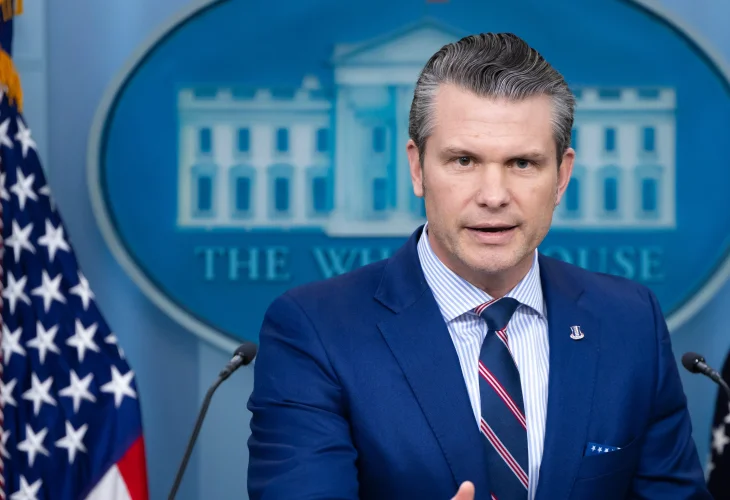
U.S. Defense Secretary Pete Hegseth sharply criticized NATO member states Thursday, announcing a sweeping six-month review of American troop deployments in Europe and warning that Washington's financial commitment to the alliance will be conditional on allies meeting their defense spending obligations. Speaking at a meeting of NATO defense ministers in Brussels, Hegseth declared that the alliance had become a "paper tiger" and called for a full reset to create what he described as "NATO 3.0."
"This will be a real review, and it is designed to ensure that NATO moves quickly and irreversibly toward a situation where Europe leads and accelerates its efforts to take primary responsibility for defending itself," Hegseth told his counterparts from the alliance's 32 member states. He said NATO required a complete "reboot" to produce an alliance that is "truly tough" and possesses "real military capabilities able to deter here on the continent and lead the conventional defense of Europe."
Hegseth traced what he called NATO's decline to the end of the Cold War, labeling the post-Cold War era "NATO 2.0," a period during which European countries, in his words, "hitched a free ride" on America's back. "Europe was never supposed to be dependent on the United States," he said. "That is not what Winston Churchill, Charles de Gaulle, or Konrad Adenauer wanted or expected. No, Europe was supposed to be a military power, with America as a strong ally." He also recalled that in 1951, Dwight Eisenhower had warned that if American soldiers had not been returned home from Europe within ten years, the entire effort would have to be judged a failure.
The secretary accused European governments of having invested in the wrong priorities. "Instead of tanks, fighters, and air defenses, Europe focused on gender equality, climate change, and austerity in defense spending. Europe's borders were thrown open, welfare states expanded, and defense budgets collapsed, along with Europe's belief in itself and its civilization," he said. The remarks closely mirrored a speech delivered by Vice President JD Vance in February of last year, which provoked widespread anger across the continent.
Hegseth also criticized NATO allies that refused to allow the United States to use their bases or airspace during the recent military confrontation with Iran, calling their behavior "shameful." "The U.S. has defended Europe for generations, and all the president asked was that our planes be able to take off from bases in Europe or from our ships in ports to strike targets in the Middle East - Iranian targets that threaten European interests even more directly than they threaten ours. But too many of our allies said no, or tried to drown us in complicated legal arguments, or criticized us publicly for doing what they are unwilling or unable to do themselves. That was shameful. Those allies are putting America's sons and daughters at risk by denying them the use of bases or air corridors that should never have been in question."
The remarks came weeks after the Trump administration announced it would no longer assist NATO countries with aircraft carriers, warships, aerial refueling aircraft, and dozens of fighter jets if one of them came under attack, a significant qualification of the alliance's collective defense commitment under Article 5. The Financial Times reported that Washington had recently presented detailed proposals to reduce the military capabilities allocated to NATO's force model, including the withdrawal of one of two aircraft carriers assigned to the alliance and all submarines capable of launching Tomahawk cruise missiles.
On burden-sharing, Hegseth was direct. "America cannot pay for NATO's defense more than our allies pay," he said, adding that where allies are not investing urgently enough, American financial contributions will be reduced. "NATO will be a two-way street," he stated. He praised member states on track to meet the agreed target of spending five percent of GDP on defense while making clear that countries lagging behind, including Spain, which has publicly refused to reach the target, would face consequences.
NATO Secretary General Mark Rutte pointed to a different picture, noting that European members and Canada had invested 90 billion dollars more in defense last year than in 2024, a 20 percent increase. The Associated Press noted that Hegseth's characterization of Europe's current policies did not fully match reality, pointing out that alliance members have undertaken an unprecedented effort to increase defense spending and that most European countries have tightened border controls significantly since the large migration waves of more than a decade ago. German Defense Minister Boris Pistorius described any withdrawal of American forces as "dangerous," warning that replacements could not be found quickly.
Belgium and several other member states declared their intention to invest in new equipment to fill any gaps left by an American drawdown, with European officials urging Washington to coordinate any troop withdrawals closely with them to allow adequate preparation time. The burden-sharing dispute is expected to dominate the agenda at the upcoming NATO summit, where pressure on lagging member states to accelerate spending commitments will be greater than at any previous gathering of the alliance.

