

For the Woman
Rabbanit Hedva Levy: A Journey of Faith, Compassion, and Transformation
Returning to Judaism, the power of leading with love instead of criticism, and the life changing impact of faith, women's gatherings, and authentic connection to God
- Tamara Carmiel
- | Updated
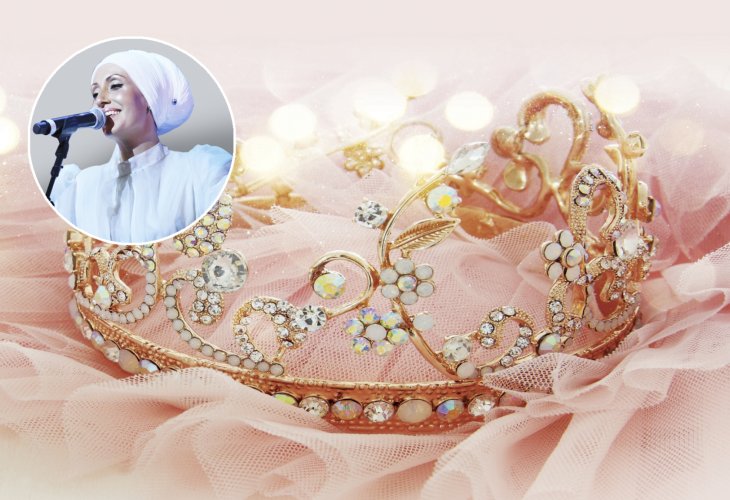 (In the circle: Rabbanit Chavah Levi)
Interviewing Rebbetzin Hedva Levy was no simple task. Although our conversation took place over the phone, I had no idea how much effort she and her secretary would invest just to clear a single quiet hour in her incredibly busy schedule. After nearly a week of trying, we finally found a brief window amid the constant whirlwind of her life — a life filled with travel across Israel, television recordings, radio and television hosting, performances, conferences, and family responsibilities. It sounds exhausting. And that is only the beginning.
Torah by Day, Performances by Night
"I've seen the world," Hedva says in the warm, melodic voice that has become her trademark. "My life was exciting and dynamic. I performed in concerts on some of the biggest stages, but I lived a divided life, and that was incredibly difficult."
She met her husband during their military service. "At some point he began growing closer to Judaism, and I was deeply drawn to it. I realized that his path would become my own. But I was still performing. The stage was an inseparable part of who I was, and I had no idea how to reconcile my two great loves, of God and the stage."
Although she grew up far from religious observance, Hedva says she always felt close to God. "From the age of six I spoke to God and practiced personal prayer. When I was eleven, I would sit in my room writing Him letters. I still have those journals today. There was always something deeper within me — a poetic soul that listened to melodies most people couldn't hear."
Looking back, she realizes she needed preparation for every major stage of life, including school, military service, marriage, but not for her relationship with God. "Returning to Judaism felt completely natural."
Even so, she never imagined becoming fully observant. "I thought I would keep Shabbat while wearing jeans and a T-shirt," she laughs. "If you had seen my wardrobe before I got married, with all my fashionable Alexis hats, you would never believe I'd one day replace it all with a headscarf. Honestly, neither would I."
Living Between Two Worlds
At the age of twenty-three, Hedva enrolled in a rigorous Lithuanian seminary in Bnei Brak, studying Torah every morning for two intensive years. Every afternoon she returned home from seminary, and every evening she headed out to another performance.
"The contrast was overwhelming," she recalls. "After performances, I'd come off stage and often burst into tears. Deep inside I knew it wasn't appropriate for me to perform before men. The gap between my mornings immersed in Torah and my nights on stage felt as difficult as the splitting of the Red Sea."
At twenty-five she married, stopped performing before men, and finally felt she had found the path that truly belonged to her.
The experience taught her one of life's greatest lessons.
"Never judge someone whose shoes you've never walked in. Every person faces different tests. We have no idea what another person's story is, so we should never speak from a place of superiority. Sometimes silence is the wisest response. And if we truly must say something, it should always be done with sensitivity and respect."
Don't Correct. Illuminate.
When asked whether there is a right way to correct someone, Hedva answers with a story.
"One winter, during a trip to Uman, we visited the grave of Rabbi Levi Yitzchak of Berditchev. While I was praying, I noticed a young woman approaching the grave wearing a very short dress. I immediately understood that she wasn't dressed that way out of disrespect. She simply didn't know."
Hedva worried someone might embarrass the young woman.
"When she bent down to kiss the grave, I quietly wrapped my large poncho around her and embraced her. We stood there praying together for several long minutes. I didn't say a single word. I simply looked into her eyes with kindness."
The following day they traveled to the grave of the Baal Shem Tov.
"When I saw her getting off the bus, I was deeply moved. She looked like an angel dressed in white, wearing a long skirt and a beautiful white coat that she continued wearing throughout the rest of the trip."
That experience taught Hedva a lesson she has never forgotten.
"Instead of correcting people, illuminate them."
Bringing Faith Through Art
Hedva recently began hosting a new television program on Hidabroot called To Be a Queen.
"The idea had been developing for a long time," she explains. "But we waited until Hidabroot completed its new studios with modern equipment because we wanted to create something at the highest professional level."
The result was a unique concept that combines faith and artistic expression.
"We're making faith accessible through art."
The production is created entirely by women. Hedva hosts the program and writes her own monologues, while the director, actresses, musicians, and guests are all women.
"It's truly a celebration of feminine creativity. But the purpose isn't simply to showcase women. Our goal is to strengthen women's connection with God."
Although the program received full rabbinic approval, including permission from Rabbi Dov Kook to appear on television, Hedva admits that she and the cast constantly examine themselves.
"We pray every day that everyone who watches will receive the messages exactly as they are intended, to be pure and sincere. Faith changes everything."
The Black Sheep
One of the productions featured on the program is The Black Sheep, which tells the story of a sixteen-year-old girl struggling after losing her father.
Her widowed mother, overwhelmed by grief and the burden of raising her family alone, becomes consumed by anxiety and stress. Every action of her daughter feels like another painful disappointment.
Yet the daughter herself is joyful, optimistic, creative, and deeply faithful.
"The tragedy," Hedva explains, "is that the mother becomes so focused on appearances that she misses the extraordinary child standing right in front of her."
The story gently challenges parenting approaches that place too much emphasis on external behavior while overlooking a child's inner world.
What It Means to Be a Queen
During one trip to Uman, a group of teachers from a Beit Yaakov school joined Hedva. One teacher later asked to speak with her privately.
"She told me she had never seen her own mother cry. She had grown up in a home where emotions were hidden, so she herself almost never cried."
After watching The Black Sheep, something inside her finally opened. "It was as though a dam had burst."
For Hedva, that moment perfectly captures the meaning behind the title To Be a Queen.
"True royalty isn't found in glamour or outward appearances. It comes from the inner place of authenticity, purity, and truth."
From Glitter to Meaning
Before becoming religious, Hedva lived in the glamorous entertainment world.
"I would change outfits four times in one evening, wear elaborate hairstyles and glamorous makeup, and put on spectacular shows. But inside I always knew something was missing. I needed a deeper connection."
Today, external appearances matter far less. "What matters most is conveying a message that comes from the soul."
The Transforming Power of Women's Gatherings
Hedva speaks passionately about the unique spiritual power of women's gatherings held in private homes.
"I believe what I've witnessed with my own eyes."
She describes these evenings as opportunities for Torah study, prayer, singing, dancing, blessings, heartfelt tears, and emotional healing.
"The atmosphere becomes so elevated that it's as though everyone boards a ship sailing toward a safe harbor. Within that protected space, women find hope, inner peace, and spiritual renewal."
She believes every woman deserves to experience such an evening at least once. "And be warned," she says with a smile, "it's addictive."
More Than Applause
Today Hedva mainly appears at large conferences and public events. Yet whenever she leads a women's gathering in someone's home, she still feels the same excitement.
"I know how we enter the evening," she says with a smile.
"But I never know how we'll leave."
And perhaps that is where the greatest miracles begin.

