

Personality Development
From Sinai to Today: The Unbroken Chain of Torah
From Moshe Rabbeinu to today, discover the chain of Torah transmission and the timeless lessons it carries.
- Rabbi Zamir Cohen
- | Updated
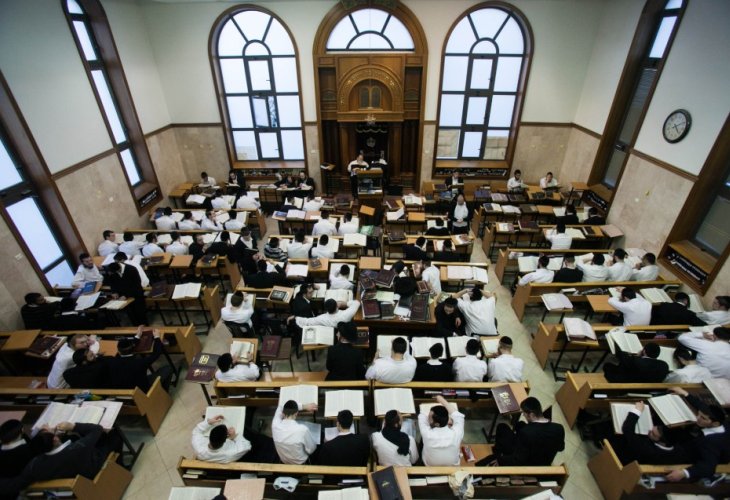 (Photo: Yonatan Sindel/Flash90)
"Moses received the Torah from Sinai and transmitted it to Joshua, Joshua to the Elders, the Elders to the Prophets, and the Prophets transmitted it to the Men of the Great Assembly" (Avot 1:1).
The Unbroken Chain of Torah
"Moses received the Torah from Sinai and transmitted it to Joshua" teaches that just as Moshe Rabbeinu received the Torah from Hashem at Mount Sinai, he passed it on to his student Joshua exactly as he had received it, without changing a single detail.
From that point onward, the Torah continued to be transmitted faithfully from generation to generation, all the way to our own day.
The Mishnah says that Moshe received the Torah "from Sinai" rather than "at Sinai." Our sages explain that this wording contains an important lesson. Pirkei Avot focuses heavily on character development and proper conduct, and Moshe learned a powerful lesson from Mount Sinai itself.
Why was the Torah given on Mount Sinai rather than on a taller, more impressive mountain?
Because Sinai was humble.
Anyone who wishes to acquire the crown of Torah must first develop humility. A humble person seeks truth rather than honor, and that quality enables him to understand the Torah properly. Since humility is the foundation of all good character traits, it serves as the gateway to genuine Torah learning.
Why Joshua Was Chosen
The Mishnah continues: "And Joshua to the Elders."
These are the Elders mentioned in the Book of Joshua: "Israel served Hashem all the days of Joshua and all the days of the Elders who outlived Joshua."
Initially, the Elders learned directly from Moshe Rabbeinu. After Moshe's passing, they continued learning under Joshua, who completed their Torah education and guided the nation. Following Joshua's death, they became the leaders of the generation.
Interestingly, Moshe originally assumed that one of his sons would inherit his position, just as kings typically pass leadership to their children. However, Hashem instructed him to appoint Joshua instead.
Why Joshua?
Because Joshua devoted himself entirely to serving his teacher. The Torah testifies that "Joshua bin Nun, a youth, did not depart from within the tent." Through constant dedication to Torah and service of his teacher, Joshua became worthy of leadership.
True Jewish leadership is not built merely on intelligence, political skill, or military strength. It is shaped through devotion to Torah.
The Era of the Prophets
After Joshua and the Elders came the era of the Prophets.
The prophets taught Torah, guided the nation, and served as the spiritual leaders of Israel. The righteous kings regularly consulted them and acted according to their guidance.
This continued throughout the prophetic period until the rise of the Men of the Great Assembly.
Who Were the Men of the Great Assembly?
The Men of the Great Assembly lived at the beginning of the Second Temple period.
Among them were the final prophets: Haggai, Zechariah, and Malachi. Their generation stood at a unique crossroads in Jewish history, bridging the era of prophecy and the era of the sages.
The Jewish people left Egypt in the year 2448 from Creation. Four hundred and eighty years later, King Solomon built the First Temple.
The First Temple stood for 410 years before being destroyed, after which the Jewish people spent seventy years in Babylonian exile.
During those years, Persia rose to power. Eventually, King Cyrus issued a decree allowing the Jews to return to Jerusalem and rebuild the Temple.
Many great leaders participated in this historic return, including Mordechai, Daniel, Chananiah, Mishael, Azariah, Ezra, and Nehemiah.
Although the rebuilding of the Second Temple faced fierce opposition from surrounding nations, the work continued with determination and urgency.
During this period, Ezra established the Great Assembly, a body of 120 outstanding sages and spiritual leaders.
Among them was Shimon HaTzaddik, who later became Kohen Gadol and is mentioned in the next Mishnah.
The Rambam writes that the Men of the Great Assembly included Haggai, Zechariah, Malachi, Daniel, Chananiah, Mishael, Azariah, Nehemiah, Mordechai, Zerubbabel, and many other great sages, totaling 120 members.
Incidentally, the modern Israeli Knesset takes both its name and its number of members from the Men of the Great Assembly. The difference, of course, is that the original assembly consisted of 120 towering spiritual giants, including prophets themselves.
Three Foundational Principles
After establishing the chain through which the Torah was transmitted, the Mishnah records three famous teachings of the Men of the Great Assembly:
"Be deliberate in judgment, raise up many students, and make a fence around the Torah."
These three principles remain as relevant today as they were thousands of years ago.
Be Deliberate in Judgment
A judge must never rush to conclusions.
Even if a new case appears identical to one he recently handled, a single small detail may completely change the ruling. That is why judges must carefully investigate every matter before issuing judgment.
Sometimes a person says something while intending one meaning, but the listener understands it differently. For this reason, Jewish law instructs judges to repeat what they have heard in order to confirm that they understood correctly.
But this teaching is not only for judges.
In many situations, every one of us serves as a judge.
Imagine a husband arrives home late after promising his wife he would be on time.
Immediately, conclusions begin forming:
"He doesn't care about me."
"He ignores my needs."
"He takes me for granted."
Then the Mishnah reminds us: Be deliberate in judgment.
Perhaps something unexpected happened. Perhaps he was delayed by circumstances beyond his control.
The same principle applies in parenting. Sometimes a child behaves poorly, and the parent immediately reacts with punishment. But if the parent pauses and tries to understand the reason behind the behavior, he may discover that the real problem lies elsewhere.
People who train themselves to judge carefully avoid countless mistakes and enjoy calmer, healthier relationships.
The Gemara illustrates this idea through a famous story about Rav Adda bar Ahavah. Seeing a woman dressed in what he believed was immodest clothing, he tore the garment from her. Only afterward did he discover that she was not Jewish and that he had acted hastily. The court required him to pay four hundred zuz in damages.
When he asked her name, she replied, "Matun."
Rav Adda responded, "Matun, Matun is worth four hundred zuz."
The word Matun means moderation and deliberation. His lesson was clear: taking a moment before acting can save a person a tremendous amount.
Raise Up Many Students
A person who teaches Torah should never say, "I've already done enough."
The greatest example is Rabbi Akiva.
After losing twenty four thousand students, he could easily have given up. He was already elderly and had suffered a devastating loss.
Instead, he started again.
He gathered five new students: Rabbi Meir, Rabbi Yehuda, Rabbi Yosei, Rabbi Shimon bar Yochai, and Rabbi Elazar ben Shamua.
From those five students, Torah spread throughout all of Israel.
Had Rabbi Akiva despaired, we would never have merited Rabbi Shimon bar Yochai, Rabbi Meir Baal HaNes, and many of the Torah teachings that continue to guide us today.
The lesson is simple:
Never underestimate the impact of teaching even one more student.
You never know from whom the next great light of the Jewish people will emerge.
Make a Fence Around the Torah
The final teaching is: "Make a fence around the Torah."
A fence protects what is valuable.
Just as governments create safety barriers to prevent people from danger, the sages established safeguards to help Jews avoid violating Torah prohibitions.
The Torah itself commands us to do so: "You shall keep My charge"—which our sages explain as a command to create protective safeguards around Torah observance.
These safeguards include many familiar rabbinic mitzvot, such as lighting Chanukah candles, reading Megillat Esther, and washing hands before eating bread.
A person should never dismiss these mitzvot as merely rabbinic.
The Torah commands us to listen to the sages, as it says: "Do not turn aside from the word that they tell you, right or left."
The Gemara therefore asks: Where did Hashem command us to light Chanukah candles?
The answer is: Through the Torah's command to follow the guidance of the sages.
Hashem entrusted the sages with the responsibility of establishing protections and boundaries, and He commanded us to heed their words.
For this reason, the Rambam writes that someone who disregards a rabbinic mitzvah is also violating the Torah's command to obey the sages.
The Men of the Great Assembly left us with three timeless principles: think carefully before judging, invest in teaching others, and protect the Torah through wise safeguards. Together, these teachings continue to shape Jewish life thousands of years after they were first spoken.

