

Parents and Children
The Song They Chose Not to Sing
A preschool graduation skipped its traditional "Mom song" to spare one grieving child—and taught everyone else a lesson in compassion.
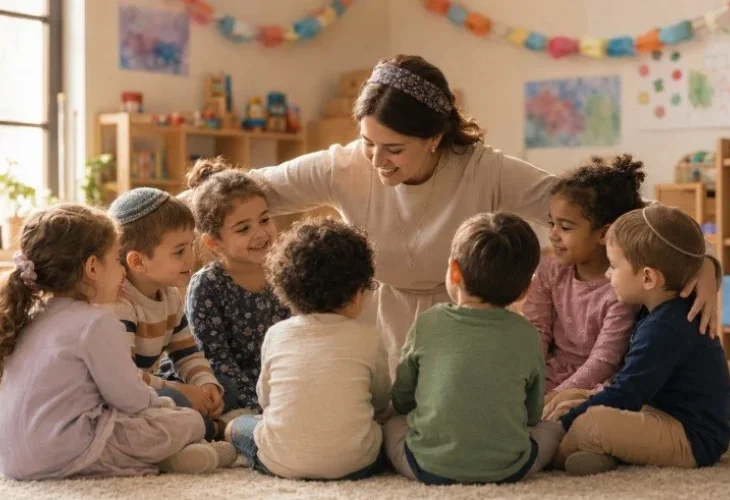
I'm not a huge fan of preschool graduation parties. To be fair, I've been lucky: my children have generally been the cooperative kind. They sing most of the songs, happily perform the hand motions the teacher has practiced with them, and actually enjoy the festivities instead of getting stressed by the break in routine. Even so, spending two hours or more perched on a tiny chair while maintaining an enthusiastic smile isn't exactly my idea of a good time.
And yet I've never missed an end-of-year celebration. Because every such party, I know, will eventually get to the “Mom songs”: The songs celebrating each child's wonderful, amazing mother. The preschoolers, still years away from adolescence (which, these days, seems to begin somewhere around second grade), sing with complete conviction that there's no one in the world like Mom. Then they run into their mothers' arms for a dance together, or at the very least, a hug.
I've never conducted a formal survey, but every mother of preschoolers I've ever talked to seems to feel the same way. Some enjoy these parties more than others, but they all agree that the "Mom song" is the emotional high point of the event.
Not long ago, though, a friend told me that this moment was missing from her three-and-a-half-year-old son's graduation party. She wasn't upset about it. Of course she would have loved the usual songs for Mom, but she thought the reason for leaving them out was absolutely the right one.
Half a year earlier, one of the children in the class had lost his mother after a long illness. The staff couldn't bear the thought of him sitting through a celebration where all his classmates sang about their mothers and then rushed into their arms. His father was there, of course—but a father is a father, and those songs celebrate mothers. So there would be no "Mom song." In fact, there would be no mention of mothers at all during the party.
My friend loves those "Mom is the best in the world" moments just as much as I do, yet she supported the preschool's decision completely. And, she says, so did every other mother. A child who has lost his mother? Nothing was worth forcing him to confront such a vivid reminder of his loss. So the celebration would be about the children, about summer, about joy—but not a single word about Mom.
The story moved me not only because of the staff's decision, but because of the wholehearted support it received from the other parents. Sometimes it feels as though we live in an age of unprecedented self-interest: news reports occasionally describe schools struggling to enforce even basic rules about life-threatening allergens because some parents refuse to cooperate. All they see is their own child and their own child's preferences. How different this story was! Here, an entire preschool community insisted on seeing one little boy—the one who no longer had a mother.
Perhaps it's no coincidence that this happened in Israel, where mutual responsibility is more than just a slogan. Every child belongs first and foremost to his or her parents, but in a sense, every child belongs to all of us. And that applies particularly to orphans. For thousands of years, Jewish tradition has taught extraordinary sensitivity toward orphans. The Torah commands, "You shall not afflict any widow or orphan" (Exodus 22:21). Maimonides expands on this obligation: "How should one treat them? One should speak to them only gently, treat them only with honor, never cause them pain or provoke them... One must be especially careful with them... whether orphaned of a father or of a mother."
Yet I don't think the preschool's decision—the determination to shield this little boy's feelings—stemmed only from a sense of collective responsibility or the Torah's special concern for orphans. I think it also reflected a deeply Jewish reluctance to cause another person pain, even if that person is a three-year-old child who may not yet fully understand where his mother has gone.
"Love your neighbor as yourself" is, as Rabbi Akiva famously taught, a fundamental principle of the Torah. It asks us to step into another person's shoes, to imagine what they are carrying, and then to do our utmost not to press on their bruises, but instead to treat them with the same tenderness and sensitivity we would hope others would show us.
At that graduation party, there was no song for Mom. And yet, in a way, the entire celebration became a tribute to motherhood—to the children's mothers, and to the preschool staff as well. Its unspoken message was simple: we cannot give this little boy his mother back. But we can surround him with every kindness possible, so that he does not have to endure any more pain than he already has.
That, perhaps, is what the Torah asks of us. Not to change what cannot be changed, but to do everything within our power to help bring healing where healing is still possible.

