

Israel News
Second Potential Red Heifer Born in Golan Ahead of Tisha B’Av
The calf’s birth alongside a male twin has created a new halachic question over whether an unseen congenital condition could disqualify it
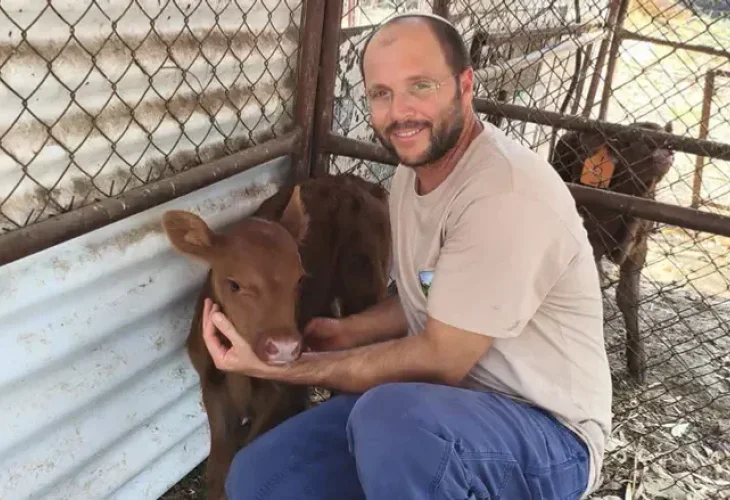
The National Institute for Red Heifer Research announced Tuesday that a second potential para aduma has been born in the Golan Heights, approximately a month and a half after another candidate was discovered in northern Israel.
The calf was born in the herd of Shay Givon, the institute’s cattle farmer, and was not fitted with an ear tag because the birth was closely monitored. The animal has not been declared halachically valid and will require continued physical and rabbinic examination.
Unlike the previous calf, the new candidate was born as the female twin of a male calf, creating a separate and complex halachic question. Female calves born alongside male twins frequently develop a condition known as freemartinism, in which shared blood circulation and hormonal exposure in the womb can prevent the female reproductive system from developing normally.
The condition leaves the female infertile in roughly nine out of ten such cases. Rabbis must now determine whether an internal congenital condition that cannot be seen externally constitutes a blemish that would disqualify the animal under halacha.
“The question is whether a congenital defect that is neither external nor visibly apparent on the cow’s body invalidates its unblemished status, both in relation to sacrifices generally and specifically in relation to the para aduma,” said Rabbi Azaria Ariel, head of the institute’s beit midrash.
The issue will first be examined by the institute’s panel of approximately 20 rabbis before being brought to senior halachic authorities. No ruling has yet been reached.
Givon, who is involved in cattle breeding and artificial insemination, said the institute is seeking to establish a permanent breeding program rather than depend on individual calves appearing by chance.
“We are on the way to raising a herd of red heifers,” he said.
Two additional red cows were inseminated at Ancient Shiloh this week as part of that effort. The institute has not announced whether either animal is pregnant.
Givon said the two recent births had generated interest from Jewish communities in Israel and abroad.
“I feel that we are living through a historic period,” he said. “Since the last calf was born, I have received inquiries and questions from across the Jewish spectrum in Israel and abroad — Hasidim, Lithuanian haredim, secular Jews and religious Jews.”
“The people of Israel are awakening more than ever to the subject of the Temple and the restoration of ritual purity to Israel,” he added.
The earlier calf, named Temima, is also still undergoing examination. It appeared fully red when first inspected, but an ear tag had already been inserted before its potential significance was recognized. The puncture later healed almost completely, leaving rabbis to decide whether the former injury remains a disqualifying blemish.
The two calves therefore present different questions: Temima’s status depends on a healed external puncture, while the new calf may have an internal congenital condition.
Four red heifers imported from the United States also remain under observation at Shiloh and have not received final halachic approval.
Under halacha, a potential para aduma must remain entirely red and free of disqualifying blemishes as it matures. White or dark hairs can appear later, meaning neither of the newly reported calves can yet be considered approved.

