

Israel News
Burned Wooden Beams From First Temple Destruction Found in Jerusalem
“It gives you the feeling that you are seeing the moment of destruction,” the excavation director said
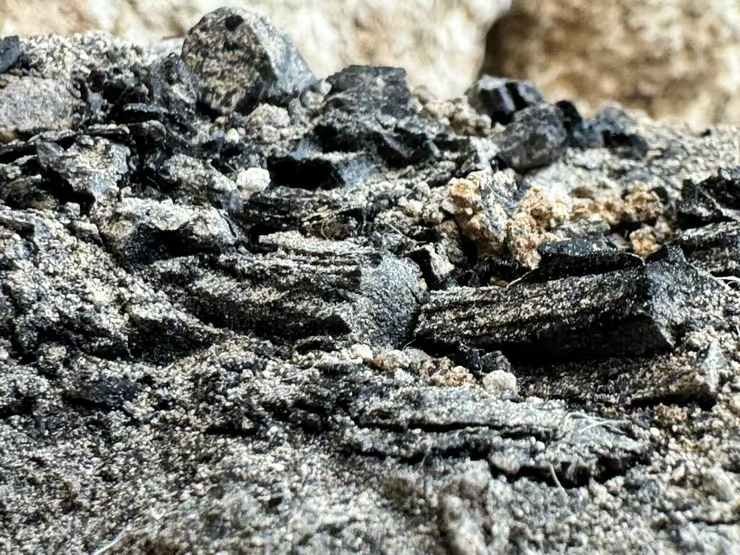 Wooden beams found (Reut Wilf/City of David)
Large wooden roof beams burned during the destruction of First Temple-period Jerusalem have been uncovered in the City of David, archaeologists announced Monday.
The beams were found in a large building at the Givati Parking Lot excavation, conducted by the Israel Antiquities Authority and Tel Aviv University. Archaeologists associate the destruction layer with the Babylonian conquest of Jerusalem in 586 BCE.
The discovery is considered unusual because wood rarely survives in Israel with a substantial number of visible growth rings. Researchers believe the thick beams could allow them to date the building and its destruction far more precisely than was previously possible.
The scientific analysis is still underway. Researchers have not yet announced that tree-ring testing has independently confirmed the exact year in which the beams burned.
Excavation director Dr. Efrat Bocher said the beams likely supported the roof of an internal courtyard before collapsing during the fire.
“It appears that these beams, which were probably used to roof an internal courtyard in a First Temple-period building, collapsed onto the building’s floor during the destruction,” Bocher said. “We believe that plaster covering the walls melted during the fire, covered the charred wooden beams and helped preserve them so exceptionally.”
Dr. Johanna Regev of the Israel Antiquities Authority said the large number of rings gives the find unusual scientific value.
“It is very rare to find wood in Israel with a substantial number of rings, and here in the City of David we found thick beams containing many rings,” Regev said. “This offers significant research potential.”
According to Regev, the greater the number of rings preserved in the wood, the more accurately researchers may be able to date it. She said finds that could previously be placed only within a range of several centuries may now be dated to a period of approximately 10 years.
The beams were uncovered inside a large First Temple-period structure whose exact purpose remains unknown. Its size, construction and other architectural remains have led archaeologists to believe it may have served an important public or administrative function.
Excavation directors Dr. Yiftah Shalev of the Israel Antiquities Authority and Prof. Yuval Gadot of Tel Aviv University said the evidence points to a violent and sudden destruction.
“It is clear to us that this large building was deliberately burned and collapsed all at once,” they said.
The excavation also revealed that residents returned to the site during the Persian period following the Babylonian destruction. They blocked the entrance to the ruined section but continued living in other parts of the structure.
The researchers believe the residents intentionally left part of the destruction untouched as a place of memory, rebuilding alongside the ruins instead of clearing them away.
The same building previously produced a clay seal impression bearing the words “Nathan-Melech, Servant of the King.” A figure named Nathan-Melech appears as an official in the Book of Kings, although archaeologists have not established that the seal belonged to the same person.
The discovery was announced shortly before Tisha B’Av, when Jews mourn the destruction of the First and Second Temples.
“On the eve of Tisha B’Av, this discovery reminds us that our connection to Jerusalem is not only one of faith, but also of history, archaeology and national memory,” Heritage Minister Amichai Eliyahu said. “Our responsibility is to continue uncovering the truth, preserving it and proudly passing it on to future generations.”

