

The Ninth of Av (Tisha B'Av)
What Was the Holy Temple? Discover Its True Purpose
Far more than a sacred building, the Holy Temple was where God's presence was revealed and where people experienced a tangible relationship with Him
- Yonatan HaLevi
- | Updated
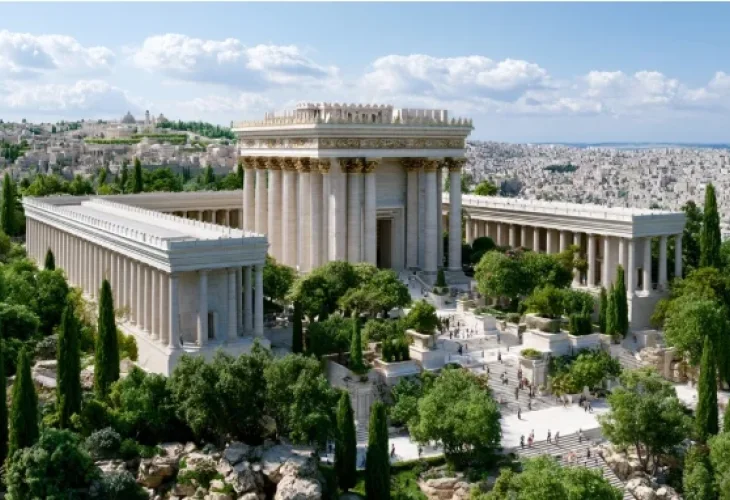
What is the Holy Temple? At first glance, it seems to be God's house. Yet this raises an obvious question: How can anyone build a house for God when His presence fills the entire universe?
King Solomon himself asks this question during his prayer at the dedication of the Temple: "But will God indeed dwell on the earth? Behold, the heavens and the highest heavens cannot contain You, much less this house that I have built!" (Kings I 8:27)
How can four walls and a roof serve as God's dwelling place?
The Temple Was Built for God and Israel
Rabbi Yaakov Yisrael Butchkovsky explains that the Temple was never intended to be God's house alone. It was the house shared by God and the people of Israel. It was the meeting place between the Creator and His people, where His presence could be tangibly experienced and where human beings could connect with Him.
If there had been a sign above the entrance to the Temple, it might have read: "Here, God lovingly dwells together with the Congregation of Israel."
That was the Temple's purpose: to create a real, physical meeting place in this world where people could encounter God through love, reverence, joy, and devotion. It was a place to serve Him, to bring offerings, to eat at His table by partaking of certain sacrificial meals, to bow before Him, to breathe in the fragrance of the incense, and to hear the Levites singing in His honor.
The Three Annual Pilgrimages
God commanded the Jewish people to come to this meeting place three times each year during the pilgrimage festivals. They were to bring burnt offerings and peace offerings, bow before Him, and rejoice in His presence, as the Torah says: "Three times a year all your males shall appear before the Lord your God."
The Sages note that the Hebrew wording can also be understood to mean, "Just as you come to see, so you come to be seen." The encounter is mutual. God not only desires to see His people, but also wants them to experience His presence. The Temple was a true meeting place.
Where Heaven Meets Earth
The Temple was built with extraordinary beauty and perfection because it served as the point where the Divine Presence connected with our physical world. Our purpose in this world is to draw close to God from within the limitations of earthly existence.
In the higher spiritual realms, everything shines with Divine revelation. God's presence is openly perceived. In our world, however, His presence is concealed. The Temple was the place where that hidden presence became manifest. It was where God's relationship with His children and our relationship with Him found their fullest expression.
The Torah states: "You shall eat before the Lord your God the tithe of your grain, your wine, and your oil... so that you may learn to fear the Lord your God all your days." (Deuteronomy 12:23)
Every visit to the Temple and to Jerusalem brought a person closer to God, inspiring reverence, humility, and devotion. When the Divine is experienced so vividly, one's relationship with God reaches an entirely different level.
Longing for a Tangible Connection
Today, we are blessed with a rich spiritual life. We have the Torah and its commandments, through which we can draw close to God. Yet much of that relationship remains internal. The primary work takes place within the heart.
We long for something more tangible. We yearn for a form of Divine service that can be seen, felt, and experienced firsthand: bringing an offering and watching it ascend upon the altar, eating from God's table, hearing the inspiring songs of the Levites, and witnessing the beauty and majesty that filled every corner of the Temple.
Once each year, during this season of mourning for the Temple, we are given the opportunity to feel that longing once again, to remember what was lost, and to sincerely pray: "May You lovingly accept the offerings of Israel and their prayers with favor."
The Western Wall: A Place of Encounter
Rabbi Butchkovsky concludes with a moving thought. Anyone who visits the Western Wall during these days, or at any time of the year, should remember that they are not merely coming to a place of prayer. They are coming to a place of encounter.
Here, just beyond this wall, God's presence rested in a revealed way. Here, our ancestors walked and brought their offerings. Here, the songs of the Levites echoed through the courtyards. Here, the fragrance of the incense filled the air.
The Holy Temple was a real place where people could physically walk, worship, and connect with God. And with heartfelt prayer and sincere longing, may we merit to experience that reality once again in our own days.

