

Facts You Didn't Know
Sugar in Space: What Scientists Discovered Near the Milky Way
Scientists discovered a simple sugar molecule near the Milky Way, revealing new insights into the universe and offering another glimpse of Hashem's infinite wisdom and creation.
- Shira Dabush
- | Updated
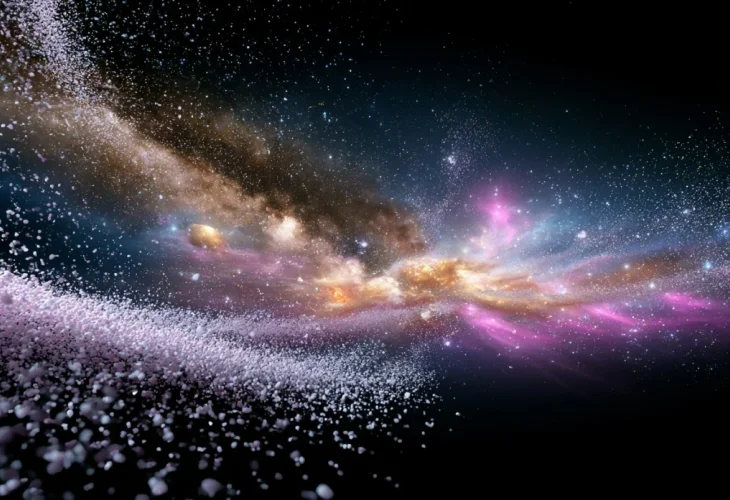
Not long ago, leading astronomers from around the world, including scientists from NASA, gathered at a major conference in the United States to discuss one of the fascinating discoveries of modern astronomy: the detection of sugar molecules near the center of the Milky Way.
For decades, astronomers have studied the vast reaches of space, searching for the molecules and compounds that exist between the stars. In 2000, researchers identified glycolaldehyde, the simplest sugar molecule known to science, within a massive cloud of gas and dust near the center of our galaxy.
Although this discovery captured headlines, it is important to understand that the molecule found is not table sugar like the white or brown sugar we use every day. Instead, it is a simple organic sugar molecule. For scientists, identifying such a complex molecule from thousands of light years away is an extraordinary achievement that helps deepen our understanding of the chemical makeup of the universe.
Over the past several decades, astronomers have discovered an increasing number of complex organic molecules in space. Each new discovery provides another piece of the puzzle, revealing just how rich and intricate Hashem's universe truly is.
How Scientists Detect Molecules Across the Universe
Considering the unimaginable distances involved, many people wonder how scientists can identify molecules that are so far from Earth.
The answer lies in spectroscopy. Every molecule emits and absorbs light in its own unique way, creating a distinctive spectral signature, much like a fingerprint. Powerful telescopes detect these signatures, and scientists compare them with laboratory measurements to determine which molecules are present in distant clouds of gas and dust.
This remarkable technology allows researchers to study the chemical composition of regions that are thousands of light years away without ever leaving Earth.
"How Great Are Your Works, Hashem"
While discoveries like this may not directly affect our daily lives, they remind us how much there is still to learn about Hashem's magnificent creation.
Each year, scientists uncover new details about galaxies, stars, planets, and the countless materials scattered throughout the universe. Every discovery inspires a renewed sense of wonder.
For people of faith, these scientific breakthroughs are far more than impressive achievements. They offer another glimpse into the extraordinary wisdom of the Creator.
The more science uncovers about the universe, the more its astonishing precision, complexity, and vastness become apparent. As King David declares:
"How many are Your works, Hashem! In wisdom You made them all." (Psalms 104:24)
The deeper our understanding of creation becomes, the greater our appreciation for the infinite wisdom that encompasses both heaven and earth.
10 Things to Know About the Sugar Molecule Discovered in Space
1. It is called glycolaldehyde.
The sugar molecule discovered in space is called glycolaldehyde. It is the simplest sugar molecule known to science.
2. It has a very simple chemical formula.
Its chemical formula is C₂H₄O₂, meaning it is composed of two carbon atoms, four hydrogen atoms, and two oxygen atoms.
3. It is not the sugar we eat.
Despite its name, glycolaldehyde is not white sugar or brown sugar. It is a much smaller and simpler organic sugar molecule.
4. It is one of the simplest sugar molecules.
Chemically, glycolaldehyde belongs to the family of simple sugars, making it especially valuable for scientific research.
5. Scientists identified it by its unique spectral signature.
Every molecule leaves behind a unique pattern of emitted or absorbed radiation. By matching this spectral fingerprint with laboratory data, scientists were able to identify glycolaldehyde from thousands of light years away.
6. It was discovered near the center of the Milky Way.
Researchers found the molecule inside a massive cloud of gas and dust located near the center of our galaxy.
7. It demonstrates that complex chemistry exists in space.
The discovery shows that relatively complex organic molecules can form naturally in the harsh environment of outer space.
8. It is an important discovery for astrochemistry.
Studying glycolaldehyde helps scientists better understand the chemical reactions taking place between stars and within enormous interstellar gas clouds.
9. It expands our understanding of the universe.
Each newly discovered molecule helps researchers build a more complete picture of the chemical composition of the Milky Way and other regions of space.
10. It paved the way for future discoveries.
Since glycolaldehyde was first identified, astronomers have continued discovering additional complex organic molecules, bringing us closer to understanding the remarkable chemistry of Hashem's universe.

