

Wonders of Creation
Scientists Discover New Monkey Species Hidden in Congo's Rainforest
A black monkey with striking orange markings has been officially recognized as a new species after decades of research in the Congo Basin.
- Shira Dabush
- | Updated
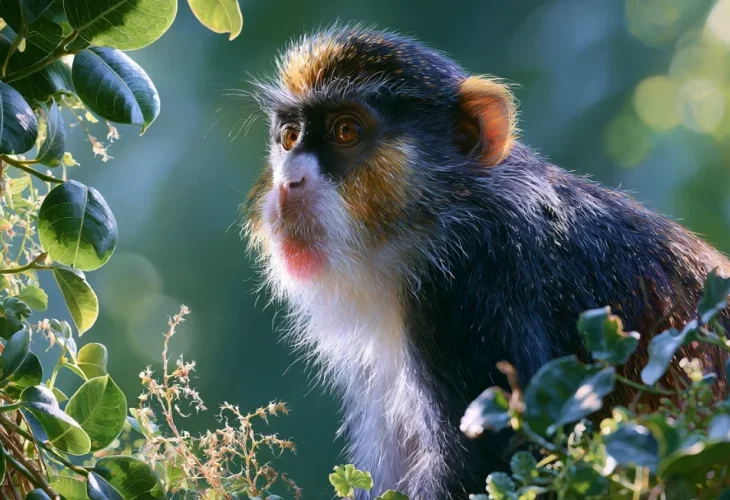
Hidden deep within the dense rainforests of the Democratic Republic of the Congo, a black monkey with striking orange markings around its mouth remained unknown to science for decades. Now, after nearly 20 years of research, scientists have officially identified it as a completely new species.
Named Colobus congoensis and known locally as the Likweli, it is only the fifth new African monkey species to be discovered in the past 75 years, highlighting just how rare such discoveries have become.
A Discovery Years in the Making
The mysterious monkey was first photographed in 2008 during a wildlife survey in Lomami National Park.
The image was blurry, but unusual enough to catch the researchers' attention. Despite repeated attempts, they were unable to locate the animal again for years.
It was not until 2018 that the monkey was spotted a second time, launching an extensive scientific investigation. Researchers carried out field observations, recorded the animal's vocalizations, collected genetic samples, and interviewed local villagers familiar with the forests.
Together, this evidence confirmed that the Likweli was unlike any known species of African colobus monkey.
A Distinctive Appearance
According to Prof. Christopher Gilbert, the monkey's glossy black fur is contrasted by a vivid orange and cream patch surrounding its mouth and nose, giving it an appearance similar to a mask.
It also has gray cheek patches, unusually long facial hair, a long tail, and a distinctive white patch on its lower back. Weighing only about 6.8 kilograms (15 pounds), it is smaller than many of its close relatives.
Its voice is equally distinctive.
Researchers found that the Likweli produces deep, roaring and snorting calls, but with an acoustic pattern unlike that of any other known colobus species.
Further examination of its skull, teeth, and skeleton revealed additional unique anatomical features, while DNA analysis conclusively confirmed that it represents a previously unknown species.
Why Was It Hidden for So Long?
One reason is the monkey's elusive lifestyle.
The Likweli spends most of its life high in the canopy of dense rainforest, rarely descends to the ground, and naturally avoids human contact.
Scientists interviewed people from 52 nearby villages, yet only residents from eight communities reported ever seeing the animal.
Ironically, for some local people, the monkey was never a discovery at all.
They had known about it for generations and had long called it the Likweli.
Already Facing Threats
Although the species has only recently been recognized by science, conservationists are already concerned about its future.
The Likweli is found only in a relatively small region between the Lomami and Lualaba rivers, where deforestation and hunting continue to threaten its habitat.
Because of its limited range, researchers recommend adding the species to the International Union for Conservation of Nature (IUCN) Red List of threatened species in hopes of securing protections before its population declines further.
A Reminder of Nature's Hidden Wonders
The discovery of the Likweli is a powerful reminder that even in the 21st century, when satellites map nearly every corner of the Earth, remarkable wildlife discoveries are still possible.
Scientists believe the Congo Basin, the world's second-largest rainforest after the Amazon, may still be home to species that have never been documented.
Each new discovery underscores the importance of continuing scientific research while protecting some of the planet's last great wilderness areas, where countless natural wonders may still be waiting to be found.

