

Yom Kippur
The Rabbi Who Delayed Kol Nidrei Until Two Jews Made Peace
A remarkable true story of Rabbi Noach Gad Weintraub, who refused to begin the Kol Nidrei service on Yom Kippur until two feuding congregants reconciled, revealing the profound Jewish connection between forgiveness, unity, and atonement
- Machon "BeOhalei Tzaddikim"
- | Updated
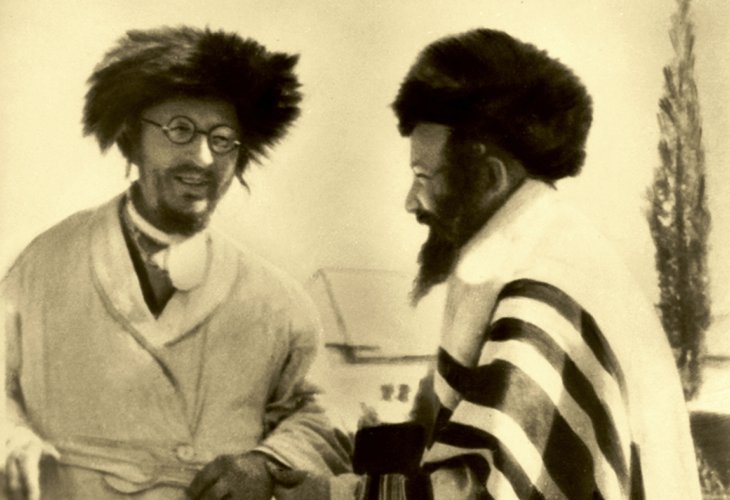 Rabbi Noach Gad, at left, with Rabbi Meir of Amshinov in 5694 (photo: courtesy of the "B'Ohalei Tzaddikim" Institute)
On the seventh of Tishrei, the yahrzeit of the revered Jerusalem sage Rabbi Noach Gad Weintraub of blessed memory is observed. Renowned for his extraordinary mastery of both the revealed and mystical dimensions of Torah, he was regarded in the Chassidic world as one of the greatest transmitters of Torah traditions. His writings preserve teachings and insights he personally heard from more than 500 leading Torah scholars, many of whom he knew closely.
Rabbi Weintraub authored over one hundred books and pamphlets covering every area of Torah scholarship, including profound commentaries on the Five Megillot and Pirkei DeRabbi Eliezer. He was among the foremost disciples of the eminent kabbalist Rabbi Chaim Shaul Dweck HaKohen of blessed memory and, at his teacher's instruction, published Kuntres Tikkun HaYesod.
Nearly a century ago, Rabbi Weintraub immigrated to the Land of Israel from Radomsko, Poland. Long before the destruction of European Jewry, he foresaw the coming catastrophe and remarked that only in the Land of Israel would there be survivors.
One unforgettable story from his years in Tel Aviv has been passed down by residents of the Neve Shalom neighborhood in Jaffa. It is a powerful illustration of his unwavering commitment to peace between Jews.
No Kol Nidrei Without Reconciliation
It was the eve of Yom Kippur. The congregation had gathered for the solemn Kol Nidrei service, dressed in white kittels and filled with awe as they prepared to enter the holiest day of the Jewish year.
Yet beneath the atmosphere of sanctity lay a painful reality. Two members of the synagogue had been locked in a bitter feud for years, casting a shadow over the entire congregation. Rabbi Weintraub had repeatedly tried to help them reconcile, following the example of Aaron the High Priest, who loved peace and pursued peace. Despite all his efforts, both men stubbornly refused to forgive one another.
The service began as expected. The Torah scrolls were removed from the ark, and the synagogue was filled with anticipation. Even those who attended only once a year had come to hear the stirring words of Kol Nidrei.
Then, just moments before the cantor was about to begin, Rabbi Weintraub stepped onto the platform and made an astonishing announcement.
With deep emotion and boundless love for his fellow Jews, he declared that the congregation would not begin the Kol Nidrei service until the two men reconciled.
"If Jews cannot forgive one another," he proclaimed, "and Yom Kippur cannot atone for sins between people until they have made peace with each other, then there is no purpose in praying on Yom Kippur."
His words stunned the congregation. No one dared challenge his decision.
The tension in the synagogue was almost unbearable. Yet despite the gravity of the moment, the two men refused to yield. Their resentment had become so deeply rooted that even the sanctity of Yom Kippur could not immediately overcome it.
A Rabbi Who Would Not Give Up
More than an hour passed in complete silence.
At one point, one of the men appeared ready to give in and make peace, but the other remained unmovable. As the minutes dragged on, the more stubborn of the two finally stood up. Rather than reconcile, he announced that he was leaving the synagogue altogether, insisting that he would never make peace with his adversary.
Many assumed that the matter was over and that the delayed Kol Nidrei service would finally begin.
But Rabbi Weintraub had other plans. Without the slightest concern for his own honor, he hurried after the man, who had already left the synagogue.
"You are free to leave," Rabbi Weintraub told him gently but firmly, "but know this: if you refuse to end this dispute tonight, you will bear the responsibility for preventing an entire congregation of Jews from praying Kol Nidrei."
These heartfelt words, spoken with complete sincerity, pierced the man's heart. The hardness that years of resentment had created suddenly began to melt.
Moments later, to the amazement of everyone watching, the man turned around and walked back into the synagogue alongside Rabbi Weintraub.
He approached his longtime rival. Before the eyes of the entire congregation, the two embraced, wept, and sincerely forgave one another.
Only then did Rabbi Weintraub's face light up with joy.
Those present felt that he had not only broken down the barrier separating two fellow Jews but had also helped remove the spiritual barrier between the Jewish people and their Father in Heaven, allowing the prayers of the holy day to ascend unhindered.
The moment brought to life the verse, "And He became King in Jeshurun, when the heads of the people assembled together." Rashi explains that God is truly King when Israel is united in one fellowship and lives in peace with one another, not when they are divided by conflict.
A Kol Nidrei Like No Other
Late into the night, long after synagogues elsewhere had already completed the Yom Kippur evening service, the congregation in Neve Shalom finally began Kol Nidrei.
Those who were there never forgot it.
"The Kol Nidrei prayer that night," they later recalled, "was filled with such extraordinary repentance, spiritual awakening, and commitment to good deeds that we had never experienced anything like it before."
For Rabbi Noach Gad Weintraub, peace between people was not merely an ideal. It was the very foundation upon which sincere prayer and true atonement could stand.

