

History and Archaeology
Ancient Innovations: How the Israelites Made the Land of Israel Flourish
Discover the fascinating archaeological evidence behind the ancient Israelite innovations that transformed the Promised Land into a center of agriculture, industry, and prosperity.
- Yehosef Yaavetz
- | Updated
In Parshat Ekev, the Torah highlights one of the most remarkable differences between the Land of Israel and Egypt:
"For the land that you are entering to possess is not like the land of Egypt, from which you departed, where you would sow your seed and water it by foot, like a vegetable garden. But the land you are crossing into to possess is a land of mountains and valleys; it drinks water from the rain of heaven. It is a land that Hashem, your God, cares for constantly; the eyes of Hashem, your God, are upon it from the beginning of the year until the end of the year."
Unlike Egypt, which depended on the steady flow of the Nile, the Land of Israel relied almost entirely on rainfall. At first glance, this seemed like a major disadvantage. Yet according to the research of Prof. Menashe Harel, the Israelites transformed this challenge into an opportunity. Through remarkable ingenuity, they developed innovative agricultural and engineering methods that allowed them to build thriving communities across the country's rugged mountains. Combined with faith in Hashem's blessing, these achievements turned a difficult landscape into one of prosperity.
Building Farms on the Mountains
Before the Israelites entered the land, civilizations generally settled near large rivers or permanent water sources. Egypt flourished along the Nile, while Mesopotamian civilization developed between the Tigris and Euphrates. Even in Canaan, most settlements were clustered around springs and wells.
The Israelites envisioned something far more ambitious. Rather than limiting themselves to areas with natural water, they settled throughout the mountainous heart of the land, including regions the Canaanites had largely avoided.
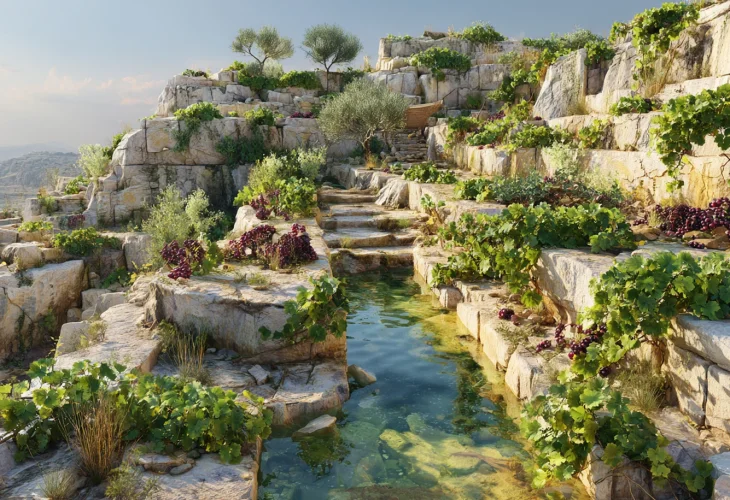
One of their greatest innovations was the creation of agricultural terraces. Steep hillsides could not naturally hold soil, and rainwater quickly rushed downhill, washing valuable earth away. To solve this problem, the Israelites built stone retaining walls that created level strips of farmland along the slopes. These terraces prevented erosion, captured rainfall, and allowed water to soak slowly into the soil instead of being lost in the valleys below.
Archaeological evidence shows just how extensive this system became. More than half of the Jerusalem hills are still covered with ancient terraces dating back thousands of years, a lasting reminder of the engineering skill of Israel's early settlers.
Turning Rain Into a Reliable Water Supply
Rain alone was not enough to support large cities. The Israelites also pioneered sophisticated systems for collecting and storing water.
They carved enormous cisterns into the rock and coated them with thick layers of lime to prevent leaks. Entire towns were carefully designed so that rainwater flowing from rooftops and streets was directed into these underground reservoirs, ensuring a dependable water supply throughout the year.
The ancient city of Gibeon provides an impressive example. Built in the mountains without a major river, it depended on a massive rock cut cistern that collected rainwater from across the city. This innovation made it possible for thriving communities to exist far beyond the locations of natural springs.
An Agricultural Economy Unlike Any Before It
The Israelites also recognized that the mountainous terrain was ideally suited for vineyards. Grapevines flourish in rocky soil, require relatively little water, and grow well on hillsides. As a result, wine production became one of the country's most important industries.
Wine was used not only for drinking but also for vinegar, dried grapes, trade, and commerce. Excavations at ancient Gibeon uncovered 63 rock cut wine cellars that maintained an ideal temperature for fermentation. Archaeologists estimate that the city alone produced around 100,000 liters of wine annually, demonstrating the impressive scale of Israelite agriculture.
Olive cultivation became another cornerstone of the economy. Olive oil served countless purposes, including cooking, lighting, medicine, cosmetics, soap production, and the anointing of kings and priests.
Evidence of this industry was uncovered at Tel Miqne, identified as biblical Ekron, where archaeologists discovered 102 olive presses. The site is believed to have produced approximately 1,000 tons of olive oil each year, making it one of the largest olive oil production centers in the ancient Near East.
Transforming the Land Through Industry and Infrastructure
The Israelites did not stop with farming. They also transformed the forests that covered much of the hill country into valuable economic resources. Timber supplied building materials, furniture, tools, transportation equipment, and charcoal for metalworking. Clearing forests and quarrying stone created opportunities for skilled craftsmen, including carpenters, blacksmiths, and stonemasons, helping to establish thriving centers of industry alongside agriculture.
At the same time, they built an extensive network of mountain roads connecting the coast, the Jordan Valley, Jerusalem, and the desert. These routes made travel easier for merchants, pilgrims, and soldiers, strengthening trade and communication throughout the land. Remarkably, later Roman and Byzantine engineers often incorporated these ancient Israelite roads into their own transportation networks.
The Israelites' achievements reveal a remarkable partnership between faith and human effort. While they depended on Hashem for the rains that sustained the land, they also invested extraordinary wisdom, creativity, and hard work into making every drop count. Their innovations transformed rocky mountains and dry hills into a flourishing homeland, giving practical expression to the Torah's description of the Land of Israel as a land flowing with milk and honey.

