

Parshat Ekev
The One Fear That Frees Us From All the Rest
As Moses prepares to say goodbye, he offers a surprising lesson about fear, freedom, and what is truly within our control.
The entirety of the book of Deuteronomy can be considered Moses’ magnum opus. From the first of the month of Shevat until his death on the seventh of the month of Adar, Moses spoke to the Israelites, closing out his forty years of leadership with a thirty-seven day speech. As hard as it is to say goodbye to Moses now, in our yearly reading of the Torah portion, it must have been that much harder for the people who had grown into a nation under his tutelage.
I cannot fathom how difficult it was for him to have to say goodbye to them.
And so the book of Deuteronomy is his final message. He has this chance to impart his final words of wisdom, to teach them some commandments that will only be relevant once they go into the land, to remind the people—again and again and again—to avoid idolatry, to follow in God’s footsteps, and to stay on the path of righteousness and justice.
In this week’s Torah portion, Eikev, which is the third in the book of Deuteronomy, Moses makes a seemingly offhand comment that is, in a word, perplexing. After recounting a series of travels and missteps of the people in the desert, Moses turns to them and says, “And now, Israel, what does the Lord your God ask of you but to fear the Lord your God to walk in all of his ways, and to love Him, and to serve the Lord your God with all your heart and all your soul” (10:12). Every time I read that verse, I can’t help but chuckle. Ah yes, that’s all God asks of us. Sure, for Moses, it’s easy to say; he dedicated his entire life in service to God and the Jewish people, so he can make it sound easy. But for the rest of us? It’s not quite that simple.
Or is it?
On this verse, Rashi offers an insight from the Talmud in the tractate Berachot: “Everything is in the hands of God except for fear of God” (33b). The entire world, the Talmud implies, is run by God—all of the myriad things that are outside of our control. But what is in our control is our fear of God. It is, perhaps, to this phrase that Rabbi Joseph B. Soleveitchik was referring when he said, “I would rather have one big fear than a thousand little ones.”
The truth is that the world is a scary place. Many children instinctively know this and have to be taught how to face their fears. (And then there are the kids who are utterly fearless and are simultaneously terrifying but also hilarious because of it.) There is so much that we do not control, so much that we cannot control. We do what we can, we try to live well, we try to protect ourselves and the people we love, but there’s a real limit to our abilities. And that knowledge can be paralyzing.
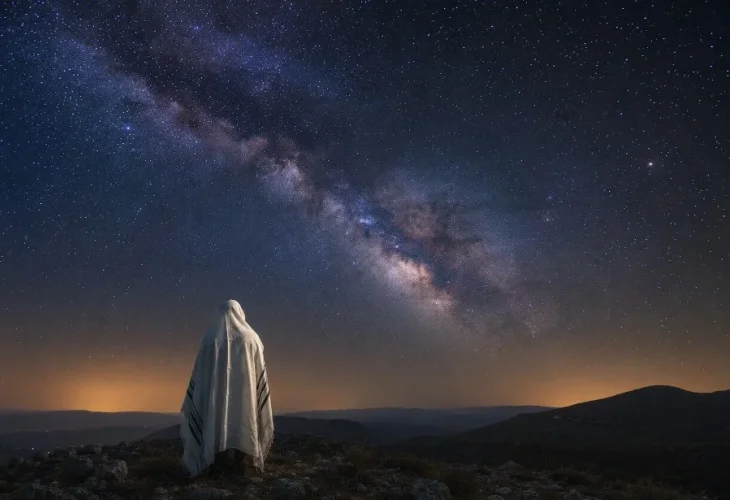
Fear of God, ironically, is liberating. Rabbi Obadiah Seforno says that we come to fear of God—or awe of Him, if you prefer—by understanding His greatness. God split the sea. He took a slave population out from under the nose of the mightiest empire in the Ancient Near East and made that slave-nation the moral compass of the world. He created the stars in the heavens and He maintains their existence—and He knows how many stars there are! And not only that, He cultivates clumps of cells into new life that He then breathes into the world. There is, truly, nothing that God cannot do.
And yet, with all of His might, God will never make you fear Him. He will never force you to love Him, and He will not make you have a relationship with Him if you do not seek Him out. That is entirely in your hands.
We are coming up quickly on Rosh Hashanah and Yom Kippur, the Days of Awe. This seemingly casual remark of Moses—which he says and then moves on—is a critical reminder to set ourselves as we begin preparing for the High Holidays. Fear of God is a good thing because it gives us clarity. It allows us to focus on the things that are within our sphere of control, freeing us from the agony of worry of the things that are outside of that sphere. We can breathe easier because we only have one fear, and it’s the one that truly matters.
And in the end, Moses is quietly telling us, it’s our choice. It’s up to us. What does God ask of us? Just to fear Him—not just as in, “It’s easy,” but just as in, “Focus on this.”
Because it’s not easy. But it is, in the end, quite simple.

