

Israel News
Former Hostage Evyatar David Opens Up: “I’m Living With Flashbacks — My Mind Still Goes Back to Gaza”
Former hostage Evyatar David has shared his first personal post since his release, opening up about post-trauma, flashbacks, and his long road to recovery — as well as his decision to seek support as he rebuilds his life.
- Yuval Aviv
- | Updated
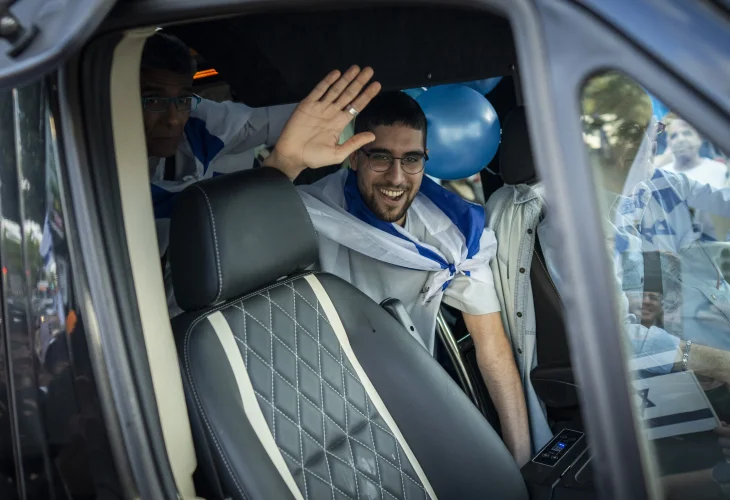 David (Photo: Erik Marmor, Flash90)
After long months of recovery away from the spotlight, former hostage Evyatar David shared his first personal post today (Thursday) since his release, describing the daily struggle with the aftermath of captivity. In a raw and honest post, David said that his family had launched a crowdfunding campaign for him, allowing him to focus on healing: “I’m not writing this so people will pity me, because I know and believe that I have the strength to fulfill my dream and show the terrorists that I won.”
David, who was released after 738 days in Hamas captivity, acknowledged that he does not know why he chose this particular moment to share his feelings: “Maybe because after more than two years in captivity, I was sure that after what I had been through, nothing in life could ever be too much for me.” He recalled the moment he was abducted from the Nova festival: “It’s crazy to think that I went to dance and have fun at Nova, and in one second, with no warning or feeling that my life was about to change, I was brutally kidnapped while being beaten and abused.”
He went on to describe the conditions of captivity and the daily fight to survive. According to David, shortly after he was kidnapped, he was taken into a dark tunnel with little air and no basic conditions: “I didn’t think about the day after. I couldn’t think that far ahead. I had one goal: to hold on for one more day. And another day. Until I came home.” He said that in his hardest moments, he drew strength from thoughts of his parents, family, and friends, and from his belief that they were not giving up on him. Even when hunger became routine and loneliness deepened the pain, the hope of returning home kept him going.
David spoke about the moment of his release, on October 13 last year, and described reuniting with his family and the wave of public support he received: “I received more love than anyone could imagine. The first hug with my mom, dad, and siblings was a moment I had dreamed about so many times.” In his words, “After everything I saw there, Am Yisrael reminded me that there is good in the world too.”
Still, he said that it was only after returning that he realized how far he was from the end of his recovery: “I’m truly grateful for every moment and every second that I’m here... but slowly, I understood that even when you come home, not everything comes back with you.” He described how, even when he is in a safe place surrounded by family and those closest to him, the memories return without warning: “I tell myself, ‘You’re back. You’re home. You’re free.’ But my mind and body do not always manage to believe it.”
He continued: “I’m dealing with post-trauma and flashbacks. These are words I never thought I would need to use when talking about myself.” He added that he believed he could cope on his own, but came to understand that returning from captivity was only the start of a far more complicated journey: “It’s important to me that you know that a former hostage’s story does not end the moment the door opens and he returns to his family. That is actually when a struggle begins that people on the outside cannot always see.”
David said: “There are days when I smile only because I feel uncomfortable reacting differently.” According to him, “What people see from the outside is not always what is happening inside. It would have been much easier for me to write that everything is fine and move on. But I do not want to only appear fine.”
At the end of the post, he shared one of the most difficult moments he experienced in captivity: “Even when the terrorists forced me, with almost the last of my strength, to dig my own grave. I did not give up. I stood there and did not know whether this was my final moment.” He described how the memory of that moment still follows him today: “I survived that moment too. But it did not stay there. Sometimes it comes back to me without warning. In the middle of the day. In a safe place. Especially when everything around me looks calm and quiet.”
Alongside the personal disclosure, David explained that his decision to publicize the crowdfunding campaign came from his wish to focus on recovery without also carrying a financial burden: “They enjoyed watching me shrink and slowly grow weaker in unimaginable suffering, and my dream is to feel the real victory. To get married and start a family in Israel. Through Judaism and faith. I am Jewish, and I am proud of it. No one will ever take that from me.” He concluded: “My recovery journey is long and challenging. I cannot also think about how to finance my process of returning to life. It is not easy for me to write these lines. I never thought that I, too, would ask for help.”

