

Torah Personalities
Og, King of Bashan: The Torah's Most Mysterious Giant
Who was Og, King of Bashan? Discover what the Torah, Chazal, and ancient traditions reveal about the legendary giant defeated by Moshe Rabbeinu.
- Yehosef Yaavetz
- | Updated
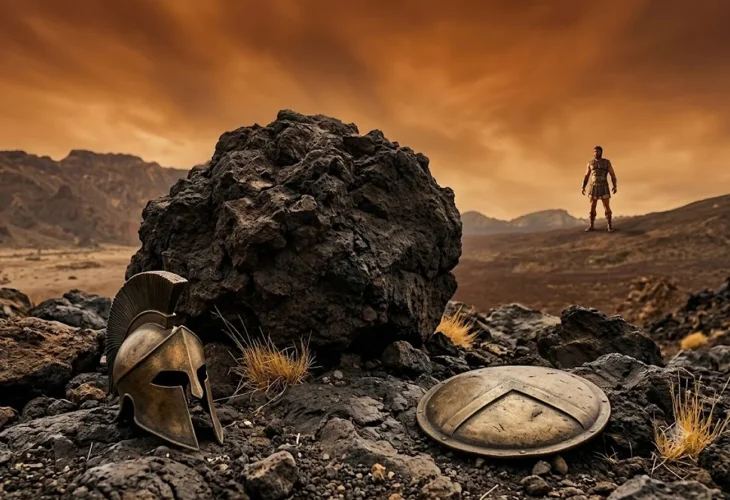
Throughout the Torah, we encounter mighty kings and powerful nations, but few figures are as mysterious as Og, King of Bashan. Described as one of the last survivors of the Rephaim, an ancient race of giants, Og appears only briefly in the Torah. Yet Chazal weave around him a remarkable tapestry of traditions spanning generations, from the time of Noach to the days of Moshe Rabbeinu. His story combines history, Midrash, and enduring lessons about strength, pride, and Divine providence.
Who was this legendary giant, and why did his memory leave such a lasting impression on Jewish tradition?
The Giant King Defeated by Moshe
In Sefer Devarim, the Torah recounts Israel's battle against Og, King of Bashan, following its victory over Sichon, king of the Amorites.
Og ruled over Bashan from the cities of Ashtarot and Edrei, governing the fortified region of Argob and many surrounding settlements. When the Jewish people approached his territory, he marched out with his entire army to confront them at Edrei.
Although the Torah describes the battle itself only briefly, it gives special attention to Og's extraordinary size. Scripture notes that he was "the last of the remnant of the Rephaim" and records that his iron bed measured nine cubits long and four cubits wide. The bed was preserved in Rabbat Bnei Ammon as testimony to his unusual stature.
The Rashbam explains that this was actually Og's childhood cradle, preserved because even as a young child he was exceptionally large. The Ramban, however, understands the bed to refer to Og's adult bed, serving as evidence of the enormous size of both Og and the Rephaim, the ancient race of giants to which he belonged.
Was Og Avraham's Enemy or His Faithful Servant?
Chazal present two very different traditions about Og's relationship with Avraham Avinu.
According to Midrash Rabbah, Og was the fugitive who informed Avraham that Lot had been captured. The Midrash explains, however, that his intentions were far from noble. Og hoped Avraham would be killed while rescuing Lot, allowing him to take Sarah for himself. According to this tradition, Og was already an enemy of Avraham Avinu and remained alive until the days of Moshe Rabbeinu.
A different picture appears in Pirkei DeRabbi Eliezer.
There, Og is identified with Eliezer, Avraham's loyal servant. According to this tradition, Eliezer was the servant Nimrod gave to Avraham. After faithfully serving Avraham and performing an act of kindness for Yitzchak, Avraham freed him. Hashem then rewarded him in this world by making him king of Bashan.
Although these traditions differ dramatically, together they highlight the enduring fascination surrounding Og's identity.
The Giant Who Lived Through the Generations
According to Pirkei DeRabbi Eliezer, Og's story began long before the time of Avraham.
When the Flood came, Og clung to the outside of Noach's Ark. He swore loyalty to Noach and his family, promising to serve them forever. In return, Noach made an opening in the Ark and passed food to him each day, allowing him to survive the Flood.
Other Midrashim preserve different traditions. Some suggest that the floodwaters reached only Og's ankles because of his immense height. Others maintain that he escaped to the Land of Israel, which, according to that opinion, was not flooded.
According to these accounts, Og witnessed some of the greatest events in history, living through the generation of the Flood, the time of Avraham Avinu, the Exodus from Egypt, and finally the leadership of Moshe Rabbeinu.
The Mountain That Never Reached Israel
One of the most famous accounts about Og appears in the Gemara in Berachot.
The Gemara teaches that anyone who sees the stone Og intended to throw at the Jewish people recites the blessing thanking Hashem for the miracles performed there.
According to the Gemara, Og asked how large the Israelite camp was and was told it stretched for three parasangs. Determined to destroy the entire nation at once, he uprooted a mountain of the same size to hurl upon them.
Before he could carry out his plan, Hashem performed a miracle. Ants bored through the base of the mountain, causing it to collapse around Og's neck like a giant collar. His teeth then became embedded in the rock, trapping him in place.
The Gemara concludes by describing how Moshe Rabbeinu, whose height is said to have been ten cubits, took an axe ten cubits long, leaped ten cubits into the air, and struck Og on the ankle, bringing down the mighty giant.
The Legacy of the Rephaim
Another fascinating tradition appears in tractate Niddah.
The Gemara relates that Abba Shaul, who was involved in burying the dead, once chased a deer into what he believed was a cave. After traveling three parasangs without reaching its end, he discovered that the "cave" was actually the thigh bone of Og, King of Bashan.
Og was not the only giant remembered in ancient tradition. References to giants also appear in historical sources outside the Torah. The Egyptian Papyrus of Sinuhe, which describes travels through Canaan, mentions unusually large warriors. The first-century historian Josephus likewise writes about the giants of Hebron, claiming that enormous bones unlike those of ordinary people could still be seen in his day.
Even today, some ancient structures have been associated with these traditions. Thousands of massive basalt dolmens scattered across the Golan Heights have long captured the imagination. Built from enormous stone slabs weighing many tons, these prehistoric monuments have inspired ancient legends that they were constructed by the Rephaim, the giant people mentioned throughout the Torah.
Whether viewed through the lens of Scripture, Midrash, or ancient tradition, Og remains one of the Torah's most intriguing figures. His story reminds us that no matter how powerful a person may appear, true strength belongs to Hashem alone. He guides history and grants victory not through physical might, but through His will.

