

Parashat Re'eh
When Jews Divide: Why the Torah Compares It to Cutting the Body
The Torah’s prohibition against cutting the body contains a deeper message about Jewish unity. Discover why the Maharal compares division among Jews to wounding our own flesh.
- Rabbi Moshe Sheinfeld
- | Updated
One of the most powerful verses in this week’s Torah portion says:
"You are children of Hashem, your God. You shall not cut yourselves or make a bald spot between your eyes for the dead. For you are a holy people to Hashem, your God, and Hashem has chosen you to be His treasured people from among all the nations on the face of the earth" (Deuteronomy 14:1–2).
At first glance, the verse appears to contain a straightforward prohibition against an ancient form of mourning. But our sages and commentators reveal something much deeper within these words: a lesson about faith, the immortality of the soul, and ultimately, the unity of the Jewish people.
You Are Children of Hashem
Rashi explains the plain meaning of the verse: "Do not make a gash or scratch in your flesh for the dead, as the Amorites do, because you are children of God, and you are worthy of being beautiful, not gashed or bald."
The word "titgodedu" refers to damaging or scratching the flesh (Rashi on Jeremiah 20:10). Many idol worshippers would scratch and wound themselves as an expression of grief after the death of someone close to them. The Torah forbids the Jewish people from adopting this practice.
But why does the Torah introduce this prohibition with the words, "You are children of Hashem, your God"?
The commentators explain the connection. Once you understand that you are Hashem’s child and that He loves you more than a father loves his son, you should not wound yourself in response to what He does. Everything Hashem does is ultimately for the good.
A small child does not always understand his father’s decisions. Yet the child trusts that his father loves him and is acting for his benefit. The same is true of our relationship with Hashem. We may not understand everything that happens to us, particularly in moments of tremendous pain and loss, but we remain His children.
"You are a holy people," and therefore, the Torah tells us, do not mourn in the ways practiced by the surrounding nations (Ibn Ezra and other commentators in similar language).
The Ramban finds an even deeper idea in these verses: an allusion to the immortality of the soul.
"In my opinion," the Ramban writes, "the meaning of ‘a holy people’ is a promise that souls endure before Him, may He be blessed."
He cites the verse, "God does not take away a life, but devises plans so that no one banished from Him will remain banished" (II Samuel 14:14).
Since the Jewish people are holy and treasured by Hashem, the Ramban explains, it is inappropriate to cut the body or create baldness in response to death, even when someone dies young.
This does not mean that Judaism prohibits grief.
The Ramban emphasizes that the Torah does not forbid crying. Human nature moves us to tears when we are separated from people we love, even when that separation is temporary. Certainly, then, it is natural and permitted to cry when someone passes away.
But there is a difference between mourning and allowing grief to become so extreme that a person wounds his own body.
According to the Ramban, such behavior can reflect a failure to recognize that the soul continues to exist. Death is a painful separation, but it is not the end of the soul.
The Or HaChaim also offers a beautiful explanation of this verse that is worthwhile studying in depth.
Don't Divide the Jewish People Into Separate Factions
The Talmud reveals another meaning hidden within the words "You shall not cut yourselves."
"Do not make yourselves into separate factions" (Yevamot 13b).
The same Hebrew word, titgodedu, that refers to cutting the body is understood by the sages as a warning against dividing the Jewish people into separate groups, particularly within a single community.
The Gemara discusses the details and boundaries of this prohibition, and there is certainly room within Judaism for different legitimate customs and traditions. But one practical example can be seen within a synagogue.
If a particular synagogue has an established tradition and regular custom for prayer, individuals should not simply introduce a different practice without the agreement of the community.
Rashi explains that such divisions must be avoided so that it should not appear, God forbid, as though there are two Torahs.
The Rambam similarly writes in Hilchot Avodah Zarah 12:14 that different practices within the same place and community can lead to disputes and conflict.
But this raises an obvious question.
The Torah uses the same word, titgodedu, to teach two apparently unrelated prohibitions. One concerns physically cutting the body in mourning. The other concerns dividing the Jewish people into factions.
What could these two things possibly have in common?
The Jewish People Are One Body
The Maharal, in Gur Aryeh on this verse, addresses precisely this question.
"If you ask, what do these two things have to do with one another, that they should not form separate factions and that they should not cut themselves? You do not find elsewhere in the Torah that two such matters are connected."
How can one word contain two interpretations that seem so completely different?
The Maharal answers that, in reality, they are deeply connected.
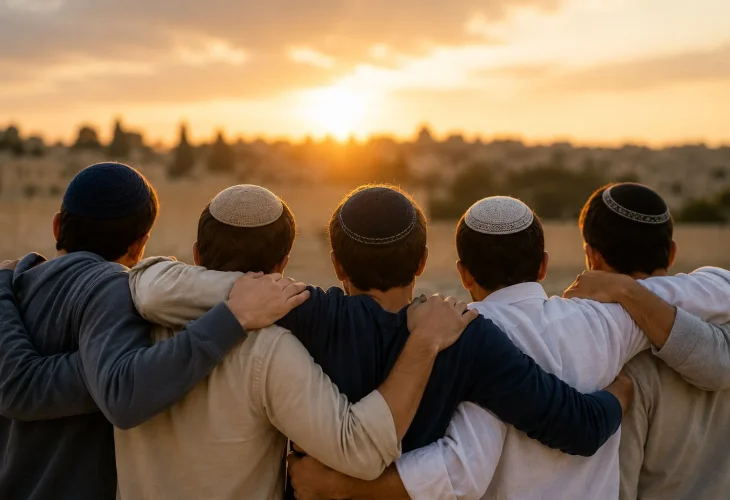
Just as a cut divides the human body, leaving its flesh no longer whole and unified, so too division within the Jewish people damages something that was meant to function as a single body.
The Maharal gives the example of a court within one city in which half the judges rule according to Beit Hillel and the other half according to Beit Shammai. Such division, he explains, is comparable to dividing a person’s physical body.
The two meanings of titgodedu are therefore not truly separate at all.
They express the same idea on two different levels.
One is physical. The other is spiritual.
The Jewish people are one body.
The Torah forbids us from scratching and cutting our skin as an expression of mourning because our bodies are holy. Even in the most painful moments of grief, we may not treat the body as something whose wholeness and sanctity can simply be discarded.
And the same principle applies to the Jewish people.
When we splinter into hostile groups and cut ourselves off from one another, we are not simply separating from someone else. We are cutting into something of which we ourselves are a part.
The Jewish nation is one body.
When I cut a particular Jew out of my life simply because he belongs to a different group, or when I unnecessarily separate myself from another part of the Jewish community, I may think I am cutting away something external to myself.
But the Maharal teaches us otherwise.
I am cutting into my own flesh.

