

Jewish Law
A Snakebite Saved His Life: A Fascinating Jewish Law Question
A venomous snakebite nearly killed him, but doctors discovered it may also have saved his life. Does the snake catcher still have to pay damages according to Jewish law?
- Rabbi Erez Hazani
- | Updated
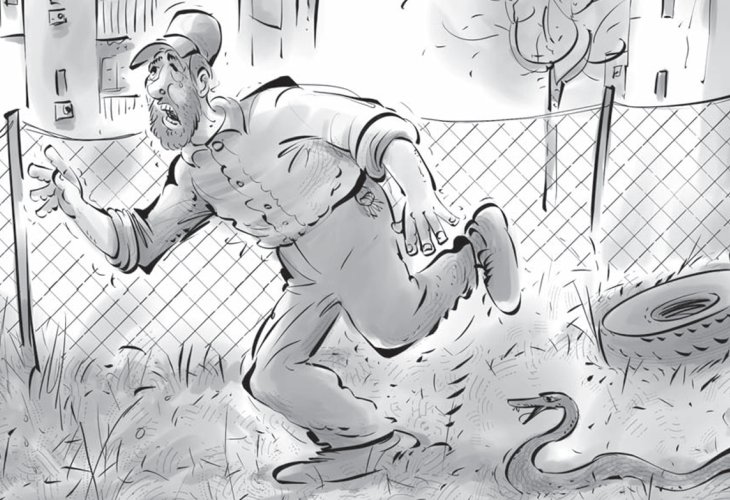
A Jewish man was bitten by a venomous snake, leaving him in life threatening danger. Emergency responders were immediately called, and he was rushed to the hospital in critical condition.
For more than two weeks, doctors worked to save his life. With Hashem’s kindness and Divine assistance, they eventually managed to stabilize his condition, and the day finally came when he was well enough to return home.
Before leaving the hospital, the man approached the head of the department to thank him for the professional and devoted care he had received.
The doctor looked at him and said, "You should know that you need to recite Birkat HaGomel."
"Of course," the man replied. "I need to thank Hashem for saving me from the snakebite."
"No, no," the doctor responded. "I mean you need to recite HaGomel for the snakebite itself."
The patient stared at him in astonishment.
What could possibly be good about nearly dying from a venomous snakebite?
The Discovery No One Expected
The doctor explained.
"When you arrived here unconscious, we performed extensive tests and discovered something else. You had a large malignant tumor in your kidney.
"We decided that we first needed to treat the snakebite and then address the dangerous growth. But after treating the effects of the venom, we performed a CT scan and discovered something astonishing.
"There was no longer any trace of the malignant tumor.
"The snake venom had destroyed it."
The doctor looked at his patient.
"So you need to thank and praise Hashem not only for surviving the snakebite, but for the snakebite itself."
The very event that had appeared to threaten the man’s life had, according to the account, become the means through which another life threatening danger was eliminated.
But the story did not end there. It raised a fascinating question of Jewish law.
An investigation into the incident revealed that the snake had been kept by a snake catcher. Because the catcher had been negligent in securing it, the snake escaped and eventually bit the man.
The victim now demanded compensation from the snake catcher for the injury he had suffered.
The snake catcher, however, had an unusual defense.
"The snakebite brought you an enormous benefit," he argued. "It may even have saved your life. How can you demand damages for it? What appeared to be an injury ultimately became your salvation."
So who is right?
A Surgeon Removed the Wrong Kidney
Before answering, consider another remarkable case that occurred several years earlier.
A Jewish man’s son urgently needed a kidney transplant. After testing showed that the father was a suitable donor, he decided to donate his right kidney to save his son.
During the operation, however, the surgeon made a serious mistake.
Instead of removing the right kidney, he removed the left one.
Then came the shocking discovery: The left kidney that had been removed "by mistake" was cancerous.
Had the surgeon followed the original plan and removed the right kidney, the cancer in the left kidney could have continued to spread. What appeared to be a terrible medical error had ultimately resulted in the removal of a dangerous tumor.
It seemed that the hand of Hashem had guided the doctor toward the very kidney that needed to be removed.
This raised a halachic question: Was the doctor obligated to compensate the father for mistakenly removing the wrong kidney?
The ruling was that the doctor was exempt from paying damages for the injury. Ultimately, he had not removed a healthy kidney unnecessarily. He had removed a diseased kidney that needed to be taken out in order to save the patient’s life.
Every Jew would have been obligated to help remove such a danger and save the patient. The doctor therefore performed an act that needed to be done, even though he himself had no idea that he was doing it.
Does the Snake Catcher Have to Pay?
The same reasoning can be applied to the snakebite.
From the moment the man was bitten, the venom served, according to the circumstances of this case, as a form of medicine for the dangerous tumor inside his body. The snakebite also led to the extensive medical testing through which the tumor was discovered.
What initially appeared to be an injury ultimately became the means through which the man was saved from another potentially deadly condition.
Certainly, a person would be willing to endure such an injury if he knew that doing so was necessary to save his life.
For that reason, the snake catcher cannot be obligated to compensate the man for the bite.
The bottom line: The snake catcher is exempt from paying damages to the man who was bitten.
Beyond the fascinating halachic question, the story carries a powerful message. Sometimes an event can appear entirely harmful from our limited perspective, while something very different is unfolding beneath the surface.
The snakebite looked like a disaster. Yet according to this remarkable case, the very thing that endangered the man ultimately became the means of saving him.
The story appears in the book One Thing I Asked 2, from the teachings of the distinguished Rabbi Yitzchak Zilberstein.

