

Health Recipes
Delicious and Healthy Treats Made with Coconut Oil
Discover the surprising health benefits of coconut oil, why it deserves a place in your kitchen, and learn how to make delicious homemade chocolate treats and healthy afternoon snacks with simple, natural ingredients
- Chen Tovi
- | Updated
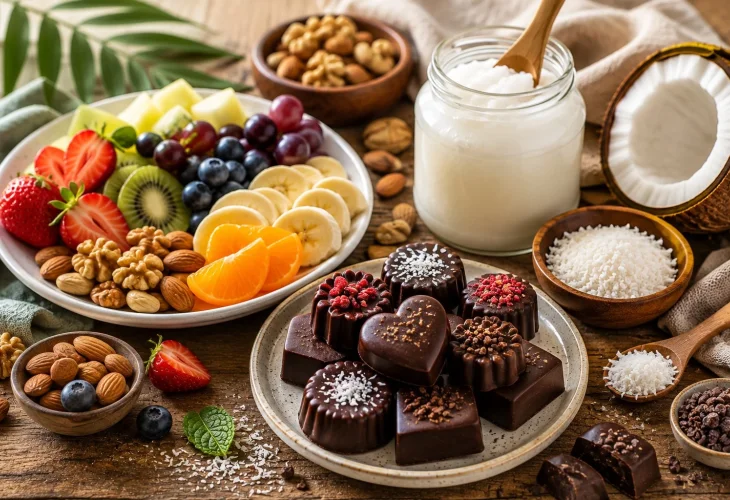
Afternoon is my children's favorite part of the day.
School is over, lunch has been eaten, homework is finished, and their household chores are done. Now it's their time to enjoy their hobbies or play with friends and neighbors. Before baths and dinner, we always pause for a serving of fresh fruit.
In my experience, if the fruit is colorful, varied, beautifully arranged, and cut into bite-sized pieces, the plate almost always comes back empty.
Fruit is best enjoyed between meals, rather than as dessert. Because fruit digests relatively quickly, eating it after a heavy meal forces it to sit in the stomach while waiting for the rest of the food to digest. This can lead to fermentation, bloating, gas, and discomfort.
Nuts, however, pair wonderfully with fruit, which makes sense as they both grow on trees, and are naturally suited to one another. The healthy fats in nuts also help slow the absorption of the fruit's natural sugars.
I'd like to focus on healthy, delicious afternoon snacks that combine fruits and nuts.
Coconut Oil: Healthy or Harmful?
I'd like to begin with coconut oil, made from the coconut, because few foods spark as much debate. Some people praise it for its remarkable health benefits, while others warn against it because it contains saturated fat.
Dr. Gil Yosef Shachar, an observant physician and director of the Rambam Center for Preventive Medicine, offers an important perspective. Dr. Shachar explains: "Many people are afraid of coconut oil because they think, 'It's saturated fat, it's unhealthy, it raises cholesterol.' This is simply a mistaken myth."
There is a fundamental difference between saturated fats from animal sources and coconut oil, which comes from plants. Animal fats are made primarily of long-chain fatty acids, whereas coconut oil is composed largely of medium-chain fatty acids (MCTs). Research suggests these medium-chain fats are metabolized differently and are less likely to accumulate in the arteries.
But that's not all. Medium-chain fats are absorbed more easily by the body and do not require bile acids for digestion. They pass directly from the intestines into the bloodstream, providing a rapid source of energy and promoting a quicker feeling of fullness.
Interestingly, coconut oil also contains fatty acids naturally found in breast milk. In addition, coconut oil supports several body systems, including hormonal balance and cardiovascular health. It contains antioxidant compounds that help neutralize free radicals and has demonstrated antiviral, antibacterial, and antifungal properties, including activity against organisms such as Candida.
Perhaps its greatest advantage is its stability. Unlike many vegetable oils, coconut oil remains stable at high cooking temperatures, making it an excellent choice for frying, baking, roasting, and even spreading on bread.
More Than Just a Cooking Oil
Once you have a jar of coconut oil in your kitchen, you'll quickly discover how versatile it is.
Chicken schnitzel fried in coconut oil develops a wonderful aroma. Roasted vegetables brushed with coconut oil and sprinkled with coarse salt before baking are absolutely delicious. For a quick snack, simply heat a spoonful of coconut oil in a pot, add popcorn kernels, and season the finished popcorn with sumac and nutritional yeast.
Coconut oil isn't limited to the kitchen.
Studies suggest that oil pulling (swishing coconut oil in the mouth), may help reduce plaque and improve gum health. Applied to the skin, coconut oil may help soothe irritation and eczema while providing excellent moisture for dry skin, especially on the feet, elbows, and arms. People with dry skin often enjoy using it as a facial moisturizer as well.
Because of its anti-inflammatory properties, coconut oil may also help relieve itching and discomfort from insect bites while reducing swelling and lowering the risk of infection. It also works beautifully as a natural lip balm, helping relieve dry, cracked lips and keeping them soft for hours.
Mary the Jewess and the Bain-Marie
Mary the Jewess was a Jewish alchemist who lived in Egypt about 1,800 years ago.
She became famous for developing innovative laboratory equipment. Her best-known invention was a double vessel in which boiling water in the lower container gently heated whatever was placed in the upper container.
Professional chefs still use this method today. It's known as a bain-marie, or Mary's bath.
Coconut oil is liquid during the summer but solidifies in cooler weather. The gentlest way to melt it is by using a bain-marie. Simply place the coconut oil in a stainless-steel bowl over a pot of simmering water. Once it melts, it's ready for all kinds of delicious creations.
Rich Homemade Chocolate Bites
These rich chocolate treats have a smooth texture and deep flavor that rival the gourmet chocolates sold in specialty shops in Belgium and France.
Ingredients
½ cup coconut oil
1 cup unsweetened cocoa powder
1 cup date syrup (made from 100% dates)
Silicone chocolate molds
Instructions
Melt the coconut oil using a bain-marie.
Stir in the cocoa powder and date syrup until you have a smooth, glossy chocolate mixture.
Pour the mixture into the silicone molds and smooth the surface with the back of a kitchen knife.
Refrigerate (not freeze) for about 30 minutes until firm.
Serve with seasonal fruit such as bananas and strawberries, bananas and melon, or fresh berries.
Warning: They're addictive!

