

World News
“Police Protected Antisemitic Protesters”: New Testimony Shakes Australia
Australia’s Royal Commission on Antisemitism and Social Cohesion has heard new testimony about the pro-Palestinian protest held outside the Sydney Opera House two days after Hamas’ attack. Among the claims: police advised Jews to stay away from downtown Sydney, an officer congratulated protest organizers, and authorities knew in advance that members of an extremist group were expected to attend.
- Shira Dabush
- | Updated
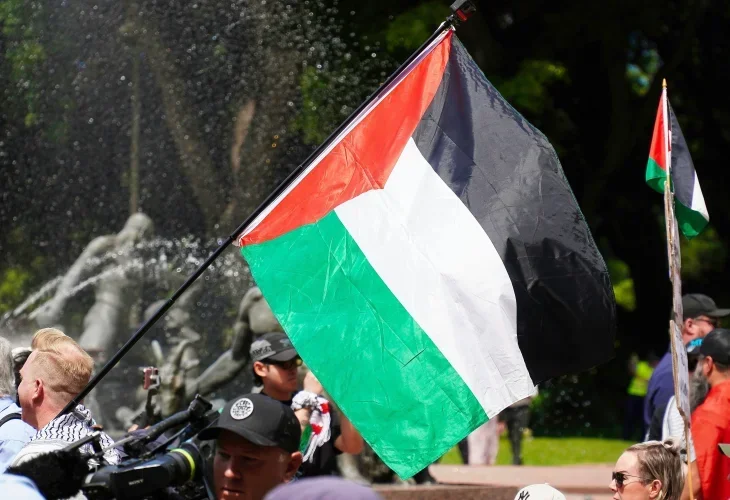 Pro-Palestinian protest in Australia (Credit: shutterstock)
Hearings before Australia’s Royal Commission on Antisemitism and Social Cohesion continue to stir public controversy. New testimony has emerged about how police handled the pro-Palestinian protest held outside the Sydney Opera House on October 9, 2023—just two days after Hamas’ terrorist attack on Israel.
One of the most notable testimonies was that a police officer contacted one of the protest organizers from the Palestine Action Group to congratulate him on what the officer reportedly viewed as the way the demonstration was conducted. In contrast, counsel for the organizers argued that the offensive chants and the lighting of flares were carried out by “disruptive elements” who joined the march at a later stage, not by the event’s organizers.
During the hearings, Acting Deputy Commissioner of New South Wales Police Peter McKenna testified that, before the protest, police had intelligence indicating that members of Hizb ut-Tahrir were expected to take part in the event. According to him, that information was considered in the risk assessment, but there was no specific intelligence about a terrorist threat, so the main focus of preparations was maintaining public order.
“Jews Were Told to Stay Away From Downtown”
One of the sharpest allegations raised before the commission came from David Ossip, president of the New South Wales Jewish Board of Deputies. According to him, police advised members of the Jewish community not to go to Sydney’s central business district (CBD) that evening, out of concern for their safety. He said the feeling was that control of the area had been handed over to the protesters, and that the demonstration took place at a sensitive time, when the Jewish community was still in shock following the terrorist attack in Israel.
Instead of a quiet solidarity gathering that was meant to take place in Sydney in memory of those who were murdered, thousands of protesters gathered at the site. During the protest, according to the testimony, antisemitic chants were heard—deeply damaging Australian Jews’ sense of physical and emotional security.
Richard Lancaster, counsel assisting the commission, said it had heard testimony that some members of the Jewish community came away with the impression that police were protecting protesters who voiced antisemitic messages. However, he stressed that freedom of speech and the right to protest do not legitimize incitement to violence, racism, or antisemitism.
Deputy Commissioner McKenna, however, presented a different picture. He said images broadcast in the media created the impression that the event was more serious than it actually was. He noted that while a flare was thrown over the heads of police officers, the incident was under control, and there was no sense on the ground that the protest was about to spiral out of control.
He also said that police have a neutral role and are sometimes required to permit demonstrations whose content may be viewed as offensive, as long as they take place within the law. During the same hearings, the deputy commissioner also apologized for a separate incident in which police failed to alert the Jewish community about a neo-Nazi protest held outside the New South Wales Parliament building in 2025.
He called it “human error,” and said new procedures have since been introduced to prevent similar incidents from happening again. The commission is expected to continue hearing witnesses and later submit its findings, aiming to examine how to balance the right to protest with the obligation to protect citizens from incitement, racism, and antisemitism.

