

Shabbat
Can You Reheat Food on Shabbat? 5 Common Questions Answered
From warming plates to tea and cholent, learn the halachot behind five common Shabbat kitchen questions.
- Rabbi Ofir Yitzhak Malka
- | Updated
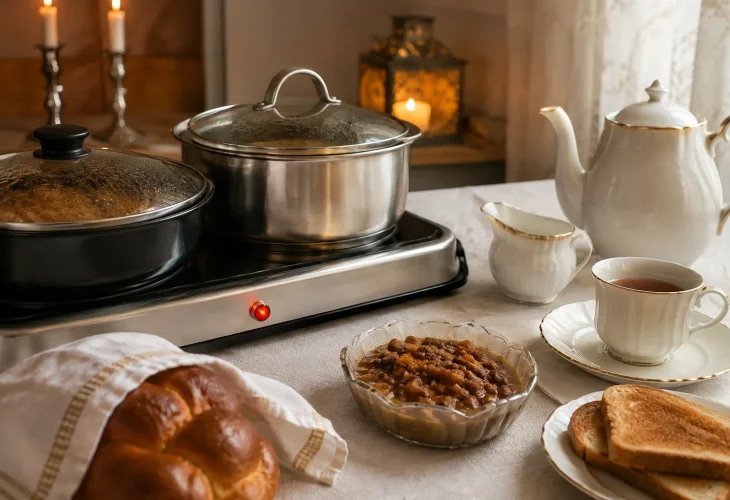
Shabbat meals often raise practical questions that seem simple but involve important details of halacha. What happens if you forgot to put the food on the warming plate before Shabbat? Can you reheat a dish with sauce? What should you do if the cholent has dried out? And what is the proper way to prepare tea?
Here are several common questions about heating and preparing food on Shabbat, with important distinctions between Sephardic and Ashkenazi practice.
Placing Pots on the Warming Plate During Twilight
"I forgot to place the pots on the warming plate before Shabbat and remembered a few minutes after sunset. Can I still put them on during twilight?"
If the food is still hot to the point of yad soledet bo—approximately 71°C (160°F), or 80°C (176°F) according to some opinions—it may be returned to the warming plate, since returning it in this state is permitted on Shabbat.
If the food has cooled below this temperature, one may ask a non-Jew to place it on the warming plate, since certain minor rabbinic prohibitions may be permitted during twilight for the sake of a mitzvah.
This distinction is particularly relevant for Sephardic Jews who follow the Shulchan Aruch, according to whom a liquid or saucy dish that is no longer yad soledet bo may be subject to further cooking. According to Ashkenazi practice, a fully cooked dish may be returned while it is still warm, even if it is no longer yad soledet bo.
However, if a person has already accepted Shabbat or the community has begun the Shabbat prayers, this leniency does not apply, aside from the possibility of asking a non-Jew for assistance.
Reheating Liquids on a Warming Plate
"May I place a dish containing sauce on a warming plate that is currently off but will later turn on with a timer?"
According to Rabbi Ovadia Yosef, a dish containing sauce may be placed on a warming plate before the timer switches it on, since the heating occurs through grama, or indirect causation.
Some halachic authorities disagree, however, due in part to concerns that doing so may resemble cooking.
Adding Hot Water to a Dish on the Warming Plate
"The cholent has dried out by Shabbat morning. Can I add hot water?"
According to Sephardic practice, one should not add water to the dish, even if the water is hot. According to Ashkenazi practice, hot water may be added as long as it has remained hot.
Ideally, the water should be poured gently from a glass rather than directly from a kettle, both to avoid stirring the food and, when dealing with a meat dish, to avoid transferring meat status to the kettle.
For Sephardic Jews who anticipate needing additional water, one option is to prepare a bag of hot water before Shabbat. Alternatively, an Ashkenazi Jew who follows the permissive ruling may add the water.
Making Tea on Shabbat
"If tea essence was prepared before Shabbat, what is the proper way to prepare tea according to all opinions?"
First, pour hot water into an empty cup, making it a kli sheni, or second vessel.
Place the sugar and prepared tea essence into a separate cup, and then pour the hot water from the kli sheni into that cup.
This method accommodates the various opinions, including the more stringent approach regarding coloring liquids on Shabbat.
Turning Challah Into Toast
"Can I place challah on a warming plate on Shabbat so that it becomes slightly toasted?"
Halachic authorities disagree on this question. Many prohibit turning challah into toast because the process creates a new form and may be considered similar to baking the bread again.
Rabbi Ovadia Yosef, however, permits placing challah on the warming plate provided that it does not undergo a complete transformation into toast.
A separating layer should also be placed between the challah and the warming plate to avoid the appearance of cooking.
These questions demonstrate how seemingly small details—whether food is liquid or dry, how warm it remains, and whether one follows Sephardic or Ashkenazi practice—can make a significant difference in the laws of cooking and reheating food on Shabbat.

