

Parashat Shoftim
Why Does This Torah Verse Say “Justice” Twice? 5 Powerful Explanations
“Justice, justice shall you pursue.” Five classic commentators reveal the deeper meanings behind this powerful Torah verse.
- Yonatan HaLevi
- | Updated
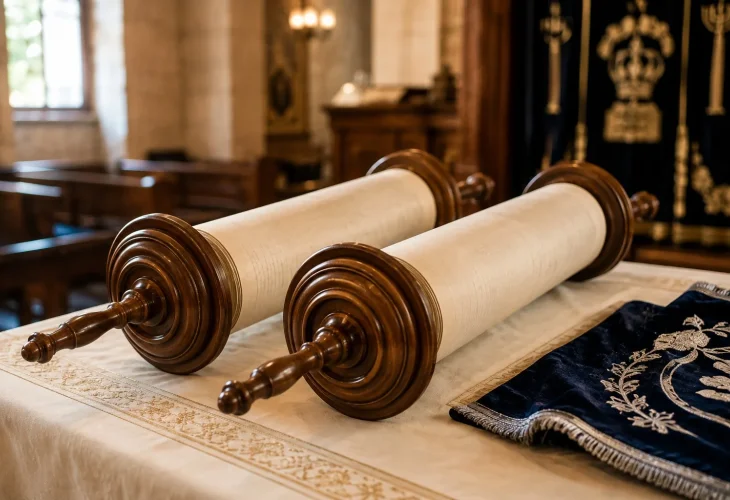
The Torah, the Book of Books, is not merely a collection of laws and stories. It is a complex and rich system of Divine wisdom, revealed on many different levels to anyone who wishes to delve deeper.
Every verse, and sometimes every word, contains worlds of meaning, from the most straightforward understanding to the deepest hidden secrets. Jewish sages throughout the generations have uncovered different levels of understanding in the Torah, from its plain meaning to Kabbalah, demonstrating how every generation can find within it the answers and guidance suited to its needs.
The Torah’s immense richness lies not only in its scope, but also in its ability to offer every person a personal connection, moral guidance, and spiritual inspiration.
In this week’s Torah portion, Parashat Shoftim, we find the following verse:
“Justice, justice shall you pursue, so that you may live and inherit the land that Hashem your God is giving you” (Deuteronomy 16:20).
Why does the Torah repeat the word “justice”? Here are the interpretations of Rashi, Ramban, Rabbeinu Bachya, Sforno, and Ohr HaChaim on this powerful verse.
1. Rashi: Seek Out the Right Judges
“Justice, justice shall you pursue.” Rashi cites the words of the Midrash in the Sifrei: “Follow an esteemed court.”
“So that you may live and inherit.” Rashi quotes the words of the sages in Sanhedrin: “The appointment of qualified judges is worthy of giving life to Israel and settling them on their land.”
Rashi’s interpretation teaches that pursuing justice requires more than simply wanting a fair outcome. A person must actively seek out a distinguished and qualified court, placing matters of Torah law in the hands of those most capable of deciding them correctly.
2. Ramban: Pursue Justice in Every Circumstance
Ramban cites Rashi’s interpretation of the verse and explains the reason for the repetition of the word “justice”:
“The meaning of the repetition is that judges must judge the people with righteous judgment, and you, too, must always pursue justice, traveling from your place to the place of the great sages: after Rabban Yochanan ben Zakkai to Yavneh, after Rabbi to Beit She’arim.”
Ramban continues: “And Rabbi Abraham said, ‘justice, justice’ twice means that one should pursue justice whether one will gain or lose from it, or time after time, for emphasis.”
Ramban then adds a deeper interpretation from the teaching of Rabbi Nechunya ben HaKanah:
“Justice is the attribute of judgment of the world, as it says, ‘Justice, justice shall you pursue,’ and immediately afterward it is written, ‘so that you may live and inherit the land.’ ‘If you judge yourself, you will live; if not, He will judge you, and you will rise against your will.’ ... If so, the verse means: You shall judge in your court and pursue justice, justice, and attain them, so that you may live in the World to Come through the second justice, which is the higher justice, the great light hidden away for the righteous in the future, and it is the strength of Hashem; and you shall inherit the land through the first justice, which is the Land of Israel.”
Ramban therefore offers several ways of understanding the repetition.
First, he cites Rashi’s interpretation, emphasizing the importance of pursuing justice both on the part of judges and on the part of the individual. A person must seek out the great Torah scholars and experts in halacha, even if doing so requires traveling elsewhere, as seen in the historical examples of Rabban Yochanan ben Zakkai and Rabbi.
Ramban also cites the view of Rabbi Abraham Ibn Ezra, who explains that the repetition teaches that a person must pursue justice in every circumstance, whether doing so results in personal gain or loss.
Finally, the teaching of Rabbi Nechunya ben HaKanah gives the repetition a deeper meaning. The first “justice” represents judgment in this world, in which a person must judge themselves and pursue righteousness. The second alludes to a higher justice that leads to life in the World to Come, the reward reserved for the righteous.
In this way, the verse calls on us to pursue justice on two levels: spiritual justice that leads to eternal life and earthly justice that leads to inheriting the Land of Israel.
3. Rabbeinu Bachya: Justice in Speech and Action
Rabbeinu Bachya ben Asher explains the verse on two levels: its plain meaning and Kabbalah.
“‘Justice, justice shall you pursue.’ According to the plain meaning, it warns that a person should be righteous in deeds and in speech, for these are the things through which a person can harm themselves and others. This is why the wording is repeated. Anyone righteous in speech is a sign and proof of righteousness in action. Therefore, every Jew should be righteous in speech and deed, as it is written (Zephaniah 3): ‘The remnant of Israel shall not do injustice and shall not speak falsehood.’ Or the verse speaks to people who have a dispute and warns them to pursue justice whether it brings gain or loss; this is the meaning of the repetition.”
According to the plain meaning, the verse warns a person to be righteous in both actions and speech. A person has the power to harm themselves and others through both words and deeds, which is why the Torah repeats the word “justice.” Someone who is righteous in speech demonstrates righteousness in action as well.
The repetition can also teach that justice must be pursued regardless of whether the outcome brings personal gain or loss.
Rabbeinu Bachya then explains the verse according to Kabbalah:
“‘Justice, justice shall you pursue’: pursue the justice that receives from justice when you render a just judgment in your court.
“So that you may live: in the World to Come, through the higher justice, which is the great light hidden away for the righteous. And inherit the land: through the lower justice that corresponds to the Land of Israel.”
On the level of Kabbalah, pursuing justice represents the pursuit of the higher attribute of “justice,” connected to the sefirah of malchut, which receives justice from a still higher justice. The repetition therefore hints at justice on different spiritual levels, both in this world and in the World to Come.
The phrase “so that you may live” refers to life in the World to Come, associated with the higher justice and the great light reserved for the righteous. The words “and inherit the land” refer to inheriting the Land of Israel, reflecting the lower justice in this world.
Rabbeinu Bachya connects this idea to the words of King Solomon in Proverbs: “One who pursues righteousness and kindness will find life, righteousness and honor.” One who pursues judgment combined with mercy will merit life in the World to Come and honor in this world.
4. Sforno: Look Beyond Outward Appearances
Sforno offers another interpretation:
“‘Justice, justice shall you pursue.’ When you appoint judges, you who appoint the judges should choose those who are the most righteous judges, even if they do not possess all the other qualities considered fitting for a judge, such as material wealth and physical perfection, as in the matter of: ‘Do not look at his appearance or at his height.’
“‘So that you may live and inherit.’ You need this more in the land, because this failing will prevent inheriting it, as it says: ‘Because of the sin of his greedy gain, I became angry.’”
Sforno focuses on the appointment of judges and their moral character. When choosing judges, the priority must be those known for their righteousness, even if they lack certain outward qualities that might otherwise be considered desirable, such as wealth or an impressive physical appearance.
This recalls what Hashem told the prophet Samuel when David was chosen as king: “Do not look at his appearance or at his height.” What matters most is inner integrity.
Sforno further explains that preserving justice and integrity is essential to remaining in the Land of Israel. Corruption, greed, and dishonesty in matters of justice can ultimately prevent the Jewish people from maintaining their inheritance of the land.
5. Ohr HaChaim: Never Settle for Less
Ohr HaChaim explains:
“‘Justice, justice shall you pursue.’ It comes to warn that when there are two people in a city outstanding in wisdom, and two others who are also wise but not of the first rank, a person should not say: Since two people can rule and judge justly, I will not trouble the outstanding scholars with the burden of serving as judges. Or, because their appointment requires effort, one may refrain and make do with the lesser scholars.
“Therefore, the verse says ‘justice, justice,’ meaning that even if you have found judges who are qualified, you must continue seeking those who are more qualified than they are.”
According to Ohr HaChaim, the Torah warns us not to settle simply because someone is capable of judging fairly. If greater Torah scholars are available, we should make the effort to seek them out.
A person might reason that there is no need to trouble the greater scholars when other qualified judges are available, or might avoid appointing them because doing so requires additional effort. The repetition “justice, justice” teaches otherwise.
We must strive to appoint the most worthy judges in terms of wisdom and awe of Heaven, rather than settling for those of lesser stature simply because doing so is easier or more convenient.
One Verse, Worlds of Meaning
The fact that a single verse in the Torah can contain so many interpretations teaches us something profound about the infinite depth of Torah wisdom.
“Justice, justice shall you pursue” can teach us to seek out the greatest Torah authorities, pursue justice regardless of personal gain or loss, live with righteousness in both speech and action, value inner integrity over outward appearances, and refuse to settle when greater wisdom is available.
The Torah is not simply a text containing instructions. It contains entire worlds of meaning that every generation continues to explore and understand more deeply. Jewish sages throughout the generations have uncovered many layers of Torah wisdom, from its straightforward meaning, peshat, to its deepest secrets in Kabbalah.
Each interpretation offers another perspective, reveals additional meaning, and enables us to connect more deeply with the values of justice, truth, and morality. This wealth of interpretation testifies to the Torah’s extraordinary spiritual richness and its ability to continue inspiring and guiding our lives in every generation.

