

Behind the News
From Architect to Tank Commander: One Reservist’s Mission to Document the War
Jerusalem architect Tamir Mansour Carmel shares his experience commanding an armored company through months of fighting, the personal cost of reserve duty, and why he is preserving his wartime experiences for future generations
- Michal Arieli
- | Updated
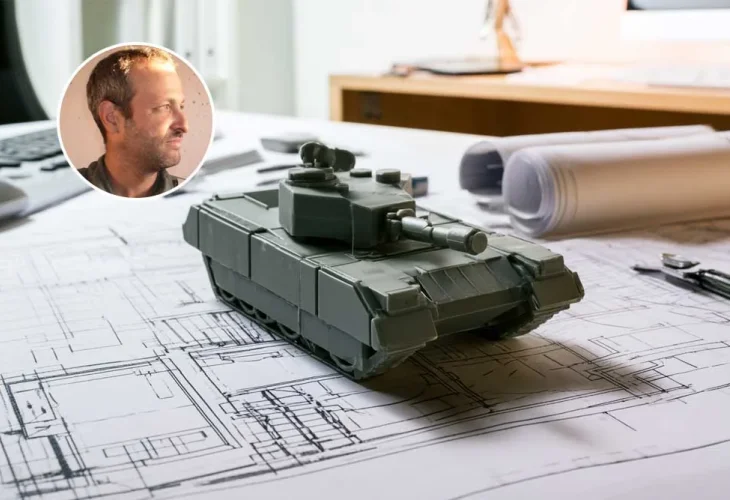 In the circle: Tamir Mansour-Carmel (Credit: Guy Eshet)
For Tamir Mansour Carmel, a Jerusalem architect, one of the most unforgettable moments of his life came about four years ago, when he was given command of Company B in an armored battalion. Since then, the company has become his second family.
“I took command at the age of 39, which is relatively late,” he says. “I always told my soldiers that we are the ‘insurance policy’ of the Jewish people. You pay a little every year and set it aside, hoping you will never have to activate the policy. On October 7, the country activated that insurance, and we showed up and fought. I had the privilege of leading the company through three rounds and a year of combat. Even now, we continue serving in reserve rotations. From our perspective, the war has not ended. We continue serving the Jewish people.”
The Architect Who Became a Commander
When Tamir is asked to introduce himself, he hesitates for a moment. Before the war, his identity seemed straightforward: he was an architect and vice president of planning at a leading Jerusalem firm, a husband, and a father of three. Since the outbreak of the war, however, he has felt more like a full time reservist, constantly concerned for the welfare of his soldiers and serving with a profound sense of mission.
“Where haven’t we been?” he asks. “At first, my company was called up to Mount Hermon to reinforce the sector and the Mount Dov area. We were there for about a week, feeling that Hezbollah could attack at any moment, and they did.
“The day after the attack, I called my battalion commander to report what had happened, but he stopped me. ‘Tell it to your replacement. You and the company are heading to Gaza now.’
“It was a complete surprise. We thought our mission would be to defend the Golan Heights, and suddenly we were heading south.
“We fought in Gaza and experienced everything there: explosive devices, tanks being hit, malfunctions, rockets, missiles. There was almost nothing we didn’t encounter. Thank God, no one in our company was killed, although there were fatalities in the battalion, and many people I worked alongside were injured in one way or another.
“We left Gaza about three months after entering, and we were promised a few months of quiet. But about two months later, we were called up again, in the midst of the Iranian attack.
“We held the Netzarim Corridor for two months and from there returned to Gaza. They told us, ‘Just one month, and that’s it,’ but during that period the ground operation against Hezbollah in the north began. At that point, we understood something: we were no longer counting the days until we could go home. We were here for the Jewish people.
“Every time we were given a discharge date, it was postponed. Every time we were given a new call up date, it was moved earlier. But we remained on the front for one simple reason: we were needed.”
Where does the strength come from?
“The truth is, there isn’t any strength left, and I see that in my soldiers too. The price we are paying is enormous. Not long ago, my battalion commander presented figures showing that around 80 percent of the people in the battalion had been fired, resigned, changed jobs, suffered career setbacks, or missed out on promotions.
“I relate to that personally. As a senior manager, my company is clearly affected by my absence, and my own professional advancement has also been put on hold.
“But there is a deep belief in the justice of what we are doing. I feel that throughout our entire military lives, both in regular service and in the reserves, we trained and invested precisely for this moment. So how could we give up when the moment we prepared for finally arrived? Yes, the war has gone on far longer than anyone expected, but you simply cannot say no.”
A Mission to Document the War
Amid the relentless cycle of reserve duty, Mansour Carmel took on another mission, to personally document what he and his company were experiencing.
“On the very first day of the war, I started keeping a journal. Every day, I wrote a short account of what had happened. At the time, I had no idea where it would lead.
“But I had read almost every firsthand account I could find about the Yom Kippur War, a subject that had always fascinated me. I quickly realized that we were living through historic and significant events on a similar scale. I felt that I needed to document exactly what we did and what happened around us.
“Within a few weeks, I already had a substantial journal. It became clear to me that this material needed to be preserved as a historical record.
“As soon as I returned from the first round of fighting, I sat down at my computer with the notebook. I used it to trigger my memories and began writing down everything I could remember. After that came a long process of rewriting and checking details, because it was important to me that every part of the account be completely accurate. I interviewed quite a few members of the company and battalion so I could include perspectives I had not personally witnessed.”
The Battle for Beit Hanoun
Asked about particularly memorable moments he documented, Tamir immediately points to the attack on Beit Hanoun.
“For me, that was the peak. We were the first force to enter. There were no units ahead of us, and no one really knew what the ground operation was going to look like.
“We had been warned that Gaza was filled with explosive devices, missiles, and snipers, and that we were about to enter an extremely dangerous battlefield.
“We spent two weeks preparing. When the moment finally came to advance, I felt that we had reached the culmination of everything we had trained for. I found myself leading a battalion assault into the section of Beit Hanoun we had been assigned to capture.
“Those were extremely stressful and frightening moments. My greatest fear was not that I would be injured. I was afraid that fear itself might prevent me from functioning as I needed to, or that my soldiers might not be able to function.
“But I believed that if we did exactly what we had learned, our training would take over. Muscle memory would guide us. From that moment, I took command, issued instructions, and we did exactly what we had trained to do.”
When the Ceasefire Became Anything but Quiet
Another unusual period he remembers vividly was the first ceasefire connected with the release of hostages.
“We very quickly discovered that the ceasefire was anything but quiet,” he says. “From the time we captured Beit Hanoun until the ceasefire began, we had barely seen anyone in the entire area. Then suddenly, on the first day of the pause, at seven in the morning, men, women, and children began arriving from every possible direction.
“We had to remain extremely alert. We needed to identify anyone who might pose a threat to us, while at the same time keeping civilians away from danger. It was the most active ceasefire we could have imagined.
“During that period, we also learned that hostages were being released from a location about two kilometers away from us. It was clear to everyone that the pressure we were applying in the area had also contributed to that achievement.”
Life Inside a Tank
Alongside the major battles and complex military operations, Mansour Carmel says there were also the most basic challenges of daily life: What do you eat inside a tank? How do you sleep? Is it even possible to sleep?
“Sometimes you are inside the tank for 20 hours straight, and you have to remain alert and focused,” he explains. “You eat a lot to stay awake, drink huge amounts of caffeine, and occasionally take turns getting a little sleep, usually while sitting.
“During the final weeks of one period of fighting, we gained a special privilege: taking off our shoes for the night. We took turns, and each time another crew got the chance.
“We were constantly on alert because we knew someone could attack us at any moment. We never allowed ourselves to become careless. We slept next to our protective gear, always in an interior room, always dressed and ready, with our boots and helmets close at hand. Even if we went outside for just 20 meters, we went in pairs and wore helmets.
“You gradually adapt to an entirely different way of living. At some point, it stops feeling like a period of war. It simply becomes your life.”
How, amid such constant tension, did you find the mental space to write?
“The need to process my personal field journals grew directly out of that reality,” he explains. “I grew up reading Avigdor Kahalani’s books and learning about the battles of the Yom Kippur War. Those accounts did more than teach me history. They prepared me mentally and professionally for this war inside a tank. Through them, I felt that I understood something about what war actually looks and feels like before I ever entered one myself.
“I decided to turn my writings into a book, which I called Company B: A War Diary, and I turned to crowdfunding to help make it possible.
“My hope is that what I have documented will serve future generations in the same way those earlier accounts served me. We all hope there will be no more wars and that no one will ever need this knowledge. But if reality turns out differently, future generations need to understand, learn, and know exactly what soldiers experienced on the front so that they can prepare themselves as well as possible.”
Were there things you deliberately chose not to include?
“I tried to be as open and detailed as possible and not hide anything,” he says. “But in certain places, I was careful to protect people’s dignity, feelings, and privacy.
“The material will also, of course, go through military censorship, and anything that cannot be published for security reasons will be removed. I don’t know what will ultimately be cut, but none of that will change the truth of the story or the experience of the person reading it.”
Looking back, is there anything you would have done differently?
“Human relationships,” he answers after a moment of thought. “I think there were situations in which I could have acted with greater sensitivity. Perhaps I could have recognized earlier that there were problems, difficulties, or tensions between people and dealt with them before they grew.
“Actually, that is another message I want to share with the public. War stretches the human psyche to its limits, and preserving the connection between the soldiers is a challenge no less important than the fighting itself.
“Our job is to manage the impossible reality we have found ourselves in while remembering, first and foremost, to remain human.”

