

Wonders of Creation
A Beach Covered in Ice Balls? The Incredible Natural Phenomenon Explained
A Finnish beach was covered with hundreds of perfectly rounded pieces of ice. Discover the rare combination of waves, wind, and freezing temperatures that created them.
- Tehila Cohen
- | Updated
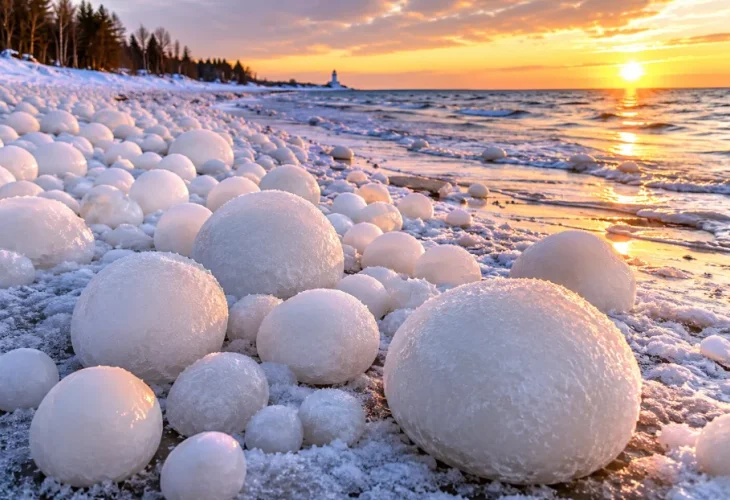
Imagine heading out for an ordinary walk along the shore and discovering the beach covered with hundreds of perfectly rounded chunks of ice. Some are as small as eggs, while others are nearly the size of soccer balls—and they look as though someone spent hours carefully rolling one snowball after another.
That was the remarkable sight amateur photographer Risto Mattila encountered in Finland in November 2019. Along a stretch of roughly 100 feet (30 meters), round and oval-shaped pieces of ice had gathered on the shore. The smallest were about the size of an egg, while the largest were comparable to a soccer ball.
The photographs looked almost unreal, but behind the unusual sight was an entirely natural process.
So Who Rolled All These Ice Balls?
Here, too, we can see the wonders of the natural world created by the blessed Creator.
The phenomenon is commonly known as “ice eggs” or “ice balls,” and it requires a very particular combination of temperature, water, wind, and wave conditions.
According to ice expert Jouni Vainio of the Finnish Meteorological Institute, who commented on the phenomenon documented in Hailuoto, the water needs to be close to freezing, while the shoreline must be shallow and the wind conditions just right.
The process can begin around a small “core,” such as a piece of ice, a small stone, or another object in the water. Ice gradually forms around it as the movement of the waves and wind rolls it back and forth.
Layer after layer of ice can build up, while the repeated movement helps round and smooth the formation. Eventually, the waves may push the newly formed ice ball onto the shore alongside many others created under the same conditions.
The result can be an extraordinary beach covered with what look like giant frozen eggs.
Why Doesn’t This Happen Every Winter?
This is where the phenomenon becomes especially fascinating. Cold weather alone is not enough.
If the wind is too strong, the conditions may not allow the ice balls to form properly. If the water is too still, on the other hand, it may simply freeze into a larger sheet of ice rather than producing individual rounded pieces.
Instead, the process requires a delicate balance: extremely cold water, suitable freezing conditions, shallow water, and just enough movement to roll the pieces of ice without breaking them apart.
That precise combination helps explain why a beach covered with “ice eggs” is such an unusual sight.
Although the photographs from Finland attracted widespread attention, naturally formed ice balls are not unique to one country. Similar formations have been observed in other cold regions when the right combination of freezing temperatures, water, waves, and wind comes together.
Even in Finland, similar ice formations have appeared on other occasions. Their size, shape, and appearance can vary depending on the conditions—but when everything comes together just right, nature can transform an ordinary shoreline into a landscape that looks almost too perfect to be real.

