

Issues in the Bible
“They Bow to the Dust of Their Feet”: Understanding Rashi’s Reference
What did Rashi mean by people who “bow to the dust of their feet”? Ancient Arabian beliefs and rituals may offer fascinating context for his words.
- Yosef Yabece
- | Updated
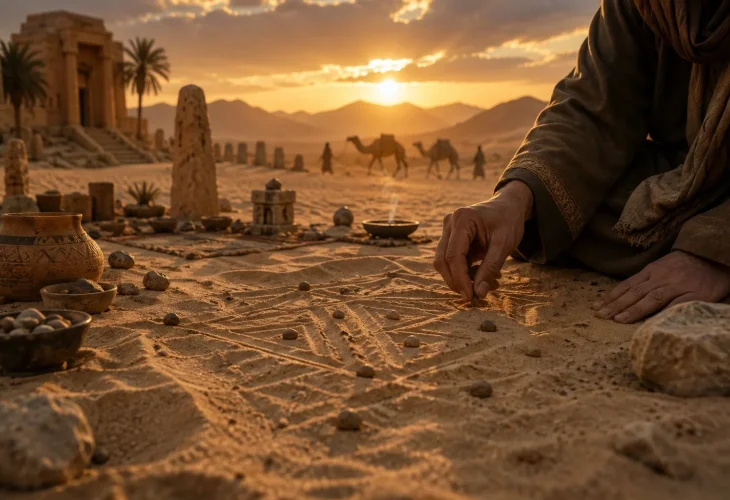
Ancient Jewish sources describe forms of idolatry practiced among peoples of the Arabian Peninsula, including a striking reference to those who would bow to the dust of their feet. At first glance, the practice can seem difficult to understand. Historical traditions surrounding divination, nature worship, and the religious significance attached to earth and stone may offer a broader context for understanding how such practices developed.
The Ancient “Science of Sand”
Historical sources describe an Arab tradition known as ilm al-raml, literally the “science of sand,” and generally referred to in Western literature as geomancy.
The practice involved forms of divination in which lines, dots, or other patterns were made in sand and then interpreted for meaning. Variations of geomancy became widespread during the Middle Ages and eventually reached Europe as well.
Such practices developed within cultures in which elements of the natural world could carry religious or symbolic significance. Sand, stones, celestial bodies, and other features of the surrounding environment could therefore become incorporated into systems of divination and ritual.
Seen against this background, references in Jewish sources to people bowing to dust can be understood within a wider world in which elements of nature sometimes became objects or instruments of religious practice.
Nature Worship in Ancient Arabia
Archaeological and epigraphic evidence from ancient southern Arabia reveals a complex religious landscape. Different communities worshipped numerous deities, some associated with celestial bodies and natural forces.
Temples, altars, inscriptions, and ritual objects discovered throughout parts of the Arabian Peninsula testify to organized systems of worship involving offerings and other religious ceremonies.
Ancient sources also preserve the name Nasr as that of a deity worshipped in Arabia. This is particularly noteworthy in light of references in Jewish literature to forms of idolatry practiced among the Arabs.
The religious world of ancient Arabia was therefore far more complex than a collection of isolated superstitions. Worship was intertwined with agriculture, trade, travel, water sources, and the difficult realities of life in the desert.
Earth, Dust, and Religious Ritual
Within this broader environment, earth itself could acquire symbolic or ritual importance. Dust, rocks, and particular locations could be associated with religious meaning, while physical acts such as bowing or prostration formed part of various ancient systems of worship.
This provides an interesting backdrop to Rashi’s reference to “Arabs who bow to the dust of their feet.” Rather than necessarily describing an inexplicable isolated custom, the statement can be considered within a much broader history of religious practices involving the natural world.
The dust carried by a desert traveler may have possessed particular symbolic significance within some of these traditions. However, attempts to reconstruct the precise ritual behind Rashi’s words remain speculative. Claims that travelers routinely collected the dust from their feet in bags and subsequently worshipped it should therefore be presented as a possible interpretation rather than an established historical fact.
What Changed With the Rise of Islam?
With the emergence of Islam, Arabian religious life underwent a fundamental transformation toward a strictly monotheistic system.
Prostration remained an important physical expression of prayer, but Islamic theology explicitly directs that worship toward God rather than toward the earth itself. The worshipper’s contact with the ground is therefore understood within Islam as an expression of submission and humility before God, not as worship of the material beneath them.
A distinctive practice later developed among many Shiite Muslims involving the use of a turba, a small piece of clay or earth upon which the forehead may be placed during prayer. Clay associated with Karbala has particular religious significance for many Shiites.
Shiite scholars have explained that prostration upon earth does not mean prostrating to the earth. Rather, the earth serves as the surface upon which an act of worship directed exclusively toward God is performed. Some explanations also connect the practice with humility and the biblical and Quranic idea that human beings originate from earth and ultimately return to it.
The practice has nevertheless been the subject of considerable disagreement within Islamic thought, with Sunni and Shiite scholars differing over the religious significance and legitimacy of particular customs surrounding sacred earth.
How Does This Relate to the Jewish Sources?
These later practices should not automatically be identified with the pagan practices described by earlier Jewish sources. Similar physical actions can carry fundamentally different theological meanings in different religions and historical periods.
This distinction is particularly important when discussing the halachic status of Islam. Rambam famously regarded Islam as monotheistic rather than idolatrous, even while strongly rejecting its religious claims. Other Jewish authorities discussed aspects of Islamic practice differently.
The Rogatchover Gaon’s approach can therefore be examined as part of a broader halachic discussion, but historical similarities involving prostration or contact with earth do not by themselves establish that later Islamic prayer constitutes the ancient form of idolatry described by Rashi.
Understanding Rashi’s Description
Historical and archaeological research into pre-Islamic Arabia does, however, help illuminate the cultural world behind Rashi’s striking description of people “who bow to the dust of their feet.”
Ancient Arabia contained numerous forms of idolatry, divination, nature-related ritual, and worship connected with particular objects and places. Against that background, a religious practice involving dust or earth becomes considerably easier to understand.
The precise ritual Rashi had in mind is difficult to reconstruct centuries later. We cannot say with certainty exactly what was done with the dust, why it was considered significant, or whether it was collected and preserved in the manner sometimes suggested.
What the historical evidence does show is that the surrounding religious culture contained practices in which elements of the natural world could acquire profound spiritual significance.
Rashi’s brief statement therefore opens a fascinating window into an ancient world very different from our own—one in which even something as ordinary as the dust beneath a traveler’s feet could become intertwined with religious belief and ritual.

