

In Search of God
When Faith Met Science: The Man Who First Saw Bacteria
Antonie van Leeuwenhoek was not a university trained scientist, yet his handmade microscopes revealed a world no one had seen before and forever changed our understanding of life.
- Yehosef Yavetz
- | Updated
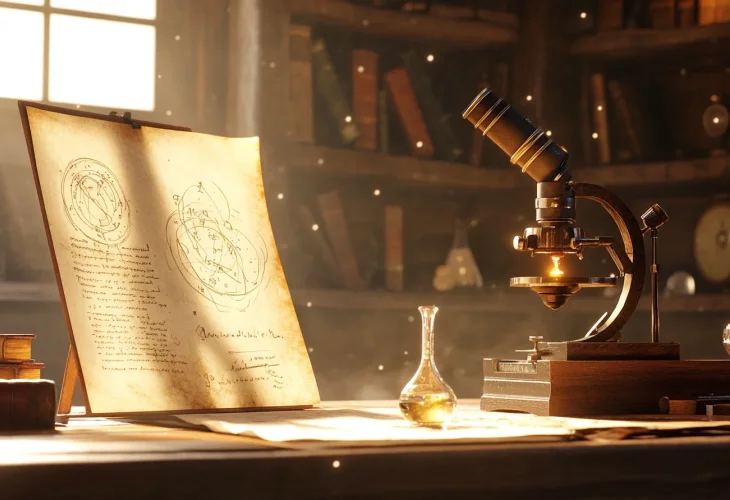
Antonie van Leeuwenhoek (1632–1723) changed the way humanity sees the natural world. With microscopes he built himself, the Dutch observer revealed forms of microscopic life that had never before been seen and helped lay the foundations of microbiology.
For Leeuwenhoek, studying nature was also connected to his belief in a Creator. The extraordinary complexity he observed in even the smallest forms of life inspired a profound sense of wonder at creation.
From Fabric Merchant to Pioneer of Microscopy
Leeuwenhoek was not trained as an academic scientist or professional researcher. He worked as a fabric merchant in the Dutch city of Delft and held several municipal positions. Yet he possessed an extraordinary curiosity about the natural world.
Rather than viewing nature only in terms of its practical uses, Leeuwenhoek became fascinated by its smallest details. He believed that creation contained an order and complexity worthy of careful investigation, including things too small for the human eye to see.
In the 1670s, Leeuwenhoek began making remarkably powerful single lens microscopes. Through exceptional skill in producing and working with tiny lenses, he created instruments capable of magnification far beyond what the unaided eye could achieve.
Those small microscopes opened an entirely new world.
Leeuwenhoek examined water, blood, dental plaque, bodily tissues, insects, plants, and countless other specimens. His observations included bacteria and protozoa, which he famously described as tiny “animalcules.” He also made important observations of sperm cells, red blood cells, and other microscopic structures.
A simple drop of water could contain an astonishing abundance of life.
Discovering an Invisible World
Beginning in the 1670s, Leeuwenhoek communicated his findings to the Royal Society in London. Over the following decades, he sent numerous letters describing his observations in extraordinary detail.
At first, some of his claims were difficult for other scholars to believe. Leeuwenhoek was describing living organisms that no one had previously known existed. His observations were eventually confirmed, however, and his work earned widespread recognition.
His discoveries helped transform the scientific understanding of life. A vast world had always existed beyond the limits of ordinary human vision. The microscope simply allowed people to see it.
Leeuwenhoek's religious outlook was intertwined with his fascination with that hidden world. In his writings, he expressed admiration for the remarkable organization and complexity he found in living creatures and connected what he observed with the wisdom of their Creator.
The smaller he looked, the more complexity he found.
Faith and the Study of Creation
Leeuwenhoek also investigated questions surrounding reproduction and the origins of small organisms. During his lifetime, spontaneous generation, the idea that certain living creatures could arise directly from nonliving or decaying matter, remained an important subject of scientific debate.
His microscopic observations contributed to the growing investigation of how tiny organisms reproduce and challenged some assumptions about organisms simply appearing from lifeless matter. However, the broader theory of spontaneous generation was not conclusively disproven during Leeuwenhoek's lifetime. That would require later experiments by scientists including Francesco Redi, Lazzaro Spallanzani, and, ultimately, Louis Pasteur.
What Leeuwenhoek did demonstrate with extraordinary clarity was that even at a scale invisible to the naked eye, living organisms possessed remarkable structure and followed observable biological processes.
For Leeuwenhoek, this order was not a reason to separate scientific investigation from belief in a Creator. It was another reason to continue investigating.
His religious convictions did not prevent him from carefully observing the natural world. Instead, his sense of wonder encouraged him to look more closely at it.
Seeing the Wonders Hidden in Creation
Leeuwenhoek's work helped open an entirely new field of scientific discovery. His observations of microorganisms were foundational to the later development of microbiology, while his microscopes revealed a level of biological complexity humanity had scarcely imagined.
His story also offers an important perspective on the relationship between faith and science. Scientific investigation and belief in Hashem do not necessarily have to be viewed as opposing forces. For a person of faith, discovering how nature works can deepen appreciation for the extraordinary world Hashem created.
Leeuwenhoek looked through a tiny lens and discovered an enormous new world.
His microscope became more than a tool for magnification. It offered a glimpse into dimensions of creation that had always been present but remained hidden from human sight, revealing just how much wonder can exist in even the smallest drop of water.

