

Raising Children
Preparing for Passover with Kids: How to Teach Them to Really Help
Passover cleaning can be an opportunity to teach children responsibility, independence, and practical life skills while giving parents some much-needed help around the house
- Chen Azulai
- | Updated
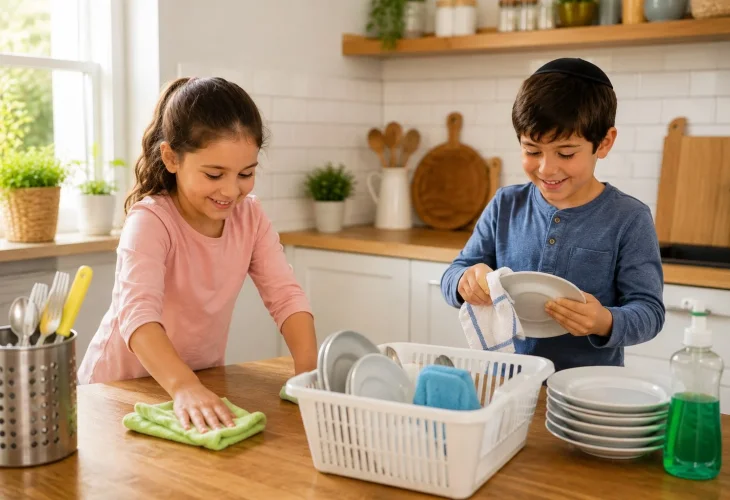
The reality today is that much of the responsibility for preparing for Passover falls on us, the mothers. We clean, organize, sort, clear things out, and at the same time, we still need to keep up with the regular routine of running the household. It isn’t easy.
Why don’t we let our children take part? Why don’t we ask them to help, divide up the tasks, and get them involved?
One of the most common answers I hear is: “They do more harm than good. It’s easier not to ask them and just do everything myself!” Sound familiar? I imagine it does.
When Helping Creates More Work
Let me share a story from my own home. One of my sweet seven-year-old daughter’s responsibilities is washing the dishes after dinner.
About a year and a half or two years ago, when I first asked her to wash the dishes, I came over afterward to see how she had done. The dishes were certainly wet, but they were incredibly dirty. The counter was flooded, the floor was wet, her clothes were soaked, and there were bits of food left in the sink. In short, it was a complete mess.
What do we usually do in a situation like this? One possibility is to think, “Why did I need this? I should never have asked her. I could have washed the dishes myself in two minutes, and now look at this mess.” We get annoyed with the child, send her away from the disaster zone, and clean everything ourselves.
Or we take the opposite approach: “Wow! You did such a beautiful job washing the dishes! You’re such a big girl! Look how clean everything is!” We pretend to be thrilled, send the child off to play, and then clean up the chaos ourselves.
Children Hear More Than Our Words
Why do we do this? Because we don’t want to tell a child that what she did wasn’t good enough. She made an effort, and we don’t want to hurt her feelings. Besides, we’ve been told how important it is to give children a sense of success.
In truth however, the communication between a parent and child goes much deeper than the words we say aloud. Children pick up on what we are really thinking and feeling in a situation.
We may have tried to give the child a feeling of success, but she may have received a very different message beneath our words: our stress over the mess, our disappointment, our lack of confidence in her abilities, and the sense that she wasn’t actually useful or helpful.
That’s why I recommend doing something completely different.
Appreciate the Effort, Then Teach the Skill
I said to my daughter, “Wow, sweetheart, it was so nice of you to wash the dishes. I love that it’s important to you to help and be part of taking care of our home. But let’s pay attention to a few important things.
“You washed them nicely, but do you see how these spots aren’t completely clean? You need to go over them and make sure there isn’t any grease or dirt left anywhere. And look at how much water splashed onto the counter. There’s a little squeegee and a cloth here that you can use to clean it up. Also, try standing a little farther away from the sink so your clothes don’t get soaked.
“Go ahead and take care of those things, and call me again when everything is ready.”
It didn’t happen immediately. But after several times of guiding her, correcting things, and showing her what needed to be done, I saw that she was able to wash everything properly and leave the area clean. Eventually, I trusted her enough that I no longer needed to check her work.
The responsibility had become hers.
Passover Is an Opportunity to Teach Responsibility
The weeks leading up to Passover are filled with opportunities to give children real responsibility. True, their efforts may create a little extra mess at first. But don’t be afraid to correct them, guide them, explain what needs improvement, and kindly ask them to fix something and try again. If necessary, do this several times until the task is completed the way it needs to be.
That is how children learn, and how they eventually become genuinely helpful.
In the process, we gain so much. We get real help rather than simply giving children an activity to make them feel involved. We teach them practical skills that will serve them in many other areas of life. They develop a sense of competence and discover that they are capable of learning, improving, and contributing.
They also learn commitment and responsibility, including the importance of staying with a task until it is completed properly. At the same time, they gain a sense of belonging because they know they are contributing to the family and are part of something larger than themselves.
And no less important, they experience genuine success. There is far more satisfaction in accomplishing something that requires effort and perseverance than in succeeding at something that came easily.
Start Small
There’s no need to begin with cleaning shutters, washing dishes, doing laundry, or mopping floors. There are plenty of simpler responsibilities children can take on first. They can sort through their toys, organize their own drawers, and decide which toys and belongings they no longer use and can be discarded or given away.
Think about what you would like your children to become responsible for, and begin gradually transferring that responsibility to them.
Now it’s time to get to work. Good luck!
Chen Azulai is a personal consultant and parenting instructor.

