

Interesting
Would You Live Here? This Tiny Japanese Village Sits Inside a Volcano
A volcano inside a volcano, fewer than 200 residents, and no road to the outside world: Discover the remarkable Japanese island of Aogashima.
- Tehila Cohen
- | Updated
 Illustration
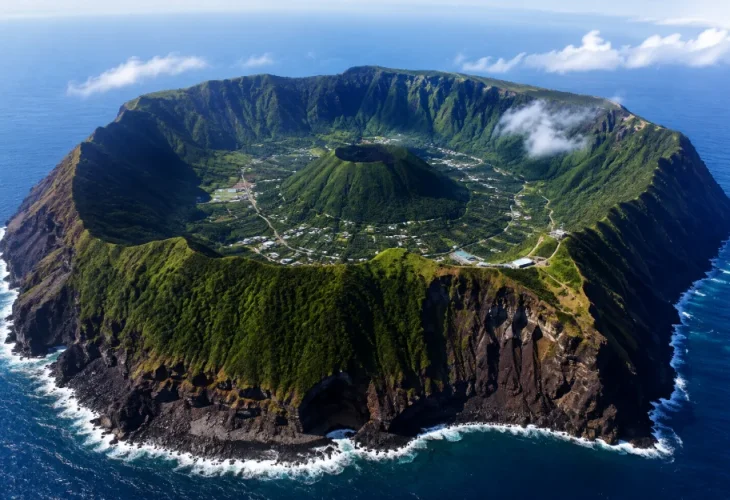
Aogashima is a tiny Japanese village unlike almost anywhere else in the world. Administratively part of Tokyo, the village sits on a remote volcanic island in the Philippine Sea. The entire island was formed by volcanic activity, and at its center lies a large, circular depression created when part of the volcano collapsed inward.
But there is another surprise inside: Over time, a second volcanic cone formed within the original caldera. The result is the remarkable sight of what appears to be a volcano rising inside another volcano.
And this is no deserted island. People actually live there. According to an official Aogashima publication, as of May 2026, just 157 residents lived on the island, spread across 113 households.
A Village Inside a Volcano
Aogashima is part of Japan's Izu Islands. The small island measures approximately 3.5 kilometers long and 2.5 kilometers wide and is surrounded by steep cliffs that rise dramatically from the sea.
At its center is a caldera, a large volcanic depression formed when part of a volcano collapses following volcanic activity. Aogashima's caldera measures approximately 1.7 by 1.5 kilometers.
Inside it stands Maruyama, a volcanic cone formed during the island's most recent period of eruptions. The result is especially striking from above: a lush green mountainous ring surrounds the island's interior, while another cone rises from within it.
Is the Volcano Still Active?
Aogashima is classified by the Smithsonian Institution's Global Volcanism Program as a stratovolcano and caldera. Its last known eruption occurred between 1780 and 1785. During this period of volcanic activity, explosions and lava flows occurred, and new cones formed within the caldera.
The eruptions had serious consequences for the island's inhabitants at the time, including casualties and an evacuation. No subsequent eruption has been recorded since 1785.
Even without its extraordinary geology, Aogashima would be unusual because of its tiny population. Official figures fluctuate from month to month. In March 2026, the island had 159 residents; in April, 144; and in May, 157.
That means fewer than 200 people currently call this remote volcanic island home.
Despite its isolation, Aogashima is a functioning community. Official village publications include information about a clinic, health and welfare services, a library, and various community activities.
Getting There Is an Adventure in Itself
Aogashima's isolation is a defining part of life on the island. There is no bridge, train, or road connecting it to another town. Wherever you look, the community is surrounded by ocean and steep volcanic cliffs.
Travel to and from the island is therefore dependent on sea and air transportation. The village even publishes monthly figures showing how many passengers arrive and depart by ship and passenger helicopter.
For its handful of residents, this extraordinary landscape is simply home. But to outsiders, Aogashima offers a remarkable combination: a tiny Japanese village, surrounded by the Pacific Ocean, living within the remains of a volcano, with another volcanic cone rising at its heart.

