

Magazine
The Gift that Outlived the Songs
Dolly Parton understood something Judaism knew long before the research caught up: give a child books early, and you may change the course of a life.
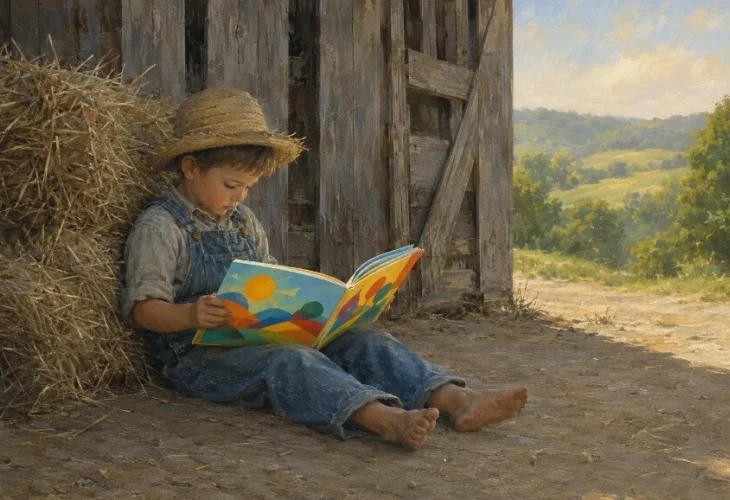
When news broke this week that Dolly Parton had died in Nashville at 80, the tributes did what tributes to Dolly always do: they reached for the songs. “Jolene.” “9 to 5.” “I Will Always Love You,” a song she wrote and then, famously, refused to sell to Elvis. But buried in nearly every obituary was a non-musical detail, one that Dolly herself would have wanted front and center: in lieu of flowers, her family asked that donations be sent to the Imagination Library. More than perhaps any song, that library might have been the real masterpiece of her life.
Dolly grew up as the fourth of twelve children in a one-room cabin in the Great Smoky Mountains, in a home where there were, by her own account, no books. She has talked for years about her father, a man of enormous intelligence who never learned to read, and about how that absence shaped her. So, in 1995, in her home county in East Tennessee, she started mailing free books to children from birth to age five: one a month, with no strings attached. It began as a local gift to the children of Sevier County. By the time she died, it had mailed something like 250 million books to children in five countries. She used to say that the program was really dedicated to her father.
What’s less widely known is how far that idea traveled beyond her own world. In the early 2000s, the philanthropist Harold Grinspoon saw what Dolly had built and adapted it for Jewish families, launching PJ Library to send Jewish-themed books to children from birth through roughly age nine. A writer who works in children’s publishing told a friend of mine that PJ Library didn’t just distribute books; it created them. It gave publishers and authors a reason to write more Jewish children’s literature—and a wider, more varied body of it than had existed before.
It turns out that both libraries were decades ahead of the data. Recently, a twenty-year study by Dr. Mariah Evans of the University of Nevada was published. The study tracked families in twenty-seven countries and found that the number of books in a child’s home predicted how far that child would go in school more powerfully than ethnicity, income, or even parental education. Growing up in a home without books, on average, left children three years behind academically. Just twenty books in the house added roughly three years of schooling. And still, an estimated 60 percent of low-income children in America grow up in homes without a single book.
Judaism arrived at much the same conclusion long before anyone had a spreadsheet to prove it, and did the very un-spreadsheet-like work of turning it into law. The Talmud credits the first-century sage Yehoshua ben Gamla with instituting something close to universal schooling for young children, mandating that every town appoint teachers rather than leaving education to whichever families could afford one. The tradition then laid out a remarkably specific timeline for how that education should unfold: “At five years old, a child is ready for the study of Scripture; at ten years old, for the study of Mishnah; at thirteen, for the fulfillment of the commandments” (Pirkei Avot 5:21). Mikra means learning the Tanakh, which of course requires knowing how to read. Centuries later, the codifiers of Jewish law made the starting point clear: “Immediately when a child reaches three years of age, one should begin teaching him the letters of the Aleph-Bet,” the Rema wrote in his gloss on the Shulchan Aruch (Yoreh De’ah 245:8).
Jewish law even carved out an interesting exception for the costs of such an education. A person’s entire income for the coming year, the Talmud teaches, is decreed between Rosh Hashanah and Yom Kippur—except for what is spent on Shabbat, on festivals, and “the tuition expenses for one’s children’s education. If one spends less on these, he is given less; if one spends more, he is given more” (Talmud, Betzah 16a). Spending on a child’s schooling sat outside the ordinary economic ledger, treated less like an expense than like a seed. The sage Elisha ben Avuyah supplied the image that explains why such early investment is so essential and worthwhile: “One who learns as a young child, to what is he compared? To ink written on fresh paper” (Pirkei Avot 4:20).
Dolly Parton never read any of those texts, as far as anyone knows. But she lived their logic. She knew from the inside what her father’s illiteracy had cost him, and she built, out of rhinestones and record royalties, exactly the intervention that both an ancient rabbinic tradition and a modern twenty-year study would later insist mattered most: put a book in a small child’s hands, early and often, and you can change the shape of a life.
It is fitting, and maybe not a coincidence at all, that a girl who grew up in a home without books ended up, through one philanthropist borrowing from another, filling Jewish children’s bookshelves too. That may be the most Dolly thing about her entire legacy: the gift that keeps arriving, one envelope a month, long after the songs have finished playing.

