

World News
Satellite Images Show Iran Ramping Up Construction at Mountain Nuclear Site
Satellite imagery points to a sharp rise in construction at Iran’s suspected Mount Kolang Gaz La nuclear site, near Natanz, which was attacked during Operations “Rising Lion” and “Roar of the Lion.”
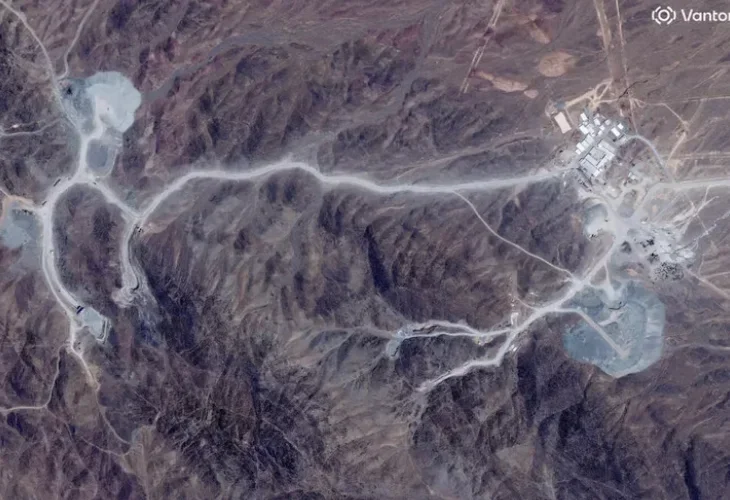 Mount Kolang Gaz (Pickaxe Mountain) in Iran (Credit: courtesy of ventor)
CNN reported today (Wednesday) that satellite imagery from the past six years reveals a clear increase in construction activity at Iran’s Mount Kolang Gaz site, which is suspected of being a nuclear facility.
It was also reported that in the past year alone, the nuclear site, buried beneath granite rock, has undergone a range of construction work.
The site is located near the Natanz nuclear complex, about 225 kilometers south of Tehran. The Natanz site was attacked during Operations “Rising Lion” and “Roar of the Lion.”
According to a new analysis of satellite images by the research institute Center for Strategic and International Studies, shared exclusively with CNN ahead of publication, there has been a “clear increase in construction activity” this year at Mount Kolang Gaz. The underground facility is “likely” intended to serve as a secure shelter for Iran’s nuclear program, according to CSIS analysts.
Israeli intelligence has suggested that Iran may be seeking to move centrifuges to the location as part of its uranium-enrichment efforts, and President Donald Trump has repeatedly threatened to strike the site. “We may hit them very soon,” Trump told reporters last week, adding that “we know everybody’s moving” at the site.
However, the granite mountain presents a difficult target even for the Pentagon’s “heaviest non-nuclear” bombs, the CSIS team reported. And it is not the only Iranian nuclear facility feared to be beyond the reach of current-generation weapons.
The report noted signs that the United States is working to develop some means of attacking these sites, although U.S. forces have focused mainly on other types of targets during the six-month conflict with Iran.
Four days before the United States launched Operation “Epic Fury,” a program manager at the Pentagon agency responsible for combating weapons of mass destruction signed a $1.2 million emergency contract to repair a “unique underground test facility at the White Sands Missile Range” in New Mexico, for a “live-fire test intended to validate classified capabilities against rapidly evolving threats.”
The memo stated that the “rapid test preparation,” as another database described the contract awarded to Pate Construction, had to be completed within two to three weeks because of a “time-sensitive national security directive.”
Plans for the test were connected to the Iran war, three sources familiar with the matter told CNN, and to the need to develop a way to strike Iran’s deepest buried underground facilities, and likely to simulate American attacks against specific nuclear facilities.

