

Sukkot
The Free Sukkah Decoration Your Guests Will Actually Remember
Paper chains, lights, and decorations can make a sukkah beautiful, but there’s one “decoration” your guests are far more likely to remember.
- Naama Green
- | Updated
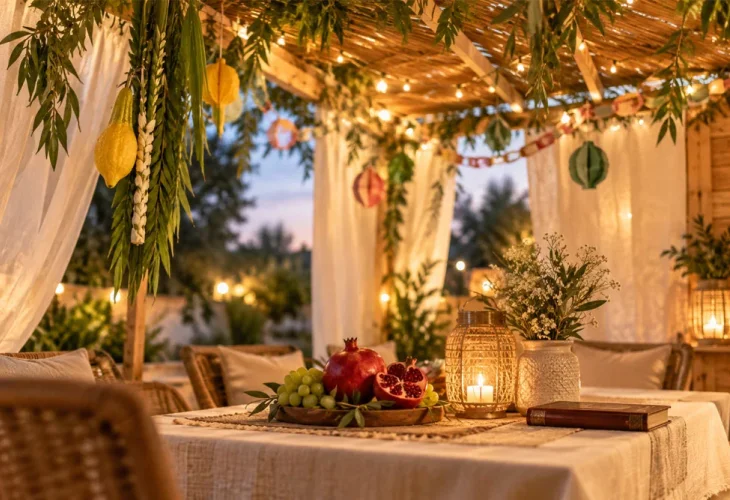
A paper chain that seems to stretch forever. Shiny pomegranate decorations. S’chach arranged to perfection.
The sukkah is ready. But what will really determine how this holiday feels is still entirely up to you.
Because in the end, people may not remember what you hung above the table. They will remember how they felt sitting around it.
Decorating the sukkah is part of beautifying the mitzvah. Chazal learn from the verse, “This is my God, and I will beautify Him,” that we should beautify the mitzvot: a beautiful sukkah, a beautiful lulav, beautiful tzitzit (Shabbat 133b).
But somewhere between one paper chain and the next, it is worth thinking about another decoration, one that is much harder to hang: the atmosphere.
The Decoration Everyone Can Feel
Chazal teach in Pirkei Avot: “Welcome every person with a pleasant expression” (Avot 1:15).
It does not say to welcome only the polite guest who arrives with a gift, or the child who manages not to spill juice on the new tablecloth.
“Every person” includes the guest who talks a little too much and the one who showed up unexpectedly.
There is another important decoration that begins before the guests even arrive: shalom bayit, peace at home.
You can set the table with your finest dishes and hang spectacular decorations, but if everyone is arguing before the meal about who forgot to buy the drinks or who will wash the dishes afterward, no string of colorful lights can hide the tension.
A small concession, a kind word, and a little patience can bring a warmer light into the sukkah than any decoration.
Five Small Things That Can Change the Mood
A welcoming expression is at the heart of hospitality. A few simple actions can create an entirely different atmosphere in the sukkah:
- Greet everyone who walks in with a genuine smile, and only afterward say, “Shoes off!”
- Start a conversation with the person sitting quietly at the end of the table.
- Offer a specific, sincere compliment instead of simply saying, “It’s so nice that you came.”
- Let the children participate, even if the result is a little less symmetrical than you planned.
- Decide in advance not to point out every small mistake during the meal.
None of these things costs anything, but they can completely change the feeling around the table.
What Does Real Holiday Joy Look Like?
The Torah commands us, “You shall rejoice on your festival.”
The Rambam teaches that the joy of a Jewish holiday cannot remain within our own private circle. We must also care for the convert, the orphan, the widow, and others in need. Joy that excludes them, he writes, is not the joy of a mitzvah (Hilchot Shevitat Yom Tov 6:18).
That principle can shape the atmosphere of our Sukkot celebrations too. True holiday joy is not only about what is on the table or hanging from the walls. It is also about making sure the people around us feel seen, welcomed, and included.
The children will probably forget which lamp hung in the corner. Your guests may not remember how many kinds of fish you served.
But they may remember that there was a place for them.
That someone listened to them.
That people were genuinely happy when they arrived.
The most beautiful sukkah may be the one people leave with their hearts just a little happier.
And thankfully, that decoration works with every budget.

