

Sukkot
From Etrog to Willow: The Surprising Science Inside the Four Species
From the powerful aroma of an etrog to willow’s surprising place in the history of aspirin, science reveals a fascinating side of the Four Species.
- Yitzchak Eitan
- | Updated
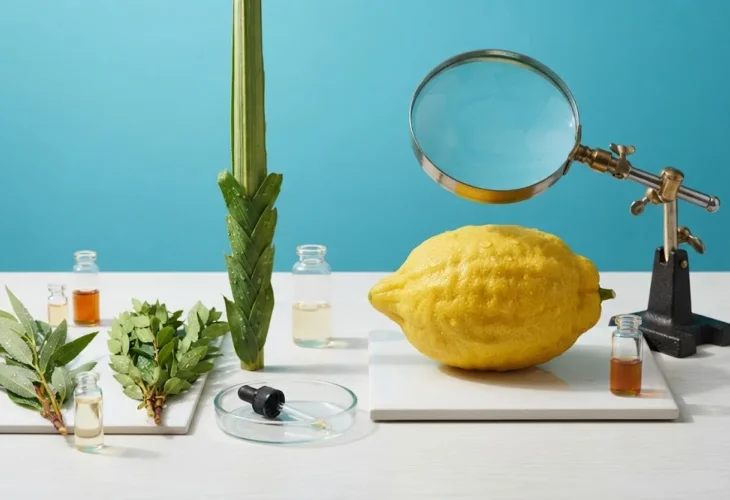
Every year as Sukkot approaches, Jews around the world search for beautiful examples of the Four Species. They carefully inspect the etrog, examine the lulav, and choose their myrtle and willow branches.
But while Jewish tradition focuses on using the Four Species to fulfill the mitzvah, scientists look at these plants through a very different lens: What compounds do they contain, and what roles do those substances play in nature?
The answers offer a fascinating glimpse into the chemistry hidden inside these familiar symbols of Sukkot.
The Etrog: The Chemistry Behind Its Powerful Fragrance
The etrog, or citron, is instantly recognizable by its distinctive fragrance.
Like other aromatic citrus fruits, the etrog contains volatile compounds, including monoterpenes, that contribute to its characteristic scent. Researchers have studied citron and its components for their antioxidant and other biological properties, although laboratory findings about plant extracts should not be interpreted as evidence that using or eating an etrog provides specific medical benefits.
Still, the chemistry helps explain something anyone who has held an etrog already knows: this small fruit can produce a remarkably powerful aroma.
The Lulav: Built to Survive a Harsh Environment
The lulav is the young, unopened frond of the date palm, a tree remarkably well suited to hot, dry environments.
Plants naturally produce a wide range of compounds, including polyphenols, that can play roles in protecting them from environmental stresses. Researchers have examined date palms and their different parts for these compounds and their potential biological properties.
In other words, the palm branch we hold on Sukkot comes from a plant equipped with its own complex chemical defenses for surviving challenging conditions.
Myrtle: More Than a Pleasant Scent
Myrtle is another highly aromatic member of the Four Species.
Its essential oil contains numerous naturally occurring volatile compounds that give the plant its recognizable fragrance. Myrtle and myrtle oil have attracted scientific interest for their chemical composition and possible biological effects.
As with other essential oils and plant extracts, however, preliminary or laboratory research should not be confused with established medical treatment.
For the person holding the Four Species, no laboratory equipment is needed to notice myrtle's most obvious characteristic: its fresh, distinctive scent.
Willow: From an Ancient Plant to Aspirin
The willow has perhaps the most famous connection to the history of modern medicine.
Willow bark contains salicin and related salicylates. Willow preparations were used for pain and fever long before scientists understood their chemistry. Historical accounts trace their medicinal use back thousands of years, while one of the best-known early modern reports came in 1763, when English clergyman Edward Stone described using willow bark to treat fever.
During the 19th century, scientists isolated and studied salicin and salicylic acid. Those discoveries formed part of the scientific path that eventually led to acetylsalicylic acid, better known as aspirin.
That does not mean chewing a willow branch is equivalent to taking aspirin. Modern aspirin is a specifically manufactured medication with a defined chemical composition and dosage. But the historical relationship between willow chemistry and one of the world's best-known medicines is very real.
Ancient Mitzvah, Fascinating Chemistry
For thousands of years, Jews have held the etrog, lulav, myrtle, and willow together on Sukkot. Modern chemistry gives us an entirely different way of looking at these familiar plants.
The etrog contains aromatic compounds responsible for its unmistakable fragrance. The date palm has chemical mechanisms that help it cope with its environment. Myrtle contains fragrant essential oils, while the humble willow occupies a fascinating place in the history of medicine.
None of this changes the reason we take the Four Species. Their significance on Sukkot comes from the Torah and the mitzvah itself.
But science reveals another layer of wonder: the plants we hold in our hands contain complex chemistry that researchers are still working to understand.

